
Information about NPT/NPTF Adapters
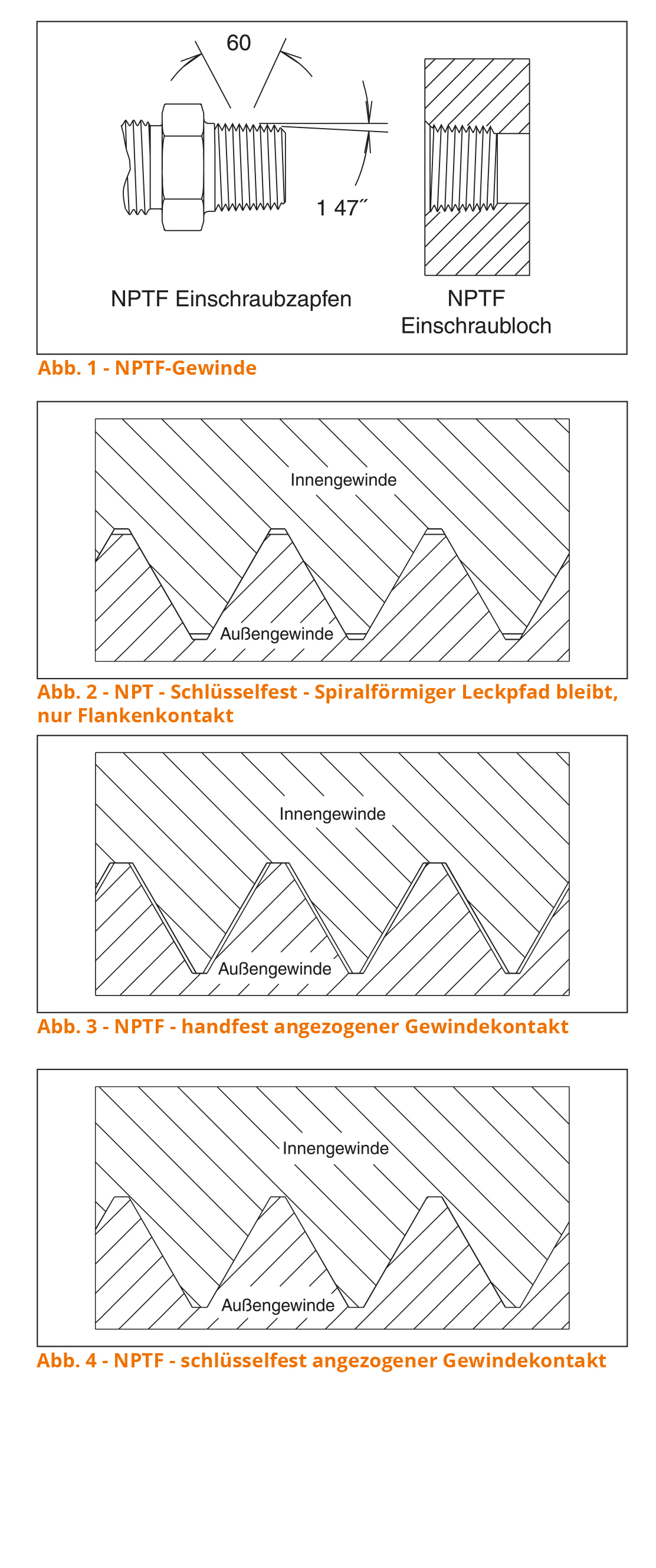
Commonly known in the USA as pipe thread adapters, NPT and NPTF (Dryseal) adapters have a tapered thread. These threads are characterized by a flank angle of 60° and a taper angle of 1°47˝. They are generally used in the USA as adjustable fittings in elbow and tee adapter variations. It has been found that NPT/NPTF adapters, despite their high static pressure rating, are unreliable in dynamic applications, especially with larger thread sizes (1˝ and larger). Therefore, Parker recommends using alternative thread types and seals based on elastomer seals for new applications.
Assembled without sealant, NPT threads leave a spiral leakage path along the thread flanks – Figure 2. NPT threads require a suitable sealant to resist the pressurized fluid.
In contrast, the NPTF (Dryseal) thread does not leave a spiral leakage path. This is due to the fact that these threads have a special thread profile that ensures metal-to-metal contact, as the internal and external threads touch at the thread root – Figure 3. As the assembly progresses, the thread crests are flattened until the flanks also establish a metallic seal – Figure 4. At least theoretically, there is no escape path for the fluid, provided the surfaces are in perfect condition and the dimensions are exact. However, reality shows that these prerequisites are usually not met and that sealants are additionally required to create a leak-free connection with NPTF threads. Due to the higher surface pressure of the NPTF design, Parker manufactures all stainless steel adapters with NPT threads to reduce the possibility of cold welding.
Sealants help to seal and also ensure smooth assembly. Pipe thread sealants are available in various compositions, such as dry and pre-applied, tape, paste, and anaerobic liquid. PTFE tape, if not applied correctly, can contribute to system contamination during assembly or disassembly. Liquid and paste sealants can also lead to system contamination if improperly applied. In addition, they are often unpleasant to work with; furthermore, some brands require a curing time after component installation and before the system can be put into use.