
Order impulse nutrunners with shut-off and non-shut-off online
Cleco pneumatic impulse nutrunners by Apex Tool Group with and without shut-off as well as accessories such as quick-change chuck can be ordered here.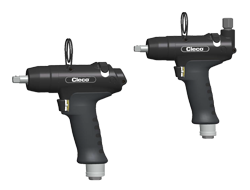
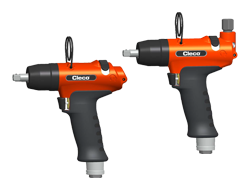
Impulse Wrenches with and without Shut-off: Technical Selection, Application, and Accessories
Impulse wrenches are specifically designed for fast, repeatable fastening applications where torque peaks and vibration forces must be controlled. On this category page, you will find Cleco / Apex Tool Group pneumatic impulse wrenches with and without shut-off, as well as suitable accessories such as quick-change chucks. The texts here focus on technical features, variants, connection and sealing solutions, and specific application scenarios to help you select the right tool for your manufacturing environment.Construction and Performance Parameters
Impulse wrenches operate with short-term torque impulses generated by a hammer or impact mechanism. Typical designs differ in housing material, drive shaft, bearings, and the design of the impact mechanism. Housings are often made of die-cast aluminum or fiber-reinforced plastic for low mass and high rigidity; in corrosive environments, anodized aluminum or stainless steel components are used. Shafts, bearings, and square drives are hardened and precision-ground, depending on the model, to ensure wear resistance and concentricity. Key technical parameters include maximum impulse torque, effective working torque, no-load speed, and air consumption at nominal load. Models with shut-off offer a defined end-position shut-off via an integrated clutch or torque-controlled lamellar clutches; this is crucial when a form-fitting tightening without further turning must occur after a predetermined torque is reached. Impulse wrenches without shut-off are suitable for pre-tightening and applications where the fastening element is monitored by subsequent systems.Connections, Air Supply, and Sealing Technology
Compressed air connections follow standard sizes (1/4", 3/8", 1/2" NPT or BSP) and are often designed with swivel connectors to prevent hose kinking. For industrial applications, the installation of an inline filter-regulator-lubricator (FRL) with fine filtration ≤5 µm and an adjustable pressure regulator is recommended. Lubricants depend on material pairings and ambient temperature: synthetic compressed air oils extend the life of bearings and the impact mechanism and prevent corrosion. Sealing elements typically consist of NBR or FKM (Viton) for higher temperatures and chemical resistance; silicone-free versions are required in areas near painting and coating processes.Accessories and Quick-Change Chucks
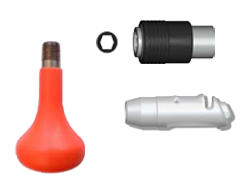
Quick-change chucks (quick-change square drives) reduce set-up times when changing sockets and bits. Chucks are hardened steel, with protective coatings such as phosphate or DLC for longer life. Extensions, angle attachments, and damping sleeves are also available to reach hard-to-access screw points or minimize vibrations. When using torque measuring devices, short, torsionally rigid adapter strands should be used to avoid measurement errors.Material and Fastening Behavior: What to Consider
The selection of the appropriate impulse wrench is based on screw material, thread type, and preload force. In aluminum or lightweight structures, lower impulse torques and finely graduated shut-off values are required to avoid thread damage. For high-strength steel screw connections, higher impulses are useful to avoid sudden plastic deformation and simultaneously achieve rapid work hardening. Thread flanks and under-head surfaces should be cleaned and, if necessary, provided with corrosion protection agents; for gas-tight connections, defined sealing systems must be combined—for example, shaft seals for rotating fits and FKM O-rings for static seals.Regulation, Measurement, and Process Integration
For serial production processes, the integration of impulse wrenches into fastening controllers is important. Shut-off models provide consistent final torque and can be coupled into assembly lines with data logging, binary signals for good/bad evaluation, and industrial fieldbus interfaces. Testing systems with torque and angle monitoring increase process reliability. For traceability requirements, fastening operations should be linked to batch numbers and timestamps; this reduces sources of error due to unsuitable device settings.Practical Application Examples
Practical Example 1 — Body Assembly, Spot Fastening: In vehicle assembly, impulse wrenches without shut-off are used for pre-fastening to quickly position components. Subsequently, a shut-off fastening process takes place in a second station for defined final application. The devices are equipped with anodized aluminum housings and NBR seals, FRL with 6 bar and 40 l/min air requirement are provided. The quick-change chuck reduces set-up times from 30 to 5 seconds per operation. Practical Example 2 — Aluminum Gearbox Housing: For flange connections on aluminum housings, impulse wrenches with finely adjustable shut-off (e.g., 8–12 Nm) and FKM O-rings are used in the surrounding environment due to elevated oil temperatures. The impulse wrench achieves maximum impulses without overtightening the screws because the shut-off is precisely matched to the preload force. Practical Example 3 — Pipe Flange Assembly in the Process Industry: For pipe flanges with sealing elements, a stepped tightening procedure is recommended: pre-tightening with an impulse wrench without shut-off, intermediate torque with measurement monitoring, and final shut-off for end force control. Sealing materials such as PTFE gaskets require exact, uniform preload, so impulse wrenches with a repeatability of ±5% are recommended. For this application, rust-resistant surfaces and FKM seals are standard.Selection Criteria: Which Model Fits?
Select impulse wrenches based on the maximum effective torque range, shut-off repeatability, air consumption, and ergonomic parameters such as weight and sound pressure level. Models with integrated shut-off are suitable for final assembly processes with documented torque values; devices without shut-off are better suited for quick pre-fastening, forming, and positioning tasks. Also, check compatibility with existing quick-change systems, the availability of replacement seals, and maintenance intervals for industrial high-load cycles. * Quick selection guide: define desired final torque, material pairing, cycle rate, and required repeatability; then select impulse wrenches with suitable connections, seals (NBR, FKM), and maintenance packages.Maintenance, Service, and Safety
Regular maintenance includes air filter changes, oil application for the impact mechanism and bearings, inspection of square drives for wear, and replacement of seals after operating hours. Safety-relevant aspects include sound insulation (protection at >85 dB(A)), non-slip handles, and locks against unintentional starting. Use only manufacturer-approved lubricants and spare parts to maintain warranty and performance requirements. Further technical information on pneumatics, connection, and control solutions can be found on the technology page https://maku-industrie.de/technik and practical application examples on https://maku-industrie.de/anwendungsbeispiele.FAQ
1. What torque can impulse wrenches achieve and how accurate is the shut-off?Impulse wrenches can achieve ranges from a few Nm to several hundred Nm, depending on their size. Shut-off models typically provide repeatability in the range of ±5–10%; for higher requirements, fastening systems with angle or torque monitoring are necessary. 2. When is an impulse wrench with shut-off absolutely preferable?
Always when a defined final torque with high reproducibility is required—for example, in safety-relevant assemblies, with sealing packages, or where rework is technically or economically unacceptable. 3. Which air preparation and seal design should I choose?
The minimum requirement is a filter-regulator-lubricator with ≤5 µm filtration and adjustable pressure regulation. For increased temperature or chemical resistance, choose FKM seals; for standard applications, NBR seals are sufficient. Pay attention to silicone-free versions in painting processes.