
Information about BSPP Adapters
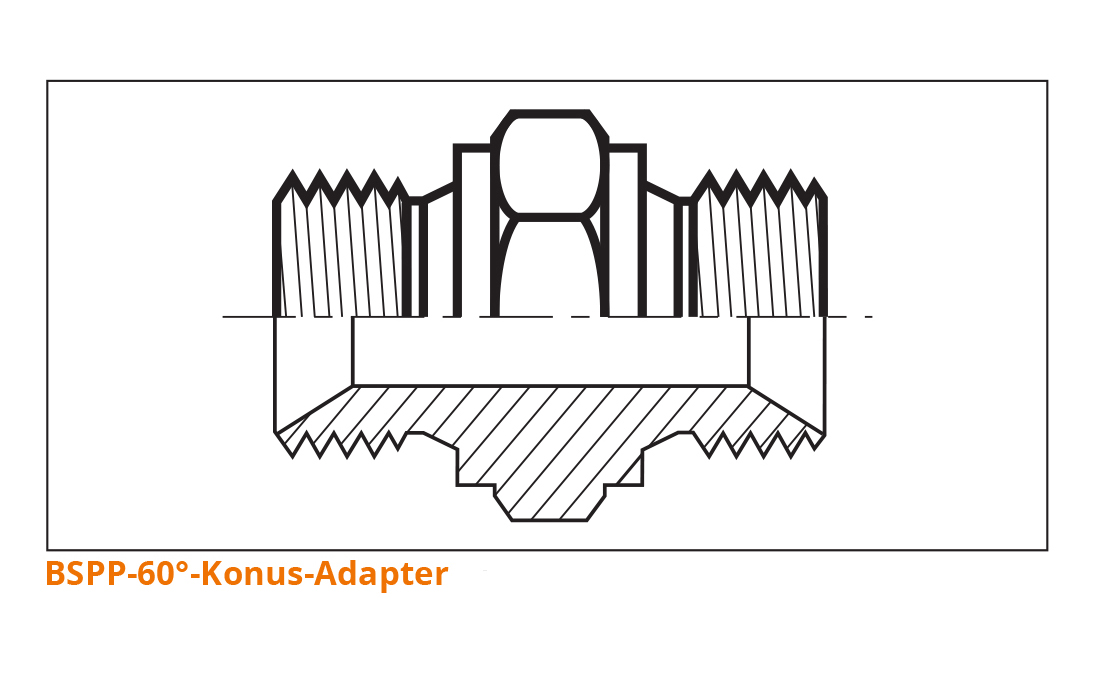
This type of BSPP adapter, which is typically also used as a hose adapter, remains very popular in Great Britain, Scandinavia, and the rest of Europe. The corresponding connections are standardized under the designation BS5200. The cone of the BSPP connection tapers inwards at an angle of 60 degrees, matching a cone taper at the same angle on an adjustable male port at the hose end. When the union nut is tightened, the two halves are pressed together to create a metallic seal. This type of connection is flexible in application, as the same threaded end is also suitable for screwing into a BSPP port hole. For this purpose, an additional seal is required, typically a bond seal, consisting of a metallic outer ring and an internal elastomer seal.
Despite their flexibility, these adapters cannot be used equivalently to Triple-Lok®, O-Lok®, or EO fittings as tube fittings and are therefore not classifiable as a universal system. Many manufacturers produce elbow and tee adapters by soldering straight sections together. This can cause the fitting to be annealed during the soldering process and therefore lose strength in the material. Parker elbow and tee adapters are manufactured from high-strength blanks and therefore offer excellent performance and service life.
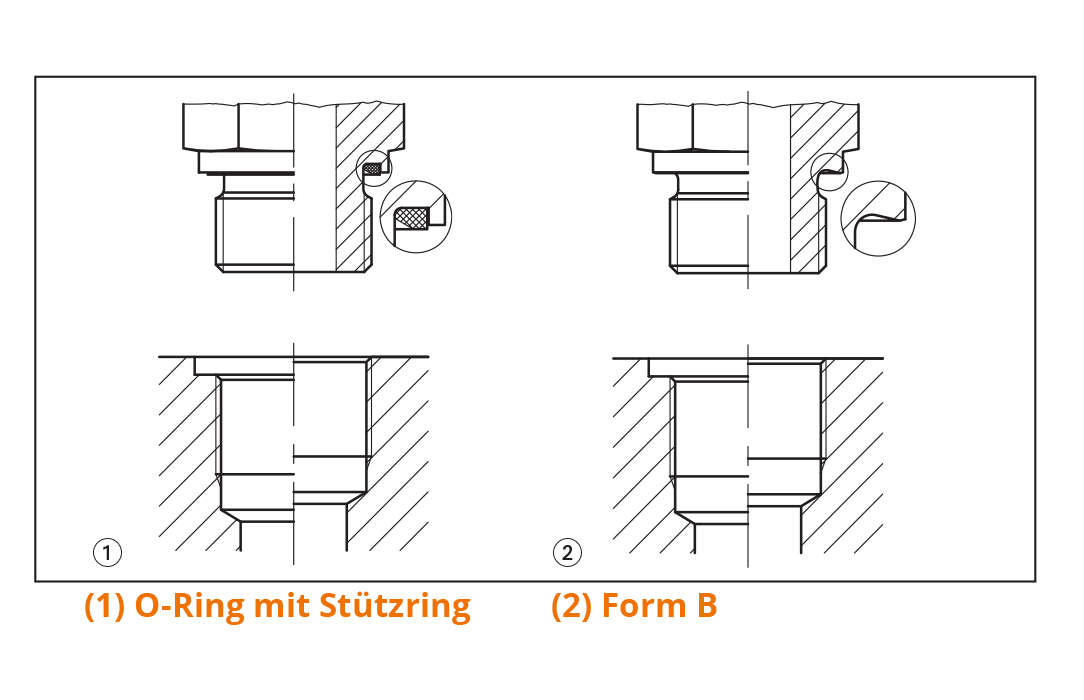
BSPP thread adapters are used to connect male threads that are provided with a flat counterbore. This counterbore allows for a continuously flat sealing surface, regardless of whether the female thread is in a machined valve block or on the surface of a cast pump housing. This seal originally took the form of a sealing washer (copper). Today, the adapters are manufactured with elastomer seals.
The best results are shown by the ED seal, followed by the O-ring with back-up ring, the bond seal, and finally the German "Form B," the metallically sealed design. The direction-adjustable fittings are usually only available in the O-ring and back-up ring versions. The ED seal design is not suitable for tasks where direction adjustability of the tube connection is required.