
Order low-priced stainless steel grinding spindles by Mannesmann Demag and collets
By using grinding spindles by Mannesmann Demag you can be sure: newest technology, highest reliability and quality gives you decisive advantages in your automation process.We are happy to advise you by phone or e-mail. We help you choosing the ideal grinding spindle for your application. Call us at +49 7151 / 90 395-0 or use our Callback service in the top right corner of the webpage. Or send us an e-mail by using the contact form on contact.
Stainless Steel Grinding Spindles from Mannesmann Demag: Technical Selection, Applications, and Purchase Criteria
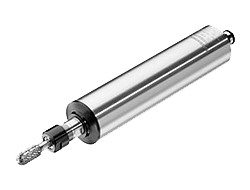
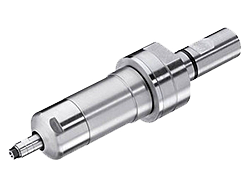
Stainless steel grinding spindles from Mannesmann Demag stand for precise speeds, high running smoothness, and corrosion resistance in industrial grinding and polishing processes. These spindles are specifically designed for use in CNC machines, robotic systems, and automated coating or cleaning cells. Critical factors in selection include material requirements, connection variants, cooling and sealing concepts, and the appropriate design for the respective machining process. At maku, we offer technical advice via phone and email for optimal selection and integration of these spindles into your manufacturing processes. Further technical information can be found on our technology page https://maku-industrie.de/technik.
Construction and Materials
Mannesmann Demag stainless steel grinding spindles are typically made of corrosion-resistant stainless steel, often with shafts and housings made of 1.4404/316L or similar martensitic/ferritic alloys to ensure both corrosion protection and mechanical strength. Internal bearing housings and supply channels are often made of hardened steel and provided with corrosion-resistant coatings to increase service life in abrasive and humid environments. For applications with high thermal loads, shafts with heat-treated running surfaces and selected lubricants for high-performance bearings are mandatory. Sealing materials such as FKM (Viton), EPDM, or PTFE-lined seals are used depending on media resistance and temperature range; PTFE offers the best abrasion resistance with chemical resistance, FKM is suitable for high temperatures and mineral oil-based coolants.
Designs, Speeds, and Performance Data
Designs range from compact direct-drive spindles to purely conical flange versions with straight or short shaft ends. Speed ranges start at a few thousand RPM for hard grinding and extend into the high-speed range (>30,000 RPM) for fine and polishing processes. Performance data must be adapted to the type of grinding wheel, grit, and material removal rate: high momentary demands require larger nominal powers and more robustly designed bearings, while high-speed applications require bearings with minimized friction moment and a balanced shaft. Pay attention to specifications for running accuracy (runout), temperature behavior under load, and insulation class of the motors (for motorized spindles).
Connections, Cooling, and Lubrication
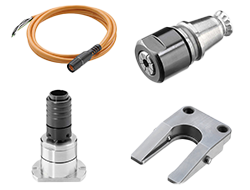
Electrical connections are standardized according to size; for water-cooled spindles, separate connections for coolant supply and return are necessary. For motor/spindle units, shielded motor cables, incremental encoders, or Hall sensors are available for speed control and feedback. Cooling systems are divided into air-cooled and water-cooled variants; water is guided through internal channels or external cooling jackets. Water-cooled spindles offer more stable temperature control and reduced thermal expansion during continuous operation, provided the coolant guidance is corrosion-protected and filterable. Bearing lubrication is either permanent with specially selected high-temperature or chemically resistant greases or by external supply via oil mist/pump lubrication, depending on the load scenario.
Seals and Protection Concepts
In industrial environments, sealing systems against particle ingress, liquids, and chemical media are required. Mannesmann Demag uses hybrid sealing concepts: outer dust seals combined with inner multi-lip or magnetic seals, supplemented by labyrinth guides for particle deflection. For wet processes or applications with highly abrasive media, additional ceramic or hard material coatings at critical points are useful. The selection depends on the ingress protection (IP) class, typically IP54 to IP67 for robust machining stations. For cleanroom or food environments, special FDA-compliant material combinations and smooth surfaces are available.
Precision, Balance, and Vibration Behavior
For grinding applications, runout (radial/axial) is a critical parameter; Mannesmann Demag specifies spindles with very low runout values (<= 0.01 mm) for high-precision processes. Dynamic balancing according to ISO standards reduces vibrations and extends the service life of grinding wheels and bearings. Vibration analyses and the use of damped spindle mounts minimize resonances at variable speed ranges. For robot-assisted integration, the weight of the spindle is relevant; light, compact spindles with integrated cooling and low moment of inertia improve path and process accuracy.
Application Fields and Material Compatibility
Stainless steel grinding spindles are used in the metalworking industry for stainless steel and aluminum parts, medical technology components, automotive parts, and in precision optics. When grinding stainless steel, abrasive wheels with specific grit and suitable coolants are necessary to avoid burning edges and discoloration; here, spindle-side cooling channels and stabilized speeds are advantageous. For glass- or ceramic-like materials, different wheel types and higher speeds are used. For polymer or plastic parts, care must be taken to keep the spindle temperature low to prevent melting or deformation.
Integration into CNC Machines and Robotic Systems
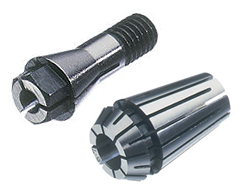
Mechanical connection is made via standardized flanges, HSK or ISO mounts, and collet chucks for grinding wheels. Electrical integration includes speed and torque control, speed encoders, and emergency shutdown. For robot integration, in addition to the mechanical interface, mass distribution and vibration damping are important to ensure path accuracy. Lifecycle support and spare parts availability are also relevant: bearing kits, seal sets, and standard electronic modules reduce downtime. For concrete integration examples and practical cases, we refer to our application examples: https://maku-industrie.de/anwendungsbeispiele.
Practical Examples
Example 1: Robot-assisted deburring of stainless steel sheets — A compact stainless steel grinding spindle with 18,000 RPM, water-cooled design, and PTFE seals is mounted on a 6-axis robot. The spindle works with a diamond-coated grinding wheel. Coolant is supplied through the robot line, filtered to <0.5 mm particles. Results: uniform burr widths, no thermal discoloration, increased wheel life due to constant cooling.
Example 2: Fine grinding of automotive axles — Use of a flange spindle with high torque reserve and oil mist lubrication. The spindle is integrated into the CNC axis via torque control; runout <=0.01 mm ensures dimensional accuracy. Result: reduced post-processing, reproducible surface roughness (Ra values maintained).
Example 3: Polishing of medical stainless steel components — High-speed spindle (>30,000 RPM) with air-cooled bearings and FDA-compliant seals, combined with fine abrasive polishing tools. Temperature monitoring prevents melting of the polishing compound; final result: mirror-smooth surfaces without contamination risk.
Maintenance, Spare Parts, and Service Life
Regular inspection of runout, bearing condition, and seals significantly extends service life. Maintenance interval recommendations are based on operating hours, operating environment, and load profile. Available spare parts include bearing kits, seal sets, grinding wheel mounts, and electrical sensors. Documented replacement procedures for bearings and seals reduce downtime. If required, maku supports with spare parts procurement and interval scheduling.
Purchase Criteria: What to Pay Close Attention To
Select a spindle based on the material of the parts to be machined, required surface quality, speed and torque requirements, cooling requirements, and integration interfaces. Specify runout tolerance, protection class (IP), sealing material, and lubrication concept in your inquiry. Use our technical advice to obtain the correct gradations and options and to design the machine for reliable process operation.
If you have specific specifications, send them to our technical advisors or check available spindle variants directly in the shop under the category Mannesmann Demag Grinding Spindles: https://maku-industrie.de/shop/de/mannesmann-demag/schleifspindeln/
FAQ
- Which seals are suitable for wet processes with stainless steel machining? PTFE-lined seals or hybrid lip-magnetic seals offer the best protection against abrasives and chemical coolants; FKM is an alternative for high temperatures.
- How do I identify the appropriate cooling variant (air vs. water)? Water-cooled is preferable for continuous runs with high thermal loads and when constant dimensional accuracy is required; air-cooled is suitable for sporadic applications or when no coolant system is available.
- What runout accuracy is needed for precise grinding? For high-precision grinding, runout values <=0.01 mm are recommended; for less critical applications, higher tolerances are acceptable, depending on workpiece requirements and grinding process.