
Durable random orbit sanders for convenient one-hand operation
With us you get high-quality one-hand random orbital sanders for sanding surfaces. In the case of grinders with extraction, the emission of grinding dust directly on the device is significantly reduced.

DSRO-01-02PSA Random Orbital Sander

DSRO-01-05PSA Random Orbital Sander

DSRO-01-06PSA Random Orbital Sander

DSRO-01-35PSA Random Orbital Sander
DSRO-01-36PSA Random Orbital Sander
DSRO-03-05PSA Random Orbital Sander
DSRO-03-06PSA Random Orbital Sander
DSRO-01-05HL Random Orbital Sander
DSRO-01-06HL Random Orbital Sander

DSRO-01-25HL Random Orbital Sander
DSRO-01-26HL Random Orbital Sander
DSRO-01-36HL Random Orbital Sander
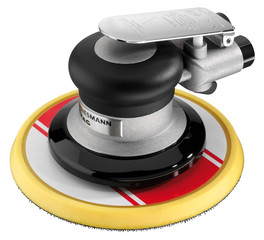
Orbital sander MDEXZ 125/2.5
Price on request
Orbital sander MDEXZ 125/5.0
Price on request
Orbital sander MDEXZ 150/2.5
Price on request
Orbital sander MDEXZ 150/5.0
Price on request
Random Orbital Sanders: Compact Power Tools for Precise Surface Finishing
Random orbital sanders combine rotary and oscillating movements to efficiently remove material and smooth surfaces without leaving sanding marks. In industrial manufacturing processes, maintenance, and assembly, they offer fast, controllable processing of metals, paints, plastics, and wood. When selecting and using them, orbit diameter, pad/diameter, speed and stroke control, and drive type (electric, pneumatic) are crucial for results, service life, and operating comfort.Power and Drive — Electric and Pneumatic Random Orbital Sanders
Electric random orbital sanders deliver constant speeds and are suitable for stationary workstations with 230 V or mobile applications with battery power. Pneumatic models from manufacturers such as Dotco and Cleco offer a high power-to-weight ratio for rough use and are standard in assembly halls with compressed air supply. In comparison, pneumatic sanders are less sensitive to overload, often have lower weight and higher speeds, but require a flawless compressed air supply, suitable connections (e.g., 1/4" or 3/8"), and regular filter/maintenance intervals. Correct hose dimensioning, pressure regulation, and oil/water separation are important for air tools. Electric models require EMC-compliant motor components and often electronic speed control for consistent surface quality under varying loads.Orbit, Pad Size, and Abrasives — Influence on Texture and Efficiency
The orbit diameter (e.g., 1.5 mm to 5 mm) determines the material removal behavior: smaller orbits produce a finer finish, larger orbits accelerate material removal. Pad sizes between 125 mm and 150 mm are most common in industry; smaller pads allow access to confined areas. The choice of abrasive (aluminum oxide, silicon carbide, ceramic, zirconium oxide) depends on the substrate: aluminum oxide for steel, ceramic/zircon for stainless steels and hard alloys, silicon carbide for plastics and paints. Grain shapes and bond types influence service life and cutting behavior. Sanding discs with hook-and-loop fastening allow quick changes, while self-adhesive variants ensure a flat fit at lower cycle frequencies.Ergonomics and One-Hand Operation — Safety and Productivity
For one-hand operation, weight, center of gravity, grip shape, and switch arrangement are crucial. A rubberized grip reduces vibrations and increases grip security. Precise switches with a pressure point, handwheel buttons, or thumb control enable stepless starting and reduce misoperations. Some models integrate vibration damping, counterweights, or decoupled pads to minimize hand-arm vibrations and reduce fatigue. In safety-critical environments, motor protection, thermal shutdown, and safety clutches are relevant.Dust Management and Surface Quality
Effective dust extraction extends sanding disc life, reduces contamination risks, and improves the working environment. Random orbital sanders with internal extraction lines and connection nozzles (Ø 27–36 mm) can be connected to stationary extraction systems; mobile solutions use filter bags or integrated collection containers. For painting processes, cleanliness is essential: a good extraction system prevents contamination, ensures uniform grain action, and reduces rework.Construction, Seals, and Serviceability
Housings made of aluminum or glass-fiber reinforced plastic offer a balance between robustness and weight. Rolling bearings or plain bearings on the eccentric shaft influence running smoothness and service life; ball bearings are standard in high-precision models, well-sealed bearings increase service life in dusty environments. Elastomer seals on shafts, sediment barriers, and labyrinth seals prevent the ingress of sanding dust and cooling lubricants. Quick replacement of wear parts such as pads, bearings, or carbon brushes reduces downtime and is a criterion in investment decisions.Electronics, Speed Control, and Monitoring
Modern electric random orbital sanders feature electronic speed control for consistent surface processing regardless of load fluctuations. Soft-start functions prevent sanding marks when starting. Variable speed ranges (e.g., 4,000–12,000 min⁻¹) allow adaptation to material and grit. In sensitive manufacturing processes, devices with feedback, servo control, or interfaces for machine monitoring are used.Practical Application Examples
Practical Example 1 — Deburring Aluminum Assemblies: An assembly team removes burrs from injection molded parts. Application: pneumatic random orbital sander with 3 mm orbit, 125 mm pad, and medium grit size (120–180). Result: uniform deburring without heat distortion. Extraction was coupled directly to the sander's connection to reduce the need for office masks and prevent rework. Practical Example 2 — Paint Preparation Before Coating: A paint shop prepares car body panels. Application: electric random orbital sander with electronic speed control, 150 mm pad, fine orbit (1.9 mm), and ceramic sandpaper 240–320. Important: dust-free environment using central extraction and HEPA filtration to ensure the paint layer can be applied without inclusions. Practical Example 3 — Rust Removal and Finish on Steel Components: Large steel beams are derusted before welding. Application: pneumatic 150 mm random orbital sander with large orbit (4 mm) and zirconium oxide grit 60–80. Result: fast material removal with controlled heat development, minimal burr formation; regular pad changes and bearing checks recommended.Accessories, Consumables, and Spare Parts
Suitable accessories include backing pads of various hardnesses, adapters for extraction, protective hoods, sandpaper of different grits and bonds, as well as replacement bearings and shaft seals. For industrial users, reliable supply chains and OEM parts from Apex Tool Group or Mannesmann Demag are relevant. Pay attention to compatible pad boreholes, hole patterns for dust extraction, and fastening type (hook-and-loop/stick-on).Selection Criteria for Procurement
When procuring, decide based on the operating conditions: working environment (dust, moisture), desired surface quality, accessibility of workpieces, and mode of operation (individual parts vs. series production). Consider weight, running smoothness, maintenance access, and spare part availability. For compressed air-driven lines, check air consumption (l/min), operating pressure, and connection size; for electric variants, check rated power, protection class (IP), cable length, or battery range. Further technical details and component information can be found in our technical overview: https://maku-industrie.de/technik. Application-oriented case studies and processes are documented at https://maku-industrie.de/anwendungsbeispiele.Connections, Tests, and Safety Instructions
Pay attention to standard-compliant connections: electrical devices with protection class and CE marking, pneumatic tools with standardized rotary couplings and quick-release couplings. Before commissioning, perform a visual inspection, leak test of the air lines, and functional test of the safety shutdown. Wear appropriate PPE: respiratory protection for dusty work, hearing protection for high speeds, and cut-resistant gloves for sharp-edged workpieces. * Essential selection factors: orbit size, pad diameter, drive type, speed control, dust extraction, weight/ergonomics, and availability of spare parts.Maintenance and Service Life Optimization
Regular maintenance extends service life: lubricate or replace bearings, check seals, flatten sanding pads, and clean extraction lines. Bearing tolerances and shaft play are wear indicators. Documented inspection intervals, spare part kits, and trained personnel reduce downtime. For series production, a stock of wear parts such as pads and bearings is recommended.FAQs
Which orbit size is suitable for fine surfaces in paint preparation?
For fine surfaces, orbits between 1.5 mm and 2 mm are ideal; in combination with a 150 mm pad diameter and fine grit (240–320), you achieve a homogeneous surface without holograms.
When should I choose pneumatic instead of electric random orbital sanders?
Choose pneumatic for high stress, a desire for low weight, and existing compressed air infrastructure. Electric is recommended for mobile applications without compressed air, when electronic speed control is needed, and in sensitive manufacturing environments with a stable power supply.
How do I ensure effective dust extraction during sanding?
Use a sander with an integrated extraction port and connect it to a central extraction system with suitable suction power and filtration. Pay attention to compatible hole patterns of the sanding discs, clean lines, and regular filter changes to prevent suction loss and dust residues.