
Order low-priced tempering quick couplings for mould cooling

87KFTR13MVX Quick coupling with hose barb 90° angled

608KFTP10MVN Quick coupling for push-in hose

10KFIW13MVX Quick coupling with female thread

10KBAR13MVX Quick coupling

10KFAR13MVX Quick coupling

11KFIM16MVX Quick coupling with female thread

11KFIW13MVX Quick coupling with female thread

11KBAW13MVX Quick coupling with male thread

11KBTF13MVX Quick coupling with hose barb

11KFAW17MVX Quick coupling with male thread

10KBTR09MVXSL Quick coupling with hose barb 90° angled

10KBAR14MVX Quick coupling

11KBAH16MVX Quick coupling

87KBIW13MVX Quick coupling with female thread

11KBAR16MVX Quick coupling

86KBAW17MVX Quick coupling with male thread

12KFTF19MVX Quick coupling with hose barb

12KFTR19MVX Quick coupling with hose barb 90° angled

87KFIW13MVX Quick coupling with female thread

12KBTF19MVX Quick coupling with hose barb

10KFAH13MVX Quick coupling

11KBIM16MVX Quick coupling with female thread

11KFAM16MVX Quick coupling with male thread
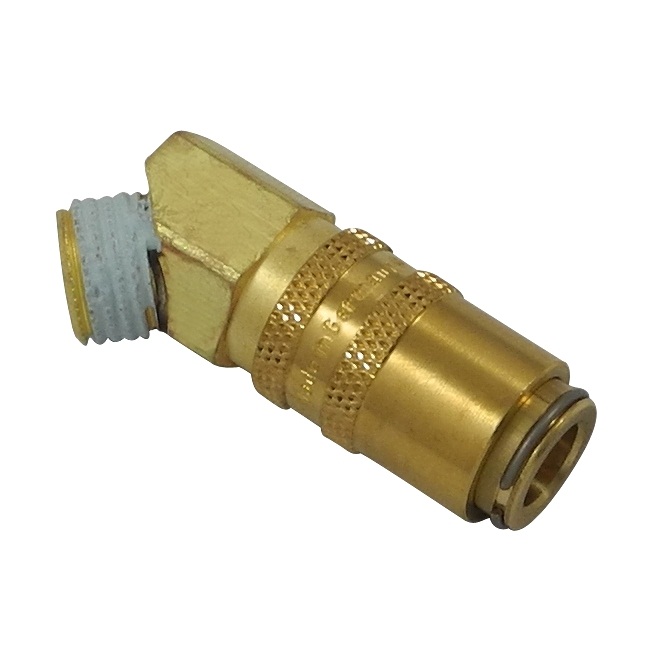
10KBAH14MVX Quick coupling
Temperature Control Couplings for Mold Cooling: Selection, Technology, and Application
Temperature control couplings for mold cooling connect mold temperature control systems securely, quickly, and leak-tight. In injection molding and die casting production, precise temperature control circuits are a prerequisite for reproducible component quality and reduced cycle times. The quick-release couplings offered here, made of brass and nickel-plated versions, are shut-off type and available with Safe-Lock mechanisms, allowing them to be reliably disconnected and connected both under pressure and during temperature changes. Suitable connections include male threads (AG), female threads (IG), and hose connections for flexible lines. Sealing materials and designs determine suitability for water, thermal oil, or temperature-stable medium combinations.
Materials and Corrosion Behavior
Brass offers good mechanical strength and thermal conductivity and is frequently used in water-based temperature control systems. Nickel-plated versions increase surface hardness, improve corrosion resistance against softened water, and enhance wear resistance with frequent coupling. For aggressive media or increased chemical resistance, alternative materials such as stainless steel (not part of the core assortment listed here) should be considered. The selection of the appropriate material takes into account conductivity, wear, galvanic effects when connected to other metals, and reaction behavior with hot thermal oils.
Designs and Functional Principle
Shut-off quick-release couplings separate the line and tool without significant fluid loss thanks to integrated valves. When connected, valves open on both sides, allowing for nearly pressure-free flow. Safe-Lock variants offer additional locking against unintentional disconnection under pressure or vibration. Important design features include piston or ball valve technology, spring loading of seals, pressure limiting options, and hygienic properties of internal surfaces. Key parameters relevant for mold cooling are permissible operating pressure, temperature limits of the seals, and volume flow losses due to cross-sectional constrictions.
Seals and Temperature Limits
The choice of seal is crucial for service life and leak-tightness. Commonly used sealing materials are NBR (nitrile rubber), FKM (Viton), and EPDM. NBR is economical and oil-resistant at moderate temperatures, EPDM is particularly suitable for hot water and steam, and FKM offers the highest temperature and chemical resistance up to >200 °C. For mold cooling with high temperatures or thermal oils, FKM is recommended; for simple water cycles, EPDM. Pay attention to the permissible temperature ranges of the complete coupling – metal housings can withstand higher temperatures than the seals used.
- NBR: economical, up to approx. 100 °C, good oil resistance
- EPDM: excellent for hot water and steam, up to approx. 150 °C
- FKM (Viton): high temperature and chemical resistance, up to over 200 °C
Connections and Installation Dimensions
Temperature control couplings are available with metric or BSP threads, male threads (AG), female threads (IG), and hose connections in various diameters. For precise tool connections, accurately toleranced thread fits are required; for hose connections, the use of hose clamps or crimp fittings is recommended to absorb axial loads. An important aspect is the installation length of the coupling on the tool, to prevent pre-tensioning that could lead to leaks when closing. When replacing existing components, thread type, nominal diameter, and sealing variants must be matched.
Performance Criteria and Technical Key Figures
Essential technical criteria for selection are: permissible operating pressure, temperature range, flow characteristics (Kv value or pressure loss at a defined volume flow), switching cycle life, leak-tightness (drip and bubble test), and weight. For high-performance tooling, couplings with a high Kv value and low constriction should be chosen to avoid pressure losses and thus increased pump power. Safe-Lock variants reduce the risk of unintentional disconnection due to vibration and enable safe quick disconnection even under residual pressure, provided the specification allows it.
Use Cases and Practical Examples
Example 1 — Injection molding tool with multi-circuit temperature control: A tool with four temperature control circuits requires a quick disconnection point for tool changes. Nickel-plated, shut-off quick-release couplings with male thread connections are installed in the manifold line. During tool change, the operator first disconnects the couplings on the tool carrier; the integrated valves prevent the cooling medium from escaping. After inserting the new tool, the couplings are locked (Safe-Lock) and the circuits are ready for operation again in under a minute. The choice of EPDM seals ensures operation with hot water up to 130 °C.
Example 2 — Provisional temperature control line in a test environment: For test series, flexible hose connections are often used. By using hose connection couplings with NBR seals, various test stands can be quickly reconfigured. The couplings are mounted on hose lines and enable modular setup and quick disassembly without medium leakage. After completion of the measurement series, lines are cleanly disconnected and safely stored.
Example 3 — Service activities on existing systems: Maintenance teams use shut-off, nickel-plated Safe-Lock couplings to isolate individual mold cooling circuits during repairs. The couplings allow for safe enclosure of the affected circuit, and repairs can be carried out without completely shutting down the temperature control station. After recommissioning, the couplings are opened and the system is filled pressure-free, minimizing air escapes.
Installation Instructions and Maintenance
During installation, threads must be cleanly turned, lock nuts secured, and sealing surfaces checked for damage. Before initial operation, couplings should be pressure tested and visually inspected for leaks. Regular inspection of seals, the locking mechanism (Safe-Lock), and valve functions extends service life and prevents spontaneous failures. Replacement intervals for seals depend on operating conditions; under high temperature loads and aggressive media, these intervals shorten significantly.
Compatibility and Standards
When selecting, check compatibility with existing thread types (metric vs. BSP) and observe relevant industry standards for pressure control and material compatibility. For critical applications, it is advisable to consult manufacturer specifications for pressure cycles, sealing material, and temperature range, and to request material certificates if necessary.
Further technical information and detailed application examples can be found on our technology page https://maku-industrie.de/technik and in specific use cases under https://maku-industrie.de/anwendungsbeispiele.
Selection Checklist (Short)
- Medium, temperature, pressure, thread type, flow requirement, sealing material, locking function
FAQs
How do I choose the right seal for my temperature control coupling?
Choose the seal according to the medium and temperature: EPDM for hot water and steam, NBR for oil-containing systems at moderate temperatures, FKM/Viton for high temperatures or aggressive media. Check manufacturer specifications for temperature limits and chemical resistance, as well as compatibility with cleaning or antifreeze agents.
Can I disconnect quick-release couplings under pressure?
Only shut-off couplings with an appropriate Safe-Lock function and specified disconnectability under residual pressure allow safe disconnection. Without this specification, disconnection under pressure leads to fluid leakage and hazards. Observe manufacturer specifications for maximum residual pressure release and perform relief steps according to operating instructions.
What role does the Kv value play in selection?
The Kv value describes the flow rate at 1 bar pressure difference. For short cycle times and high volume flows, choose couplings with a high Kv value to minimize pressure losses and pump load. Pay attention to manufacturer specifications for the Kv value and compare pressure losses at your typical operating volume flow.