
Order Parker Legris pneumatic function fittings
Parker Legris function fittings (flow control regulators, piloted function fittings, non-return valves, … ) allow you to exert even greater control over your installations. Compact, reliable and easy to install, these fittings can be used in various applications, including: food and beverage, in-plant automotive, printing, textile and water treatment industries, ...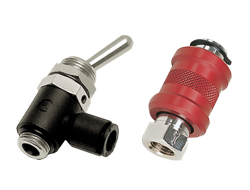


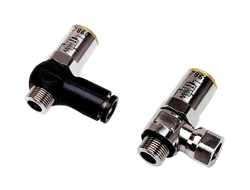


Order Parker Legris Pneumatic Function Fittings
Functional Precision: Parker Legris function fittings combine leak-tightness, quick assembly, and reproducible control and switching functions for pneumatic circuits. The product group includes check valves, exhaust valves, throttle valves, silencers, push-in and compression fittings, as well as specialized signal and stop fittings. Designed for series machine construction, maintenance, and networked manufacturing cells, these components are engineered to precisely address operating pressure, medium, and installation space, thereby minimizing downtime and leaks.
Materials and Designs
Parker Legris uses corrosion-resistant materials such as brass, stainless steel (AISI 316/1.4401), and engineering plastics (POM, PA) depending on the requirements for chemical resistance and temperature. Metallic threaded parts are primarily used in continuously loaded or high-temperature applications; plastic geometries offer weight advantages and protection against malfunctions in corrosive media. Designs range from compact inline valves for series assembly to flange and bulkhead-mountable variants with special sealing topology for feed-throughs in housing walls. Swiveling and series-mountable versions allow flexible assembly combinations without additional adapters.
Connections and Sealing Technologies
Connection technology ranges from metric and imperial external threads to BSP variants, as well as push-in and compression fittings. Push-in systems reduce assembly time and require no additional tools, while compression fittings ensure mechanical strength and reususability for compressed air lines with higher vibrations. Seals are offered in NBR, FKM (Viton), and EPDM, with targeted selection according to temperature range, lubricant contact, and medium (e.g., oil lubrication or aggressive gases). For high-temperature applications, silicone and PTFE solutions are available. The sealing geometries are matched to the respective installation position: axially sealing systems for inline valves, radially sealing versions for bulkhead feed-throughs, and special O-ring seat solutions for check valves.
Functional Types and Operating Principles
Legris function fittings cover standard and special functions: 2/2-way and 3/2-way valves for basic functions, 3/2-supply and 3/2-exhaust valves for controllable actuators, piloted check valves for secure isolation under pressure, differential pressure control valves for pressure optimization, and bidirectional valves for backflow control in complex piping networks. Throttle and exhaust throttle valves enable precise flow rate control; variants with external or recessed adjustment screws offer either easily accessible adjustment or tamper-proof setting. Silencers reduce exhaust noise without significant system resistance and are available in porous metal or sintered bodies.
Assembly and Installation Scenarios
Practical installation examples show typical applications: In a conveyor system, 3/2-supply valves with compression fittings are used for quick assembly on cylinders; for controlling grippers, 3/2-exhaust valves with external adjustment screws are used, allowing preferred settings for cycle times. In a paint shop, throttle valves optimize the air volume at spray guns; in a pneumatic test stand, differential pressure valves regulate the test pressure to defined limits. Silencers on exhaust lines in final assembly reduce noise levels and protect employees from excessive sound pressure values. For feed-throughs in control cabinets, bulkhead-mountable fittings with integrated seals are installed to maintain the protection class.
Selection Criteria: Systematic Decision-Making
The selection of a suitable function fitting begins with the precise determination of operating pressure, flow rate, and medium. Subsequently, the temperature range, mounting environment (vibration-sensitive, corrosive, hygienic), and maintenance strategy must be checked. For applications with high frequencies and short switching times, valves with low dead volume formation and short response times are prioritized. In safety-critical systems, piloted check valves and redundant compression connections are preferred. For modular machine concepts, the use of series-mountable designs is recommended to save space and reduce assembly times.
Maintenance and Replacement
Legris systems are designed for easy maintenance: seals can be replaced in many models without disassembling complete pipe runs; in push-in systems, reusability is provided without damaging compression rings. Inspection intervals should be defined based on the number of cycles and the operating environment. In case of increased wear on adjustment screws, the use of wear-resistant versions or rerouting the adjustment to easily accessible locations is recommended. Spare parts and replacement valves are quickly available via standardized thread and connection dimensions, which shortens repair cycles and increases machine availability. Technical data sheets on flow characteristics, leak rates, and switching times support selection and are available in the product section.
Practical Examples
- Example 1: In an assembly cell, a 3/2-supply valve with a compression fitting controls a double-acting gripper unit. The external adjustment screw allows for quick on-site cycle optimizations during the series start-up phase. By using an NBR seal, a good balance between cost and chemical resistance was achieved.
- Example 2: In a pneumatic test stand, a differential pressure control valve ensures the pressure stability of test environments. The valve is designed as a series-mountable variant, allowing multiple test channels to be supplied by a compact valve island. A PTFE seal prevents contamination by aggressive test media.
- Example 3: A paint line uses exhaust throttles and silencers in combination: throttle valves regulate the exhaust air for spray units, while welded metal silencers reduce noise emissions. Bulkhead fittings secure the feed-throughs through housing partitions.
Further Information and Data Sheets
Technical details on materials, seal types, and installation dimensions are stored in the product data sheets. For system design and application examples, visit our technology page: https://maku-industrie.de/technik and specific use cases at https://maku-industrie.de/anwendungsbeispiele. For orders and availability, use the category page: https://maku-industrie.de/shop/de/kategorien/funktionsverschraubungen/.
Procurement and Planning Checklist
Before procurement, check the pressure range, flow rate (Cv or Kv), connection type, sealing material, temperature range, and required protection class. Decide between push-in for quick assembly and compression for permanent, vibration-resistant connection. Choose throttle or exhaust variants according to the desired energy efficiency and noise optimization.
FAQs
1. How do I choose between push-in and compression fittings?
Push-in is advantageous for quick assembly and replacement cycles without tools; compression is preferred for high vibrations, higher pressures, and when reusability with high mechanical strength is required.
2. Which seal is suitable for oil-laden pneumatics?
For applications exposed to oils, NBR seals are economical and suitable; for elevated temperatures or more aggressive media, FKM (Viton) is recommended. In case of contamination by chemicals or when low friction is needed, PTFE-supported solutions should be considered.
3. When is a piloted check valve necessary?
Piloted check valves are necessary when backflow under load must be reliably prevented, but needs to be electronically released or controlled when required — e.g., in series production lines with time-critical process steps or in safety applications with redundant shut-off.