
Engraving pens for marking steel, metal, glass, plastic, ceramics and stone
The engraving pens with compressed air are ideal for particularly fine, high-precision, manual inscription.
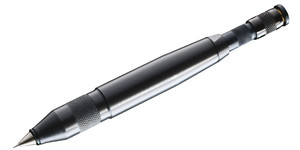
Engraving pen GST 540
Price on request

Engraving pen GST 540 M
Price on request
Engraving Pens for Precise Marking of Steel, Metal, Glass, Plastic, Ceramics, and Stone
Engraving pens are specialized hand tools for permanent marking and labeling of hard surfaces. They combine robust tips and vibration-based or pneumatic drives to create controlled notches, grooves, or dot patterns in materials such as hardened steel, aluminum, brass, glass, plastics, ceramics, and natural stone. For industrial users, variants with different designs (pen lengths, stroke lengths, tip geometries), drive types (electric, pneumatic, battery-powered), and interfaces (M10/M8 thread, quick couplings, ISO connectors) are available. The selection depends on material hardness, desired signature width, engraving depth, and environmental conditions.
Material Application and Interfaces
On steel and hardened metals, engraving pens with hardened carbide or diamond-coated tips are required to create durable notches without excessive wear. For soft metals like aluminum and copper, pens with hardened steel tips or polycrystalline diamond tips are suitable, allowing for clean material removal. Glass, ceramics, and stone require tip geometries with finer angles and often diamond-based tips; here, low stroke frequencies and higher contact forces should be chosen to avoid chipping and cracking. For plastics, a reduced stroke strength and sharp tip geometry are recommended to prevent breakouts and fiber pulling. For coated components (powder coating, paint), a process must be defined in advance: either removing the coating in the engraving area or choosing a tip and force that cleanly penetrates the coating without damaging the base material.
Designs, Seals, and Ergonomics
Engraving pens are available in compact handheld models for workshop and service teams, as well as stationary models for series engraving. Handheld pens often feature ergonomic grips with vibration-damping elastomer zones and modular tip holders for quick tip changes. Stationary units offer reinforced guides, precision bearings, and optional cooling or extraction interfaces for dust or particle loads. For dusty or humid environments, housing seals according to IP classes (e.g., IP54/IP65) must be observed; relevant components include protective sleeves at the tip, O-ring seals on rotary or piston guides, and sealed electronic housings. Pneumatic hand tools require built-in pressure regulators and silencers; electric models use brushless DC motors and electronic controls for stroke and frequency regulation.
Connections, Control, and Integration Options
Industrial engraving pens can be controlled via PLC, handheld operating devices, or CNC integrations. Common electrical connections are M12 connectors for signals and power, 24V trigger lines, and IO-Link for diagnostics. Pneumatic variants use fast quick couplings according to ISO 6150 standard; required operating pressures are typically between 3 and 6 bar, depending on the tip and material. Stationary engraving systems often offer analog inputs for force and displacement measurement, encoder feedback for positioning, and interfaces to engraving software via USB or Ethernet. For automated manufacturing cells, mounting flanges, standard hole patterns, and optional length stops are crucial for repeatable positioning.
Tips, Geometries, and Wear Management
The choice of tip determines the engraving pattern, wear behavior, and maintenance cycles. Carbide tips are economical for medium hardnesses; PCD or diamond-coated tips are durable on abrasive materials. Tip geometries vary from simple conical tips (fine lines) to ball or needle tips (dot markings) to flattened chisel profiles (wide strokes, logo fills). Regular tip inspection and reprofiling extend tool life; defects can be detected through controlled measurement cycles, e.g., deviations in the stroke signal or engraving depth. Fixtures for quick tip mounting and documentation of tool life are recommended to reduce rework and scrap.
Process Parameters and Quality Assurance
Important process variables include stroke height, stroke frequency, feed rate, contact force, and tip radius. On hard steel, higher contact forces and smaller stroke heights increase notch depth, while on glass and ceramics, the stroke frequency must be reduced and the contact force finely tuned to avoid micro-cracks. For series processes, testing strategies must be established: optical inline control of the engraving, measurement of engraving depth using a profile projector or tactile sensor, and batch logging with engraving number and parameter data for traceability. Documented process windows prevent material overheating and reduce microstructure-related crack formation.
Practical Examples
Mechanical series marking in manufacturing: A stationary engraving pen with a PCD tip is integrated into an assembly cell. Workpieces made of 42CrMo are automatically fed via pallet clamping, the pen performs 0.5 mm deep engravings with 0.2 mm line width at 4 bar operating pressure and synchronized feed; subsequent 100% optical inspection checks readability and depth consistency. Tool and machine marking in service: A battery-powered handheld pen with a carbide tip enables technicians to perform on-site markings on hardened tool flanks. Before engraving, the surface is degreased, the pen is set to 2 N contact force, and a 45° angle of attack is used to reduce chip buildup. Engraving on glass and ceramics: In the quality control of ceramic plates, a pneumatic pen with a diamond-coated tip and reduced stroke is used, engraving depth below 0.1 mm, to avoid surface cracks. Jewelry and small series: For delicate markings on stainless steel housings, a fine needle tip is combined with electronically controlled stroke frequency; the result is a narrow, easily readable engraving without discoloration due to frictional heat.
Integration into Manufacturing Processes and Links
For industrial integration, close coordination between engraving parameters, workpiece clamping, and digital controls is necessary. The use of standardized interfaces for PLC control and documentation of all parameters in MES systems for traceability is recommended. Further technical information on installation and interfaces can be found at https://maku-industrie.de/technik. Practical examples of application and process integration are collected at https://maku-industrie.de/anwendungsbeispiele, including material case studies and cycle time calculations.
Maintenance, Safety, and Spare Parts
Regular maintenance includes cleaning the guides, lubricating the bearings, checking seals, and replacing worn tips. For pneumatic systems, inline filters and oilers are essential; for electrical variants, fan openings should be kept clean and temperature sensors monitored. Safety-relevant measures: safety glasses and gloves for manual engraving, extraction for dust-intensive applications, and shutdown when manipulating lines. Spare parts such as tip holders, sealing rings, spring packages, and control lines should be stored as kits to minimize downtime.
Selection Criteria for Purchasers
When purchasing, the lifespan of the tips, available tip geometries, connection compatibility, protection class, and integration options should be checked. A meaningful supplier description should include measurement data on engraving depth for defined material, tool life measurements under production conditions, and certified test reports. Budget decisions consider total costs: acquisition, tool life costs, spare parts availability, and implementation effort.
Recommended Applications
- Permanent marking of workpieces, serial numbers, material identifications, test numbers, and assembly instructions
Frequently Asked Questions (FAQ)
Which tip is suitable for hardened steel?
For hardened steel, diamond-coated or PCD tips with small radius geometry are preferred; they offer high wear resistance and consistent engraving depth.
How do I avoid cracks when engraving ceramics and glass?
Reduce stroke frequency and stroke height, increase contact area, and use fine diamond-based tips; conduct preliminary tests for parameter optimization and use low-temperature and low-stress working methods.
Which interface is recommended for automatic manufacturing cells?
For automation, M12 or Ethernet-based interfaces with IO-Link support, as well as defined 24V trigger lines, are recommended for reliable integration into PLC and MES environments.