
Order air motors from 1,2 kW up to 4,4 kW and accessories by Mannesmann Demag here
Air motors are very robuste and unproblematic drives that are suitable for all industrial applications. It is a proven solution for many drive engineering requirements. The air motor features a high torque when starting and is fully variable on a large revolution scale.The robust planetary gears of the motors up to 1,2 kW ensure the necessary reduction for the required speed under load.
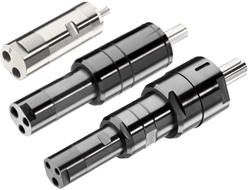
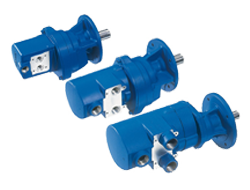
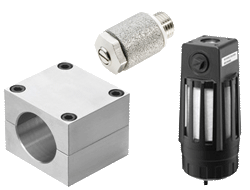
Technical Overview of Mannesmann Demag Compressed Air Motors (up to 1.2 kW / 4.4 kW)
**Compressed air motors** from Mannesmann Demag cover power ranges up to 1.2 kW and up to 4.4 kW in the shop and are designed for robust industrial applications in production, assembly, and maintenance. Typical designs include radial and axial piston motors, turbine motors, and multi-stage vane motors. The motors are available in right-hand rotation, reversible, and with an integrated holding brake for applications requiring precise positioning. Maku also offers suitable **accessories** such as couplings, speed controllers, pressure reducers, and seal kits.Design Features and Materials
Housings and rotor elements are mostly made of grey cast iron, aluminum alloys, or hardened steel variants. Grey cast iron housings offer vibration damping and thermal stability; aluminum housings reduce weight and are suitable for mobile applications. Inner races, connecting rods, and eccentrics are often hardened or surface-coated to minimize wear from abrasive solid ingress and particles in the compressed air network. Rolling bearings and plain bearings can be designed as low-maintenance ball bearings or oil-lubricated plain bearings, depending on the size. Seals typically consist of NBR (nitrile rubber) for general applications, FKM (Viton) for increased temperature and chemical resistance, or PTFE components for extreme wear requirements.Connections, Seals, and Air Preparation
Standard connections are threaded connections according to ISO 228 or ISO 7 (G-thread) as well as cylindrical designs according to ISO 7/1 for air supply. Larger motors often feature flange connections for mounting on the unit. To reduce condensate and particle inclusions, compressed air preparation with a filter-regulator-lubricator combination is recommended. Many Mannesmann Demag motors can be operated with minimal lubrication; however, the use of a finely dosed oil mist extends service life and seal durability. For potentially explosive areas, special ATEX-compliant versions must be checked.Performance and Control Behavior
The motors are characterized by high torque at low speed, linear torque behavior with pressure changes, and high starting torques. Models up to 1.2 kW are suitable for compact drives, rotating tools, and small conveying systems; variants up to 4.4 kW serve larger unit purposes such as conveyor chains, plate drives, or pump drives. Torque and speed can be finely adjusted by pressure regulation, throttling at the inlet, or stepless control valves. When used with a holding brake, the risk of unintentional rotational movements in positioning tasks is reduced.Practical Examples and Applications
**Assembly line with intermittent movement:** A 1.2 kW compressed air motor drives a shaft via an elastomer coupling, which incrementally positions feed slides for assemblies. A pressure control valve limits the maximum speed, and a fine regulator adjusts the starting current. Advantage: high durability for short, frequent uses and simple protection against overheating. **Conveyor technology in dusty environments:** A 4.4 kW multi-stage motor replaces an electric drive. The hardened steel housing with additional dust caps and FKM seals ensures tightness against abrasive particles. Air preparation with water separators reduces corrosion risks, and an oil mist system protects bearings and seals. Result: increased operational safety with reduced fire protection requirements. **Precision positioning and holding function:** A right-hand rotating motor with an integrated holding brake is used for positioning pneumatic clamping devices. The brake allows defined holding forces in case of pressure loss. Combined with a precise pressure reducing valve, repeatable accuracy can be achieved without additional electronics.Selection Criteria: Which Compressed Air Motor is Suitable?
When selecting the appropriate compressed air motor, the operating pressure, desired idle speed, required starting or holding torque, environmental conditions, weight restrictions, and maintenance interval are the decisive parameters. Furthermore, the question of reversibility (change of direction) and whether a holding brake is needed is central for positioning tasks. For applications with high dust or moisture loads, robust sealing systems (FKM, PTFE) and additional protective covers are recommended. Another factor is compatibility with existing connections and the availability of accessories such as couplings, pulleys, or flanges. * Key selection points: operating pressure, torque/speed, design, material/seal, connection type, maintenance requirements, integration of brakes/reversal.Installation, Mounting, and Maintenance
Before mounting, the compressed air network must be flushed and a filter stage installed to exclude particles and condensate. Connection is made via suitable threaded or flange connections; sealing surfaces must be secured with appropriate sealants (PTFE tape or anaerobic sealants, depending on the material). During bearing installation, attention must be paid to observing the manufacturer's specified tightening torques to avoid deformation and imbalance. Regular inspections include checking seals, bearing noises, fastening screws, and air preparation. Recommended intervals depend on operating conditions; shorter intervals should be chosen for dusty applications. Spare parts kits with seals and bearings should be kept in stock to minimize downtime.Compatible Accessories and System Integration
Suitable accessories include pressure regulators, fine control valves, check valves, dirt and fine filters, oil mist lubricators, couplings, motor mounting flanges, and holding brakes. For integration into existing controls, pneumatic switching valves and electrical position sensors are available. Further technical details on system components and additional application examples can be found on our technical page at https://maku-industrie.de/technik and for specific practical applications at https://maku-industrie.de/anwendungsbeispiele.Safety and Normative Requirements
Compressed air motors must be installed and operated in accordance with applicable machinery and pressure equipment directives. For applications with reverse torque or where there is a risk of uncontrolled rotation, holding brakes or mechanical locks must be used. In potentially explosive areas, ATEX certification must be checked. Mechanical protective covers against rotating parts are mandatory. Manufacturer specifications for permissible operating pressure and maximum speed must not be exceeded.Economy and Service Life
Compressed air motors offer advantages in harsh environments due to simple ignition safety, good overload resistance, and lower susceptibility to electrical disturbances. The service life largely depends on air preparation, lubrication, and installation conditions. Measures to extend service life include correct filtration, continuous lubricant supply when needed, and regular maintenance. The availability of spare parts and accessories from Mannesmann Demag ensures predictable maintenance cycles.Contact and Consultation
For the selection of suitable compressed air motors, nominal powers up to 1.2 kW and 4.4 kW, or for adaptation to special operating conditions, please contact our technical consulting. We provide technical data sheets, installation dimensions, and adaptation recommendations, including sealing and connection solutions.Frequently Asked Questions (FAQs)
**1. Which seal types are installed as standard and when are FKM/PTFE seals useful?**NBR seals are standard. FKM seals are useful at higher temperatures or chemical exposure. PTFE is used for extreme abrasion or chemically aggressive media, as it offers high wear resistance and chemical resistance. **2. How does air preparation affect the service life of the compressed air motor?**
Clean, dry, and finely filtered air significantly reduces wear in bearings and seals. A fine-pored filter, water separator, and optionally an oil mist lubricator extend service life and reduce downtime. Without adequate preparation, the risk of corrosion and abrasion increases. **3. Can a compressed air motor be used as a direct replacement for an electric motor?**
In many cases, yes, if torque and speed requirements are met and compressed air of sufficient quality and quantity is available. Mechanical interfaces, flanges, and couplings must be checked and adjusted if necessary. For safety-critical applications, holding brakes or additional interlocks must be considered.