
Hydraulic tube fittings and cutting ring fittings for pipes
With cutting ring fittings and a large number of flare-free fittings, Parker offers a wide range. The requirements of applicable standards are reliably met and exceeded. The excellent sealing properties secure your application. The focus is on leak-free operation and a long service life for your hydraulic connection.
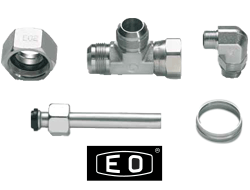
Fittings and Compression Fittings for Tubes: Function, Selection, and Application
Fittings and compression fittings are components for tight, reliable tube connections in compressed air, hydraulic, and process lines. They safely transfer media without welding, threaded fittings, or gluing, and allow for mountable and demountable connections. Crucial factors are the material, sealing system, connection design, and assembly specifications – these determine service life, sealing behavior, and operational safety.
Materials and Corrosion Behavior
Commonly used materials include brass, stainless steel (AISI 316/1.4401), galvanized steel, and aluminum alloys. Brass offers good machinability and tightness for moderate corrosion exposure; stainless steel is mandatory for aggressive media, high temperatures, or hygienic requirements. Galvanized steel is suitable for general industrial applications with limited corrosion exposure. Material selection depends on the medium (water, oil, gas, chemical substances), temperature range, and environmental conditions. For soft water or condensate with a chemical character, stainless steel is often the more economical choice despite higher acquisition costs.
Designs and Connection Variants
Fittings are available as union nuts with plain tube fittings, as compression fittings with a single- or multi-part ring, as flange fittings, as screw-in fittings, and as adapters for metric or imperial threads. Compression fittings work by means of a radial cutting ring that penetrates the outer surface of the tube, thereby creating mechanical holding force and tightness. Variants with a double cutting ring or with a conical inner part increase the holding force for thin-walled tubes or under pulsating loads. Connections can be: metric ISO thread, BSP/G (imperial), NPT (tapered), ORFS (O-Ring Face Seal), or SAE connections. Adapters facilitate integration into existing systems with different standards.
Seals and Sealing Principles
Sealing systems range from metallic seals (positive fit through contact) to elastomeric O-rings and PTFE-coated sealing surfaces. Elastomeric materials such as NBR, FKM (Viton), or EPDM must be selected according to the medium and temperature: NBR for mineral oils, FKM for higher temperatures and aggressive chemicals, EPDM for water systems and vapors without mineral oil. PTFE is suitable when chemical resistance and low friction are required. In high-pressure hydraulics, O-ring-secured fittings are frequently used to ensure a static seal between the connection and the mating surface. For compression fittings, tightness is primarily mechanical but can be supplemented by internal O-rings or combination seals.
Assembly, Tightening Forces, and Leakage Rates
Correct assembly is crucial for permanently tight connections. Compression fittings require a defined tightening torque for the union nut to correctly deform the cutting ring into the tube wall without crushing the tube. Insufficient tightening torque leads to leaks, while excessive torque leads to material deformation or cracking. Manufacturer specifications for tightening torques must be observed. Tube ends must be deburred, perpendicular, and free of damage. For thin-walled or softer tubes, special cutting rings with a larger contact surface should be used. Assembly tools such as torque wrenches, tube alignment devices, and calibration rings increase repeatability and minimize incorrect assembly. Leakage rates should be measurable and documented according to DIN/ISO standards; pressure tests must be carried out before commissioning.
Temperature and Pressure Ranges
Compression and fitting systems are designed for wide pressure ranges: from low-pressure lines to high-pressure hydraulics. Pressure capability depends on tube material, nominal diameter, wall thickness, and the shape of the cutting ring. Temperature resistance is limited by the material and seal; elastomeric seals set the upper temperature limit, while metal fittings mechanically tolerate higher temperatures. Manufacturer's specifications and standards (e.g., ISO, DIN, SAE) are binding for operating limits.
Practical Design and Selection Criteria
Selection is based on the following core criteria:
- Medium (chemical composition, viscosity, purity requirements), temperature and pressure range, tube material and wall thickness, connection standard and thread type, assembly requirements and accessibility, vibration and pulsation, and corrosion and wear requirements.
For safe design, engineers consult material tables, chemical resistance data, and approved operating data. In case of uncertainty, consultation with the manufacturer is always necessary; our technical data sheets and standard comparisons provide guidance and can be viewed under Technik.
Practical Application Examples
Hydraulic unit: In a press system, stainless steel compression fittings connect hydraulic oil lines to the valve block. Tube cross-section and wall thickness are chosen so that the cutting ring penetrates with a defined torque without weakening the tube wall. An additional O-ring in the connection prevents leaks during temperature fluctuations. Pressure tests are carried out and torque values are documented before commissioning.
Process line with corrosive medium: In a galvanizing line, brass fittings are replaced by AISI 316 compression fitting variants. The seals are made of PTFE to minimize deposits and chemical attack. Tube ends are fixed with feed devices to reduce axial loads during operation. During revisions, connections can be separated without heat and reassembled securely after replacing the affected section.
Compressed air distribution in production halls: For modular machines, compression fittings with light aluminum tubes are used to save weight. Double-ring variants ensure holding force on vibrating machines. Assembly is carried out with standardized tightening torques; leak tests are performed as part of machine acceptance.
Maintenance, Testing, and Service Life
Regular visual inspections for corrosion, signs of overheating, and mechanical damage are mandatory. Shorter inspection intervals are provided for dynamically stressed lines. Seals age due to media contact and temperature changes; replacement intervals depend on operating hours, media properties, and test results. In case of repeated disassembly, cutting rings generally need to be replaced, as the cutting edge has been plastically deformed. Documentation of all interventions and test protocols ensures traceability and minimizes downtime.
Safety and Normative Aspects
Fittings must comply with standards and, if applicable, be certified. Relevant standards define material qualities, pressure tests, tolerances, and markings. In safety-critical applications, additional tests such as leak measurement under operating temperature or cyclic life tests are recommended. For hazardous substances or Ex-applications, special approvals are required.
Procurement and Product Integration
When procuring, supplier specifications, material traceability, and availability guarantees must be checked. For retrofit projects, adapter solutions or transition pieces are necessary to connect new fittings with existing threads. Our product pages provide technical drawings, material specifications, and installation guidelines; further application examples can be found under Anwendungsbeispiele.
Conclusion
Precisely specified fittings and compression fittings reduce downtime, ensure tightness, and facilitate assembly and maintenance. Material, sealing concept, connection standard, and assembly parameters are the central decision-making criteria. Documented assembly and regular inspections extend service life and reduce safety risks.
FAQs
1. When is a compression fitting preferable to a union nut?
Compression fittings are preferable when mechanical holding force is required without additional clamping or welding, for demountable lines, or in applications with vibrations. They are particularly suitable for metal tubes with sufficient wall thickness; for thin-walled tubes, special rings or alternative connection techniques should be chosen.
2. How do I know which sealing material I need for my medium?
The selection depends on medium chemistry, temperature range, and pressure: NBR for mineral oil-based media at low to medium temperatures, FKM for high temperatures and aggressive chemicals, EPDM for water and vapor applications without mineral oil, PTFE when chemical resistance and low friction are required. Manufacturer and resistance tables as well as material data sheets are binding for final selection.
3. Do cutting rings always have to be replaced after disassembly?
Yes, in most cases, cutting rings must be replaced after disassembly, as the cutting edge has been plastically deformed and the original shape is lost. Reusing them increases the risk of leakage and failure. For multi-part or reversibly designed systems, manufacturers adhere to specific reusability rules.