
Order low-priced stainless steel grinding spindles by Mannesmann Demag and collets
By using grinding spindles by Mannesmann Demag you can be sure: newest technology, highest reliability and quality gives you decisive advantages in your automation process.We are happy to advise you by phone or e-mail. We help you choosing the ideal grinding spindle for your application. Call us at +49 7151 / 90 395-0 or use our Callback service in the top right corner of the webpage. Or send us an e-mail by using the contact form on contact.
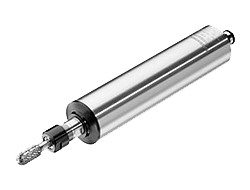
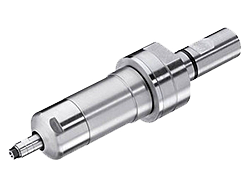
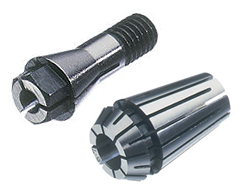
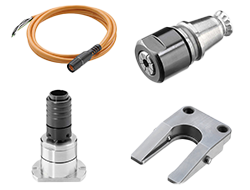
Stainless Steel Grinding Spindles: Precision, Material Expertise, and Durable Design
Stainless steel grinding spindles combine high-quality material selection with precise manufacturing technology to deliver consistent grinding results in CNC machines, robotic cells, and manual applications. Crucial factors include running accuracy, balancing quality, and a design that reliably handles both thermal and mechanical loads. When used in the metalworking industry, corrosion resistance and cleanability are particularly important; here, the choice of stainless steel (typically 1.4301/AISI 304 or 1.4404/AISI 316L) ensures significantly longer service lives compared to unalloyed materials.
Design and Construction Types
Grinding spindles are designed as compact units with an integrated bearing package, shaft end, and receptacle for collets or taper mounts. Typical designs range from air-bearing high-speed spindles and hybrid-bearing variants to robust motor spindles with integrated drives. Important design features include hardened and ground shaft ends, precise housing bores for ball or roller bearings, and media-compatible seals at entry points. For stainless steel spindles, the housing is often made entirely of stainless steel to allow cleaning processes such as blasting or wet cleaning and to prevent contamination.
Materials and Surfaces
For spindle shafts, alloyed stainless steels are frequently used, offering a combination of high strength and good machinability. The inner races of the bearings may require the use of ceramic or hybrid bearings (ceramic rings with steel outer rings) to minimize thermal expansion and friction at high speeds (> 20,000 min⁻¹). Surfaces are precision-ground and, if necessary, electropolished to reduce adhesion areas for abrasion. Sealing surfaces and seating areas for collets are often precision-ground and then lacquered or passivated to minimize surface changes.
Connections, Clamping Systems, and Seals
The interface to the machine is established via defined flanges, HSK or ISO mounts, or customer-specific flange adapters. For the tool clamping system, collets in conical mounts or quick-change systems are common. In terms of sealing technology, multi-stage shaft seals, labyrinth seals, or dynamic O-ring constructions are used, depending on the requirements for media resistance and cleaning processes. For spindles in wet environments or when using coolants, specially selected Viton or FKM seals and corrosion-resistant return springs are required.
Performance, Speed, and Thermal Management
The selection of the right spindle depends on the required torque, nominal speed, and thermal load. High-speed spindles require lower moments of inertia and often ceramic bearings, while powerful grinding spindles with larger diameters transmit higher torques. Heat dissipation occurs via housing cooling, air guidance, or integrated cooling circuits in high-performance applications. For thermally stable machining results, a spindle with constant temperature control should be chosen; this reduces dimensional deviations and increases repeatability.
Application Areas and Material Pairings
Stainless steel grinding spindles are particularly suitable for grinding, deburring, and polishing corrosion-resistant components, precision parts made of stainless steel, as well as for machining aluminum alloys, titanium, and composite materials. For abrasive materials, the use of wear-resistant collets and hardened contact surfaces on the bearing side is recommended. Stainless steel spindles also offer advantages when machining plastic components, especially when cleaning processes or hygienic requirements are present.
Practical Example 1 — Precision Deburring in a CNC Production Cell
A medium-sized parts manufacturer replaces silver-colored motor spindles with stainless steel grinding spindles featuring an integrated air bearing and HSK63 mount. Result: Reduction of residual dirt during post-processing, reduced setup times due to standardized HSK mounts, and longer cleaning intervals due to a smooth, corrosion-resistant housing surface. The spindle operates consistently at 18,000 min⁻¹, enabling micro-post-processing of edges and bore edges with reproducible surface quality. Details on technology and consultation can be found at https://maku-industrie.de/technik.
Practical Example 2 — Integration into a Robotic Cell for Surface Polishing
In a robotic cell, a compact stainless steel motor spindle with an integrated torque sensor is used to polish delicate stainless steel attachments. The spindle allows controlled torque limitation to prevent over-processing of thin-walled components. Seals and smooth housing surfaces facilitate automatic cleaning after each batch change, increasing availability and reducing downtime. Further application examples are documented at https://maku-industrie.de/anwendungsbeispiele.
Selection Criteria and Checkpoints Before Purchase
Before selecting a spindle, the following criteria should be systematically checked:
- Required speed and torque to operate abrasives and process parameters
- Mounting and interface to the machine (HSK, ISO, flange), including play and tolerance requirements
- Environmental conditions: humidity, coolant contact, cleaning cycles
- Bearing and sealing concept for expected service life and maintenance
- Material combinations and required surface roughness of the workpiece
Maintenance, Service, and Spare Parts
Regular inspection of bearing clearance, balancing checks, and monitoring of running noises extend service life and prevent unplanned failures. In case of service, machining and sealing components are available as exchange modules; modularly designed spindles allow quick on-site replacement of the bearing package. When using cooling systems, filters and the coolant circuit should be checked regularly to minimize corrosion and deposit risks. Spare parts and maintenance packages can be configured customer-specifically; discuss selection and conditions with technical consulting.
Safety and Quality Aspects
Precise assembly and proper cooling are prerequisites for safe operating conditions. Safety covers, torque limitation, and vibration monitoring should be integrated to react to anomalies early. Balancing is performed as standard according to ISO 1940; tighter tolerances are recommended for highly dynamic applications. Certifications and material tests (EN, DIN, factory certificates) document the quality of the stainless steel materials used and the manufacturing processes.
Ordering Information and Consultation
When inquiring, please specify the machine type, desired mount, nominal speed, expected torque, and environmental conditions. Based on this information, suitable models, bearing configurations, and sealing packages can be offered. For technical consultation and selection support, contact our team by phone or email; additional technical information and practical examples can be found at https://maku-industrie.de/technik and https://maku-industrie.de/anwendungsbeispiele.
FAQ
1. What advantages do stainless steel grinding spindles offer over steel housings?
Stainless steel housings offer higher corrosion resistance, easier cleaning, and lower contamination risk, which increases service life and process reliability in wet or hygienic environments.
2. Which sealing solutions are suitable for coolant applications?
Multi-stage shaft seals combined with labyrinth seals or dynamic FKM/Viton seals are common; the choice depends on the temperature, pressure, and chemical load of the coolant.
3. How do I determine the right spindle for high speeds and low vibration?
For high speeds, choose spindles with ceramic or hybrid bearings, low moment of inertia, and precise balancing; additionally, controlled cooling and vibration-damping mounting should be provided.