
High quality accessories for Parker Legris installations
Parker Legris offers a comprehensive range of accessories featuring brass, nickel-plated brass or stainless steel components: adaptors, plugs, manifolds and sealing products.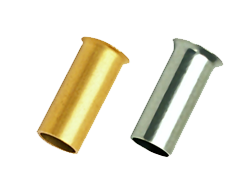
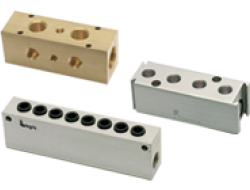
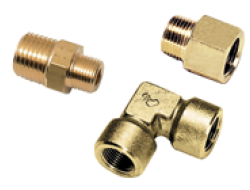
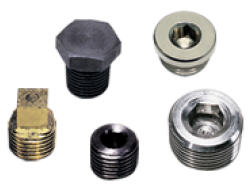

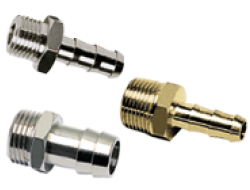
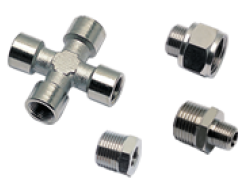
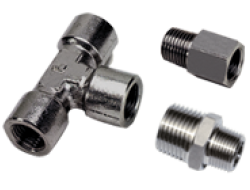
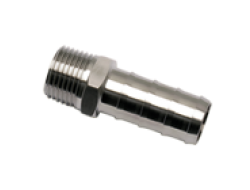
High-Quality Accessories for Parker Legris Installations
This range offers targeted components for compressed air and media-carrying lines with Parker Legris interfaces: fittings and hose barbs made of stainless steel and brass, threaded plugs, seals, and multi-distributors in dimensionally stable designs. The selection is based on practical criteria such as material resistance, leak-tightness under dynamic load, compatibility with metric and BSP/G threads, and ease of installation in confined spaces. Technical specifications are supplemented by information on thread types (M, G, NPT), flow cross-sections, and permissible operating pressures, enabling planners and maintenance personnel to make quick decisions regarding interchangeability or modernization.
Materials and Coatings
Stainless steel components (mostly 1.4404/316L or 1.4301/304) are intended for corrosive environments, elevated temperature stress, and hygienic applications. Brass and nickel-plated brass parts offer economic advantages in moderately chemically stressed environments and are standardly manufactured with fine threads and precise sealing surfaces. Anodized aluminum is used for lightweight manifold blocks and module carriers when weight and electrical insulation play a role. Surface treatments such as galvanizing, passivation, or anodizing improve corrosion protection and sliding behavior for union nuts.
Shapes, Connections, and Sealing Techniques
The range includes straight couplings, 90° and 45° elbows, union fittings, bulkhead fittings for panel feed-throughs, and various nipple types: reducing, enlarging, and double nipples. Thread adapters allow the combination of M to G threads or NPT. Hose barbs are available in conical design for hose collar mounting and in smooth design for hose clamps. For sealing, PTFE discs, NBR, FKM, and EPDM O-rings, as well as flat gaskets made of PTFE composite material, are used; the selection depends on the medium (air, water, oils, aggressive media) and temperature range. Screw connections are supplemented with circlips, spring washers, or self-locking nuts, depending on the requirement, to compensate for vibration influences.
Multi-Distributors, Module Blocks, and Manifold Rails
Manifold rails and module blocks are designed as multi-distributors for the simultaneous supply of several consumers. They are available in welded or bolted construction, with integrated throttling and shut-off options, optional check valves, and measuring ports. Anodized aluminum distributors offer an optimized weight-to-stability ratio, while stainless steel modules provide high corrosion resistance. Typical applications include assembly lines, pneumatic controls in manufacturing, and central compressed air supplies in laboratory or food environments. The connection fields are designed so that Parker Legris push-in and threaded connections fit without additional adapters.
Bulkhead Fittings and Feed-Throughs
Bulkhead fittings enable the sealed routing of lines through housing or control panel bulkheads. Available variants include single- and double-sided designs, with EPDM or FKM sealing profiles for different temperature and chemical resistances. Mechanical fastening is achieved via lock nuts and large contact surfaces to ensure maximum tensile and compressive strength. For electrical or pneumatic combinations, separate guide channels and additional sealing caps are available to prevent contamination.
Connection Compatibility and Installation Tips
For functional Parker Legris installations, precise fit and correct sealing are crucial. For brass and nickel-plated brass fittings, union nuts must be tightened to defined torques to protect threads and sealing surfaces. Stainless steel parts often require higher torques due to lower thread stiffness; the use of thread lockers is recommended in vibration-stressed systems. Hose barbs should be combined with hose clamps or bellows if pressure peaks or axial tensile forces occur. For multi-distributors, the load on each outlet must be dimensioned separately; manifold blocks with integrated shut-off valves facilitate maintenance without shutting down the entire supply.
Standards, Testing, and Maintenance Requirements
Products generally comply with ISO and DIN standards for threads, seals, and material testing. Before commissioning, leak tests according to pressure and temperature cycle protocols should be performed to identify micro-leaks. Maintenance intervals depend on the medium, service life, and environmental influences; critical points are seals, union nuts, and threaded interfaces. Spare part availability and interchangeability must be considered during system planning to minimize downtime.
Practical Examples
Example 1 — Installation of a multi-distributor in the assembly line: An aluminum manifold block is mounted as the main supply. First, the distributor is bolted to the support structure, then Legris push-in fittings are inserted into the modulated outlets. Each outlet line receives a bulkhead fitting on the control panel to route the line through the housing. Before operation, a leak test is performed at 1.5 times the operating pressure; defective seals are replaced with EPDM alternatives if the medium contains water.
Example 2 — Replacement of a corroded brass hose barb in a chemically stressed system: The defective brass hose barb is replaced with a stainless steel 1.4404 hose barb. Before replacement, the line is depressurized and drained. New FKM seals are used to ensure chemical resistance. After assembly, a functional test is performed under normal operating pressure and a visual inspection for signs of corrosion after 72 operating hours.
Example 3 — Installation of bulkhead fittings in control cabinets: For routing several pneumatic lines through a control cabinet bulkhead, bulkhead fittings with EPDM seals are used. The fittings are positioned so that the lines lead into the cable routing without a bending radius. During wiring and assembly, strain reliefs are attached to the hose ends to minimize stress on the bulkhead fitting.
Compatible Products and Further Information
For technical data sheets, dimensional drawings, and installation diagrams, please visit our Technical Page. Application examples and installation descriptions can be found under Application Examples. Our item numbers in the shop are structured so that materials, threads, and sealing variants can be quickly identified; when ordering, please note the specified diameters, thread types, and pressure ratings to ensure compatibility with existing Parker Legris systems.
- Important inspection points before commissioning: Material comparison (stainless steel vs. brass), thread compatibility, suitable sealing materials, tightening torque, leak tests.
FAQs
Which sealing materials are suitable for compressed air and slightly oily media?
NBR (Nitrile) is standard for compressed air and slightly oily media up to moderate temperatures. For higher temperatures or aggressive oils, FKM (Viton) is recommended. PTFE seals offer chemical resistance over a wide temperature range, but with lower resilience than elastomers.
How do I know if I need to use a brass or stainless steel fitting?
Choose stainless steel for contact with corrosive media, saltwater, food environments, or elevated temperature requirements. Brass is sufficient for non-aggressive environments and offers cost advantages. Additionally, check galvanic compatibility with adjacent components to avoid corrosion risks.
Which thread types are compatible with Parker Legris push-in fittings?
Parker Legris products typically work with metric (M) and BSP/G threads. NPT adapters are available for international applications. When replacing, pay attention to the correct sealing type (taper, flange, or O-ring seal) and the appropriate tightening torque to prevent leaks.