
Order hoses and needed accessories for professionals in every usecase online
Straight hoses, coiled hoses, hose kits and accessories by various manufacturers for use with compressed air, hydraulics and fluids.
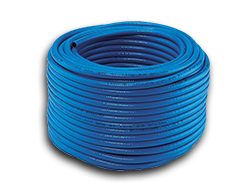
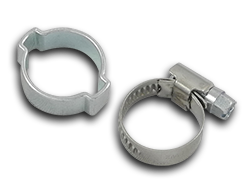
Hoses: Materials, Designs, and Specific Applications
Hoses form the physical connection in fluid systems, performing transport, damping, insulation, and protection. Material properties, design, and connection geometry are crucial. This text explains technical aspects of materials, inner layers, reinforcements, temperature and pressure limits, suitable seals, standards, and practical applications for industrial and manufacturing processes. The goal is to make a clear selection based on the medium, operating conditions, and installation requirements.
Materials and Inner Layers
Elastomers (NBR, EPDM, FKM) are standard for hydraulics, compressed air, and many chemicals. NBR offers good oil resistance, EPDM excels in weather and aging resistance, and FKM (Viton) withstands high temperatures and aggressive media. Thermoplastic elastomers (TPE, TPU) combine flexibility with good abrasion resistance and are suitable for pneumatic applications and conveying systems. PTFE (Teflon) is chemically inert, extremely temperature-resistant, and exhibits very low friction; it is the first choice for corrosive media or in food and pharmaceutical applications, provided the relevant certifications are available.
For multi-layer hoses, a combination of a corrosion-resistant inner layer and a mechanically robust outer sheath is common: a smooth inner layer reduces pressure loss and deposits, a textile or spiral reinforcement provides pressure resistance, and the outer sheath protects against abrasion, ozone, and UV.
Designs and Reinforcement
Hoses are available as smooth-walled, spirally reinforced, braided, or convoluted variants. Braided hoses made of steel or synthetic fibers allow for high operating pressures and flexibility simultaneously. Spiral metal reinforcement increases kink stability in suction hoses. Multi-layer construction principles separate functions: inner hose for media compatibility, reinforcement for pressure, outer jacket for environmental and abrasion protection. This allows operating pressures ranging from a few bar to several hundred bar to be achieved.
Connection Types, Fittings, and Seals
Connections are mechanically at least as relevant as the hose body: pre-assembled ends with crimp sleeves, push-in systems for pneumatics, quick couplings, or flange connections for process technology. The material pairing between the connection and the hose influences tightness and service life. For metallic connections, galvanic effects with different metals must be considered; for plastic connections, temperature resistance is the limiting factor.
Seals must be matched to the medium and temperature. NBR seals are suitable for mineral oils, EPDM for hot water and heat transfer fluids, FKM for aggressive chemicals. For food and pharmaceutical applications, FDA- or EU-No.10/2011-compliant sealing materials are required. For high pressure cycles, elastic seals with low relaxation are preferred to minimize leakage rates.
Temperature and Pressure Range, Service Life
Temperature range and pressure resistance depend on the material, reinforcement, and connection. Elastomer hoses typically operate between -40 °C and +120 °C; special versions with FKM or PTFE reach +200 °C and more. Pneumatic hoses require only low pressure resistance, while hydraulic hoses must reliably absorb cyclic pressure peaks and static continuous pressure values. Service life estimation includes temperature cycles, frequency of pressure changes, mechanical stress from bending and abrasion, and chemical attacks. Systematically documented test cycles and a safety reserve in the design pressure (e.g., a factor of 4 to 5 compared to operating pressure) are industry standard.
Standards, Tests, and Certifications
Relevant standards include DIN EN 853/856 for hydraulics, ISO 2398 for rubber hoses, and various food and medical standards. For potentially explosive atmospheres, ATEX conformity and antistatic designs are relevant. Pressure tests, flow measurements, bending fatigue tests, and leak detection are typical quality checks. Documentation of batches, material certificates, and test certificates increases traceability and allows for tracking in manufacturing processes.
Selection Criteria and Selection Process
Selection begins with process parameters: medium, temperature, operating pressure, pressures during start/stop, environmental conditions (UV, ozone, abrasion), flexibility requirements, and installation geometry. Subsequently, the required connection technology and the need for a pre-assembled solution are determined. For series applications, economic efficiency, availability, and ease of replacement must be considered. For critical applications, short-term and long-term tests under real operating conditions are recommended.
Practical Examples
Hydraulic presses in manufacturing: Multi-layer hydraulic hoses with braided steel reinforcement and NBR inner layer handle working fluids at 160–320 bar. In presses with high welding activity, an outer, abrasion- and heat-resistant sheath is required. For frequent installation and removal, a pre-assembled crimp connection with metric thread and an FKM O-ring seal is recommended to ensure tight connections.
Coolant lines in machine tools: Flexible PTFE versions minimize deposits and provide high chemical resistance to coolants and lubricants at room to medium temperatures. Spiral reinforcement prevents collapse under vacuum during spindle cleaning. For easy connection work, quick couplings with sealing systems that allow the use of plug connections are suitable.
Pneumatic conveying lines in assembly lines: TPU hoses offer low friction and good abrasion resistance for conveying air and solid transport. Push-in fittings made of brass or stainless steel allow for quick assembly. In areas with electrostatic charge, conductive versions should be chosen to prevent sparking.
Chemical dosing in process plants: PTFE- or FKM-lined hoses ensure chemical resistance for acids and alkalis. For precise dosing, hoses with constant inner diameter tolerance and a smooth inner layer are required, as volume flow and pulsation directly influence dosing accuracy.
Further practical examples and application scenarios can be found on our technology page and under application examples: Technology, Application Examples.
Assembly, Installation, and Maintenance
Pre-assembled hoses with crimped ends or plug fittings prevent incorrect connection selection and reduce assembly times. During installation, attention must be paid to bending radius, kink protection, abrasion protection, and free strain relief. Installation errors such as overstretching, sharp edges on clamps, or unsuitable fastening can drastically shorten service life. Regular visual inspections for swelling, cracks, abrasion, and leaks are an integral part of preventive maintenance; for critical applications, non-destructive testing methods and documentation intervals are also used.
Environmental and Safety Aspects
Material selection influences recyclability and emission behavior. PTFE is chemically stable but must be considered in disposal. Elastomers may contain plasticizers; for food contact, appropriately designated products must be chosen. For potentially explosive atmospheres, antistatic hoses and tested connection components are recommended. For hazardous substances, a leakage containment and secondary protective line should be provided.
Economic Efficiency and Supply Chain
Standard dimensions are available at short notice; special hoses with certificates or special fittings require longer lead times. For series production, stocking pre-assembled hoses is worthwhile to avoid downtime costs. In global supply chains, checking alternative suppliers and material equivalence is part of risk management.
Brief Decision Checklist
- Medium, temperature, operating and peak pressures, bending radius, connection system, standard requirements, maintenance interval — make your selection in this order.
FAQ
1. Which hose type is suitable for aggressive chemicals?
PTFE-lined hoses or hoses with an FKM inner layer are the first choice. PTFE offers the best chemical inertness; FKM is a practical alternative at higher temperatures, provided the medium does not attack fluoropolymers.
2. How do I determine the minimum bending radius?
The minimum bending radius results from the hose construction and reinforcement. Manufacturer specifications are binding; as a rule of thumb, never install below the specified minimum radius, as this can lead to kinks and premature material fatigue.
3. When is a pre-assembled solution useful?
For recurring assembly cycles, high safety requirements, or confined installation spaces, pre-assembled hoses with crimp or plug connections are recommended because they reduce assembly errors and ensure defined sealing interfaces.