
Buy highest quality robot deburring spindles by Mannesmann Demag here
The product range offers tailor-made solutions for deburring and fettling of a variety of materials and for many applications. In detail we can offer:• High speed deburring spindles for robots and machine tools
• High speed axial-compliant deburring spindles for robots
• High speed radial-compliant deburring spindles for robots
• brushing motors for robots
• axial-compliant brushing motors for robots
• oscillating filing tools for robots
• radial-compliant filing tools for robots
• chamfering tools for robots
• axial-compliant hole chamfering tools for robots
• angle chamfering tools for robot applications in difficult-to-access areas
• angle grinders and angle brushing motors for robots
The rotation speed range is between 100.000 rpm and 120 rpm.
Besides the classical deburring and grinding spindles the turbine spindles offer an excellent surface quality result at a non-lubricated use of the tool.
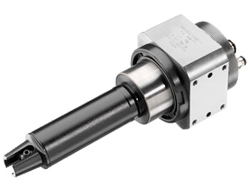
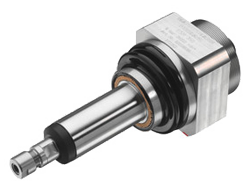

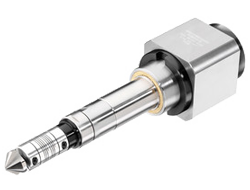
High-Quality Robotic Spindles from Mannesmann Demag — Precision for Deburring, Milling, Brushing, Filing, and Drilling
Robotic spindles from Mannesmann Demag are designed for use in automated manufacturing cells where power, speed stability, and service life are critical for process reliability. Our selection includes air- and water-cooled spindles, various power and design classes, as well as variants with integrated torque measurement and quick couplings, ensuring they precisely match application profiles such as deburring, milling, brushing, filing, and drilling.
Technical Features and Material Selection
Mannesmann Demag robotic spindles typically consist of hardened steel housings with corrosion-resistant coatings or aluminum alloys with anodized coatings for reduced weight in handling applications. Rolling bearings or ceramic bearings, depending on the model, ensure reduced friction and extended service life. Sealing systems use combined radial shaft seals and labyrinth seals to retain lubricants and prevent the ingress of abrasive particles. The choice of materials depends on media contact and thermal requirements: stainless steel (AISI 316) for moist or corrosive environments, high-strength steel alloys for high forces, ceramic bearings in abrasive environments to minimize wear.
Design and Construction Types
Construction types range from compact high-speed spindles with integrated tool holders (HSK or ER taper) to powerful, longer models with flange mounting for robot arms. Variants with pivotable motor integration allow for better mass centering and easier power supply. Some spindles are designed as modular constructions, allowing for cooled headpieces, sensors, or suction connections to be retrofitted. Drive types include brushless EC/BLDC motors for precise speed control, as well as direct drive solutions for minimal breakaway torque and high dynamics.
Connections, Control, and Interfaces
Standard connections consist of M12 connectors for sensor technology, power terminals in IP67-protected housings, and optional Harting connectors for industrial robustness. Electrical interfaces support PWM, analog 0–10 V, 4–20 mA, as well as CANopen or EtherCAT for integration into modern PLC networks. Coolant connections are designed with BSP or G threads, often with quick couplings for tool-free disassembly. For pneumatic connections (suction, compressed air purging), standardized quick couplings (ISO 6150) are used. Torque and speed sensors are either integrated or available as plug-on modules, providing real-time data for process monitoring.
Protection Classes, Seals, and Maintainability
Depending on the application, spindles offer protection classes up to IP67 or IP69K. Sealing combinations of NBR, FKM (Viton), and PTFE are used to cover different chemical and temperature requirements. Replaceable seal kits and modularity in bearing carriers enable easy maintenance and reduce downtime. For abrasive environments, spindles with protective caps and wiper rings are available; for wet machining, additional corrosion protection measures and flushing channels are used to prevent ingress.
Application-Oriented Designs
For deburring tasks, spindles with robust bearing packages, low gear ratios, and high torsional stiffness are ideal, as they require repeatable force application and long service life. For milling on robots, high torques at moderate speeds and coolant connections are crucial to ensure chip removal and thermal management. Brushing and filing often require special mounting forms and variable speed ranges, while drilling demands a combination of axial stiffness, cooling, and chip removal. Mannesmann Demag offers suitable spindle configurations with matched bearing packages and cooling systems for every application.
Practical Examples
Example 1 – Deburring in Series Production: In a zinc die-casting line, an air-cooled robotic spindle with ceramic bearings and an integrated torque meter is mounted. The robot performs path movements along the edges, and the spindle adaptively regulates the speed based on the measured values, keeping the cutting force constant. Result: reduced rework, consistent edge quality, and extended tool life.
Example 2 – Milling of Lightweight Metal Components: A lightweight aluminum housing is machined on a catalog robot with a water-cooled spindle. The spindle uses HSK interchangeable tool holders, an integrated flushing connection, and EtherCAT connectivity for speed monitoring. Active cooling reduces thermal deformation, and a uniform surface finish is achieved.
Example 3 – Brush-Safe Surface Treatment in a Paint Line: In pretreatment, emission residues are removed with brush attachments. A spindle with a dust-tight IP67 design, double labyrinth sealing, and dust-resistant ceramic bearings ensures long maintenance intervals. The spindle can be changed without tools using a quick coupling to minimize downtime during tool changes.
Compatibility with Robot Manufacturers and Mountings
Mannesmann Demag robotic spindles are mechanically and electronically designed for common robot platforms. Flange hole patterns comply with standards of common manufacturers, and control connections can be adapted to robot hollow shafts or external distributors. Mounting formats such as ER taper, HSK, or customized clamping systems are available. Integration also includes force/torque measuring flanges for process monitoring and passive vibration dampers to reduce process resonances.
Selection Criteria for the Right Spindle
Key selection parameters are power requirement (kW), speed range, required torque, cooling type, protection class, weight, and mounting type. Equally important are tool holder, interface to the control system, and desired sensor density for condition monitoring. Also consider environmental conditions such as dust, moisture, chemical exposure, and possible thermal loads to choose the appropriate sealing, bearing design, and material.
- For an initial selection, check: power/torque profile, cooling requirement, protection class, tool holder, as well as desired sensor technology and interfaces.
In case of uncertainty, technical consultation with our application specialists is recommended to ensure optimal coordination between spindle, tool, and robot arm. Further technical details and data sheets can be found on our technology page: maku-industrie.de/technik. Practical examples and application scenarios are documented at maku-industrie.de/anwendungsbeispiele.
Maintenance, Spare Parts, and Service Life Optimization
Planned maintenance reduces unplanned downtimes: replacement of seal kits and bearings after defined operating hours, inspection of cooling channels and filters, and regular calibration of integrated sensors are standard measures. For critical processes, we recommend condition monitoring with vibration and temperature monitoring. Spare parts kits (bearings, seals, chucks) are available as service packages to ensure quick recommissioning. Correct lubrication intervals, clean coolant supply, and avoidance of shock loads extend service life.
Safety and Standards
Our robotic spindles meet industrial safety requirements and are delivered with CE marking. Electrical components comply with common protection classes and EMC requirements. ATEX-compliant versions are available for use in potentially explosive atmospheres. Upon request, we provide documentation for risk analyses and integration documents for the Machinery Directive.
Procurement and Support
For procurement, we provide technical selection assistance, 3D models for robot integration, and test bench trials for process validation. Customer-specific adaptations—from special cooling interfaces to customized mountings—are realized on a project-by-project basis. Contact our consulting team for model selection and application assessment directly via the product portfolio or through our service channels.
FAQ
1. Which cooling type is recommended for milling applications on robots?
For milling on robots, water-cooled spindle technology is generally preferable as it offers thermal stability and enables high power densities. For low power consumption or limited infrastructure, air-cooled spindles are possible, but be aware of reduced service life and potential thermal displacement.
2. How do bearing types affect service life in deburring operations?
Ceramic bearings offer increased abrasion resistance and lower heat generation, which improves service life in abrasive deburring processes. Precision rolling bearings with higher tolerance classes provide better concentricity values but are more sensitive to contamination; additional seals are required here.
3. Which interfaces to the robot control system are available?
Typical interfaces include digital I/O, analog 0–10 V, PWM, as well as fieldbus protocols such as CANopen and EtherCAT. Additionally, we supply optional interface modules for PLC integration and feedback of torque, speed, and temperature for real-time monitoring.