
Spindles for chamfering and drilling by Mannesmann Demag for your robot
Robot deburring spindles for automated chamfering and drilling.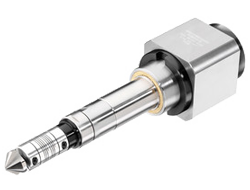
Mannesmann Demag Spindles for Countersinking and Drilling for Your Robot
Robot spindles from Mannesmann Demag are designed for automated countersinking and drilling processes where precision, repeatability, and tool life are paramount. These spindles combine compact designs with high speeds, robust bearings, and well-engineered connection concepts to ensure reproducible drilling patterns and defined countersink depths in demanding manufacturing cells. The goal is integration into industrial robots that cover both single-station and multi-head applications.
Design and Construction Types
Available construction types range from compact direct-drive spindles with short installation lengths to powerful spindles with gear reduction for increased torque. Housing materials are typically hardened die-cast aluminum or ground stainless steel for corrosion-critical applications. The choice of material class influences thermal stability and vibration behavior; aluminum offers good heat transfer with low weight, while steel and stainless steel provide better damping and increased dimensional stability.
Integral tool holder variants include HSK, ISO, or custom collet chucks. For drilling and countersinking tools, ER or DIN standard collets are frequently used, supplemented by quick-clamping systems for automated tool changes. The optional existence of quick-change flanges facilitates mounting on robot flanges and reduces downtime.
Performance, Speed, and Torque
Spindles for countersinking and drilling are available with characteristic curves that cover high speeds (typically 12,000–60,000 rpm) as well as variants with high torque (up to several 100 Nm with gearbox). Selection is based on drilling diameter, material, and process cutting data: high speeds for smaller diameters, lower speeds and higher torque for large holes or difficult-to-machine materials such as cast steel or hardened materials. When designing, the combination of feed rate and cutting speed is crucial to control drilling pressure, tool wear, and heat generation.
Cooling, Seals, and Lubrication
For countersinking and drilling processes, internal central lubrication and coolant supply are usually recommended. Spindles are available as closed systems with labyrinth or O-ring seals, sometimes with additional labyrinth seals against splashing media. For high-performance applications, active water cooling is standard in the housing; thermal stabilization reduces length changes and keeps drilling dimensions within tight tolerances. Caution when using coolants: seal materials (NBR, FKM) and bearing grease must be compatible, otherwise rapid seal and bearing failure is imminent.
Bearings and Runout Accuracy
High-precision spindle bearings combine axial-radial roller bearings with precision-ground ball bearings to absorb cutting forces and tilting moments. The choice of bearing determines runout and axial play; for drilling patterns with tight tolerances, air or hydrostatic bearing solutions are available. Bearing clearance, preload, and lubrication are matched to the expected axial loads and service life dimensioning. Regular inspection of bearing conditions is part of a reliable maintenance plan.
Interfaces, Mounting, and Robotics Integration
Spindles are available with standardized flange dimensions and drilling patterns for robot connection flanges. Electrical interfaces often offer M12 or Harting connectors for power, sensor technology, and feedback. Encoders (incremental or absolute) can be integrated directly into the spindle to enable speed synchronization and condition monitoring. Pneumatic or hydraulic interfaces for internal coolant supply are often implemented as quick couplings. Communication interfaces follow industrial protocols (Profinet, EtherCAT, CANopen) for seamless integration into robot controls and process monitoring systems.
Process Reliability and Monitoring
For reproducible drilling results, integrated sensors for torque, current consumption, and bearing condition are typical. Thresholds and automated shutdown logics prevent tool breakage and machine damage. Condition monitoring can provide vibration-based early warnings, while temperature and pressure sensors secure the coolant supply. On the process side, adaptive control is advantageous: adjustment of feed and speed depending on measured torque minimizes tool wear and optimizes cycle time.
Application Areas and Suitable Materials
Typical applications include weld seam preparation, assembly holes, thread tapping, countersinks, and through-holes in steel, aluminum, non-ferrous metals, cast iron, and fiber-reinforced plastics. For aluminum and soft non-ferrous materials, high cutting speeds with low feed force are used. For hardened or fiber-reinforced composite materials, special coated tools and reduced cutting speeds are necessary. For thin-walled components, spindle stiffness is crucial to avoid deflection and runout.
Practical Examples
Practical Example 1 – Automated Countersinking on Body Parts: A 6-axis robot operates a Mannesmann Demag direct-drive spindle with an integrated ER20 tool holder system. The process chain starts with collision checking, then positioning and approaching the tool with reduced approach speed. Upon entering the sheet metal, the control activates adaptive feed control, which increases the feed based on measured torque until the specified countersink depth is reached. Finally, a short reverse torque is applied for chip removal and a brief coolant flush.
Practical Example 2 – Multi-head Drilling in Cast Housings: Four spindles in an assembly cell are synchronized via EtherCAT. Each spindle is equipped with water cooling and an integrated absolute encoder. The cell sequentially performs drilling operations Ø10–Ø20 mm, monitoring current consumption and predefined load limits. If a limit is exceeded, the process chain stops, an alarm is sent to the control system, and an alternative run plan is activated, resulting in minimal downtime. The spindles are equipped with interchangeable quick-release chucks to accelerate tool changes.
Practical Example 3 – Thread Tapping in Aluminum Profiles: For profile-integrated assemblies, a spindle with internal coolant supply and synchronized feed is used. After pre-drilling, thread cutting is performed at a specified speed and axially controlled feed. The spindle reports flanking vibrations, and the control automatically reduces the pulling force to prevent tool jamming. The result is reproducible thread flanks and reduced rework.
Selection Criteria for the Right Spindle
Crucial for selection are drilling diameter and depth, material, desired cycle time, available space on the robot flange, required interfaces, and cooling concept. For applications with high thermal loads, a water-cooled variant is preferable. If tight roundness tolerances are required, the use of precision bearings or hydrostatic bearings is worthwhile. For high process reliability, integrated sensor technology and protocol capability of the spindle are indispensable.
- Typical selection criteria: design, speed/torque, cooling system, tool holder type, sensor technology, communication interfaces
For further technical documentation, sectional drawings, and specific application examples, please visit our technology page at https://maku-industrie.de/technik and specific application cases at https://maku-industrie.de/anwendungsbeispiele.
Maintenance and Service Life
Regular inspection includes monitoring bearing noise, seal condition, coolant pressure, and wear of the clamping systems. Replacement intervals for bearings and seals depend on the load profile, operating time, and coolant condition. A documented maintenance interval extends service life and prevents unplanned failures. For low downtimes, a replacement concept with spare spindles on hand is recommended to minimize production interruptions.
Safety and Standards
Spindles comply with relevant safety and EMC standards; additional protective measures at the robot station are necessary, especially protection against escaping chips and coolant. On the control side, interlocks and monitoring logics must be implemented. Certifications, protection classes (IP ratings), and explosion-proof variants are available upon request.
FAQ
1. Which spindle should I choose for drilling up to 20 mm in steel sheet?
For drilling up to Ø20 mm in steel sheet, spindles with medium torque (gearless direct drives with ~4–15 Nm or geared variants for larger diameters), integrated coolant supply, ER collet chuck, and robust bearings are recommended; for high production volumes, water cooling is also advisable.
2. How do I integrate the spindle into my robot (interfaces, mounting)?
Check the flange dimensions and drilling pattern of your robot connection, select suitable flange adapters, and use standardized electrical connectors (M12, Harting). Utilize encoder options and EtherCAT/Profinet for real-time integration and implement safety and monitoring functions in the robot control.
3. What maintenance measures are necessary and how long do spindles last on average?
Maintenance includes bearing monitoring, seal inspection, cleaning of cooling systems, and checking of clamping systems; replacement intervals vary greatly, typically inspections every 3–6 months are advisable, bearing replacement after operating hours depending on load profile (often between 5,000–20,000 h). Proactive bearing stocking and documented maintenance plans minimize downtime.