
Buy highest quality robot deburring spindles by Mannesmann Demag here
The product range offers tailor-made solutions for deburring and fettling of a variety of materials and for many applications. In detail we can offer:• High speed deburring spindles for robots and machine tools
• High speed axial-compliant deburring spindles for robots
• High speed radial-compliant deburring spindles for robots
• brushing motors for robots
• axial-compliant brushing motors for robots
• oscillating filing tools for robots
• radial-compliant filing tools for robots
• chamfering tools for robots
• axial-compliant hole chamfering tools for robots
• angle chamfering tools for robot applications in difficult-to-access areas
• angle grinders and angle brushing motors for robots
The rotation speed range is between 100.000 rpm and 120 rpm.
Besides the classical deburring and grinding spindles the turbine spindles offer an excellent surface quality result at a non-lubricated use of the tool.
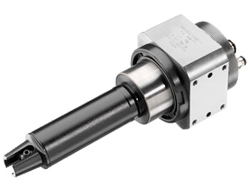
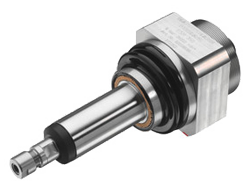

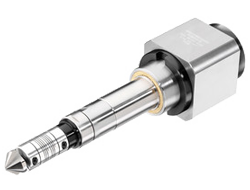
Technical Overview of Robot Spindles from Mannesmann Demag
Robot spindles from Mannesmann Demag are precise, high-performance tools for automated machining processes such as deburring, milling, brushing, filing, and drilling. The design of these spindles is engineered for continuous availability, easy integration into robot arms, and reproducible machining quality. Key characteristics include torque, no-load speed, power consumption, size, bearing concept, and connection variants. For industrial applications, construction from high-strength alloys, precision-ground shafts, and mostly ceramic or hybrid-sealed bearings determine service life and process stability.
Materials and Manufacturing Quality
Housings made of aluminum-silicon alloys or forged steel combine weight advantages with vibration damping. Moving parts are mostly made of hardened tool steel or stainless case-hardened steel to minimize wear and corrosion. Seals use fluorinated elastomers (e.g., FKM) or PTFE seating systems for elevated temperatures and aggressive media. Bearings are often designed as tapered precision ball bearings or as sealed cylindrical roller bearings for high axial and radial loads. Mannesmann Demag relies on tight manufacturing tolerances and dynamically balanced rotors for its spindles to reduce vibrations and increase tool life.
Design and Construction Types
Robot spindles are available in various designs: compact direct drives for confined spaces, longer versions with integrated gearboxes for high torque at low speeds, and modular variants with interchangeable adapter plates for quick retooling. Interfaces are standardized according to robot manufacturer standards or as custom flanges. The spindle taper can include HSK, ISO, ER collet systems, or special quick-release chucks. Cooling options range from air cooling to internal cooling and external liquid coolers; the choice influences thermal stability and thus runout accuracy.
Connections, Control, and Integration
Electrical connections follow industrial standards: M12 connectors for sensors and motor control are common, as are larger multi-pin connectors for power. Wiring is typically shielded and vibration-proof. The interface to the robot controller is via Profibus, EtherCAT, or CANopen, depending on requirements. Spindle controls offer speed regulation, torque limitation, torque monitoring, and teaching functions for tool changes. For applications with tool or temperature monitoring, additional analog interfaces or IO-Link connections are available. Integration into existing control architectures often requires parameter files; Mannesmann Demag provides documentation and characteristic curves for quick calibration.
Sealing, Protection Classes, and Maintainability
Depending on the operating environment, protection classes up to IP65 or higher are available, including additional protective covers against splash water, grinding dust, and coolants. Sealing systems combine axially arranged labyrinth seals with elastomer lips for dynamic protection. Maintenance is performed using interchangeable seal kits and service kits for bearing replacement; ideally, the design allows for quick replacement of the rotor unit without a complete spindle replacement. For high-availability environments, service contracts and spare spindles are recommended.
Fields of Application and Process Integration
Robot spindles are used where reproducible surface quality, high cycle rates, and process stability are required. Typical manufacturing fields include metal deburring after stamping, laser, or waterjet processes, post-processing of welded body components, fine milling of aluminum components, brushing for surface preparation, and inline drilling in assembly processes. The spindles enable both 3-axis and 6-axis machining on industrial robots. Process parameters such as peripheral speed, infeed, and feed rate are crucial for tool life and manufacturing quality; these parameters are stored in the robot application as axis path profiles and force limitations.
Practical Examples
In an assembly cell for post-processing body panels, a compact direct-drive robot spindle is used to remove burrs from edges in a single pass. The spindle operates at a defined speed of 18,000 rpm and with an adapted HSK-E 10 milling cutter holder to achieve minimal vibration and uniform edge radii. Internal cooling keeps the cutting edge stable and reduces cycle time. In the production of aluminum die-cast parts, a longer spindle with an integrated gearbox is used to maintain a precise milling path at low speed and high torque; the bearings are additionally equipped with thermal compensation elements to ensure dimensional accuracy. In a deburring cell for welded steel frames, a spindle with a brush holder and reinforced sealing (FKM + labyrinth) is used; the spindle is designed as a CIP-capable unit, allowing regular cleaning without damaging seals.
Selection Criteria and Specifications
The selection of the correct robot spindle depends on several technical parameters. Important criteria include the required speed ranges, necessary torque, design and weight for the robot load, tool holder type, protection class against environmental influences, cooling requirements, and the mechanical interface to the robot. Additionally, service life specifications for bearings and seals, as well as the availability of spare parts, are crucial for overall equipment effectiveness.
- Recommended inspection points before purchase: load case analysis, vibration analysis, installation dimensions, interface documentation, available control protocols.
Integration into the Production Line and Commissioning
For successful commissioning, precise mechanical measurement, electrical wiring according to the circuit diagram, and an adjustment protocol for running accuracy and vibration behavior are necessary. Parameterized torque and speed safeguards must be stored in both the spindle control and the robot control to prevent tool breakage or component damage. Calibration runs with measurement routines document process capability and serve as the basis for zero-point and quality data. For complex tasks, we offer support in simulating path profiles and tool paths to minimize cutting forces and vibrations.
Documentation, Standards, and Tests
Mannesmann Demag provides test protocols for runout, balancing, and electrical insulation testing. Spindle tests according to ISO standards (e.g., ISO 1940 for balancing, ISO 14649 for interface data) are available. For compliance with occupational safety requirements, protective devices and emergency shutdowns according to the Machinery Directive should also be considered. Compatibility information for robot manufacturers and certificates for electromagnetic compatibility (EMC) are part of the delivery documentation.
Further Information and Consultation
For technical questions regarding selection, integration, maintenance, and spare parts supply, please refer to our technical pages and practical examples: Technology and Application Examples. For model selection, information on robot payload, installation dimensions, material of the components to be machined, and desired cycle times is necessary for us to provide a well-founded recommendation.
FAQs
1. How do I choose the right speed and torque for my application?
Choose the speed based on the material and tool cutting diameter; for deburring steel, use higher feed rates at moderate speeds, for aluminum, higher cutting speeds with lower feed force. The required torque is derived from cutting force, tool radius, and safety reserve; ensure that the spindle can deliver the maximum torque at critical speed.
2. What are the typical maintenance intervals for Mannesmann Demag robot spindles?
Maintenance intervals depend on operating conditions: for clean, dry processes, inspections every 6–12 months are common; for heavily contaminated or wet environments, quarterly. Replacement of seal kits and bearing inspections according to the manufacturer's operating hour specifications or upon noticeable running noises are recommended.
3. What connection and control options are available, and how is robot integration performed?
Common options include M12 connectors, industrial-grade multi-pin connectors, and communication interfaces such as EtherCAT, Profibus, or CANopen. Integration is performed via provided parameter files, electrical connection diagram, and calibration protocol; if necessary, we support the configuration of the spindle control and the mapping of control commands to the robot control.