
Legris push-in connectors for many practical applications
Push-in fittings allow fast circuit assembly for conveying compressed air, gas or liquids at a wide range of pressures and temperatures. Connection and disconnection is immediate and manual.
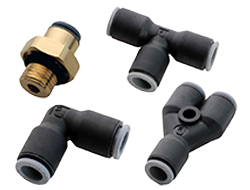


Legris Push-in Fittings for Many Practical Applications
Legris push-in fittings offer a quick, tool-free connection for tubing in pneumatic, vacuum, and fluid systems. They are designed to minimize assembly and service activities: insert the tube, the seal grips, and the lock engages. This reduces downtime, simplifies inventory management, and makes the components robust against repeated disassembly. For industrial users, reliability is paramount in addition to speed: Legris push-in fittings provide consistent sealing, reproducible connection strength, and are differentiated by targeted material selection according to operating conditions.
Materials and Components: Selection Based on Load and Medium
The material range of Legris push-in fittings covers typical industrial requirements. Polymer variants made from bio-based or technical plastics offer corrosion resistance, chemical resistance to many media, and low weight. Metal versions are available in chemically nickel-plated brass, nickel-plated brass, and AISI 316L stainless steel; these metal types provide the necessary mechanical strength, thermal stability, and higher resistance in aggressive environments. For media-critical applications, such as food or pharmaceutical production, AISI 316L is recommended due to its corrosion resistance and cleanability.
Sealing systems are crucial for push-in fittings: NBR seals are standard for compressed air and neutral liquids, while FKM (Viton) covers higher temperature ranges and aggressive media. The correct selection prevents swelling, embrittlement, or chemical attacks that could otherwise cause leaks. For special media analyses, compatibility tests are necessary; Legris seals are often available as replacement parts.
Designs and Connection Variants
Legris offers push-in fittings in various designs: threaded fittings for direct system mounting, bulkhead fittings for through-panel mounting, modular multi-distributors for compact distribution systems, and swivel fittings for movable or adjustable tubing routes. For applications with frequent changes in direction or vibrations, swivel fittings and modular swivel fittings are useful because they relieve mechanical stress from the tube connection and ensure long-term sealing.
Connection sizes and tube compatibility range from micro-tubing to larger diameters for liquids. Connectors are manufactured for standard tube inner dimensions and guarantee defined retention forces. Dimensional accuracy of tube inner and outer diameters, as well as material hardness, influence retention force and sealing; it is recommended to use tube types approved by the manufacturer for push-in fittings.
Surfaces, Coatings, and Corrosion Protection
Specially nickel-plated brass versions and chemically nickel-plated brass types increase corrosion resistance in humid or slightly aggressive environments. Surface coatings reduce friction during insertion and protect against contact corrosion in multi-material systems. Stainless steel variants prevent galvanic effects against aggressive media and are the first choice when cleaning chemicals, salts, or chloride-containing media are present.
Functional Details and Assembly Behavior
The functionality is based on a gripping ring plus a seal. Upon insertion, the gripping ring is mechanically activated, the seal is compressed, and the tubing is fixed without tools. Disassembly is performed by pushing or pulling a release ring, depending on the design; in some models, the tube cannot be opened under pressure, which increases occupational safety. Legris modules offer standardized plug-in dimensions, ensuring interchangeability and expandability in the field.
Practical Examples
Example 1 — Compressed Air Supply in an Assembly Cell: In a manufacturing cell, Legris push-in fittings made of nickel-plated brass are used for main air lines. Threaded fittings connect the manifold plate to modular multi-distributors, and swivel fittings supply air to pneumatic grippers. The seals are NBR for standard compressed air; assembly times decreased by 40% because tube changes are tool-free. For cleanroom parts, FKM seals are used on the grippers to prevent contamination from seal abrasion.
Example 2 — Coolant Lines in Machine Tools: For coolant circuits, push-in fittings made of bio-based polymer are used to avoid galvanic reactions with aluminum components. The polymer fittings are resistant to glycol-containing coolants; modular multi-distributors allow compact distribution to multiple nozzles. Maintenance is facilitated by blanked bulkhead fittings, which allow flexible retrofitting without system downtime.
Example 3 — Fluid Dosing in Laboratory Automation: In a laboratory automation subsystem, Legris connectors made of AISI 316L connect dosing pumps to consumption containers. FKM seals ensure chemical resistance to solvents. The connectors are autoclavable during cleaning cycles; modular distributors enable quick system configurations for changing experimental setups. Documented leak tests are included as testing steps in the SOPs.
Further specific application examples and industry solutions can be found at Application Examples and technical information at Technology.
Dimensioning, Pressure, and Temperature Ranges
Dimensioning is based on operating pressure, temperature, and medium. Legris push-in fittings cover common industrial pressure ranges up to specific high-pressure versions; exact values are model-dependent. For higher operating temperatures, FKM seals and metal housings are recommended. For vacuum applications, special versions with optimized O-ring profiles are suitable. Before selection, tests for pressure surges, cyclic loading, and temperature changes must be considered.
Safety, Assembly Control, and Quality Assurance
Control points in assembly include correct tube length, insertion depth, and the presence of the correct seal. A visual insertion stop or markings on the tube facilitate verification. When used in safety-relevant applications, double fixation or an additional safety clamp is recommended. Regular leak tests, especially after maintenance, are part of quality assurance and minimize process risks.
Compatibility and Spare Parts
Legris push-in fittings are compatible with standard tube types and many accessories such as fittings, adapters, and blanking plugs. Replacement seals are available for all common materials. In retrofit projects, modular distributors allow the replacement of individual segments without redesigning the entire tubing system.
Selection Note: Always choose material, seal, and design based on process requirements: medium chemistry, temperature, pressure, mechanical load, and cleaning cycles. If several criteria interact, technical approval by the specialist department is recommended.
Frequently Asked Questions (FAQs)
- Which seal is best suited for compressed air? NBR seals are standard for compressed air; for higher temperatures or aggressive media, FKM is recommended.
- When should I choose AISI 316L stainless steel? When corrosion resistance, cleanability, or contact with aggressive media are required.
- How do I correctly check the assembly? Check insertion depth, pull the tube with a defined force, and perform a leak test under operating pressure.