
General Information on Mannesmann-Demag Products
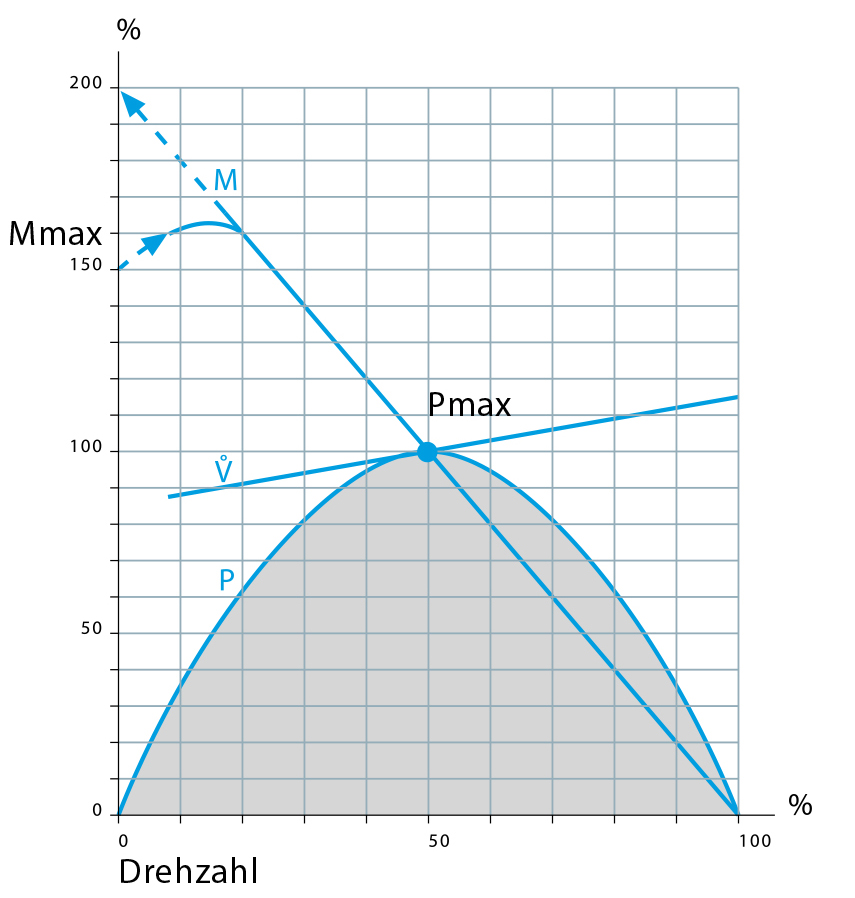
Depending on the application, various performance data of a motor may be relevant. For classic applications such as transporting, lowering, positioning, or stirring, the load speed and the associated load torque are crucial. An economically sensible solution is to select the motor based on this data. The load speed and load torque, also called nominal speed or nominal torque, are achieved when the motor is loaded to approx. 50 percent. Here, the motor reaches its maximum power ($\text{Pmax}$). This power value is achieved at approx. 50 percent of the motor's no-load speed. This corresponds to the peak of the curve. If the motor is loaded further, the speed continues to drop and the torque reaches its max. value ($\text{Mmax}$) shortly before the motor stalls (cf. Fig. 1).
V Air Consumption
P Power
Operating Pressure: 6 bar
M (Load Torque) = 14 Nm
n (Load Speed) = 260 min-1
P (Power) = 380 W
Operating Pressure: 3 bar
M (Load Torque) = 7 Nm
n (Load Speed) = 195 min-1
P (Power) = 142 W
For brushing or drilling applications, the no-load speed is decisive. The pneumatic motor must be designed accordingly based on brush diameter, weight or drill bit diameter, material, and other characteristics.
For screwing applications, the max. torque must be taken into account when closing, while the starting torque must be considered when opening.
If the pneumatic motor is to be operated outside its specific load speed and load torque (data based on 6.3 bar operating pressure), it can be throttled either via the inlet air or the exhaust air. Two different procedures for adjusting the motor are described below.
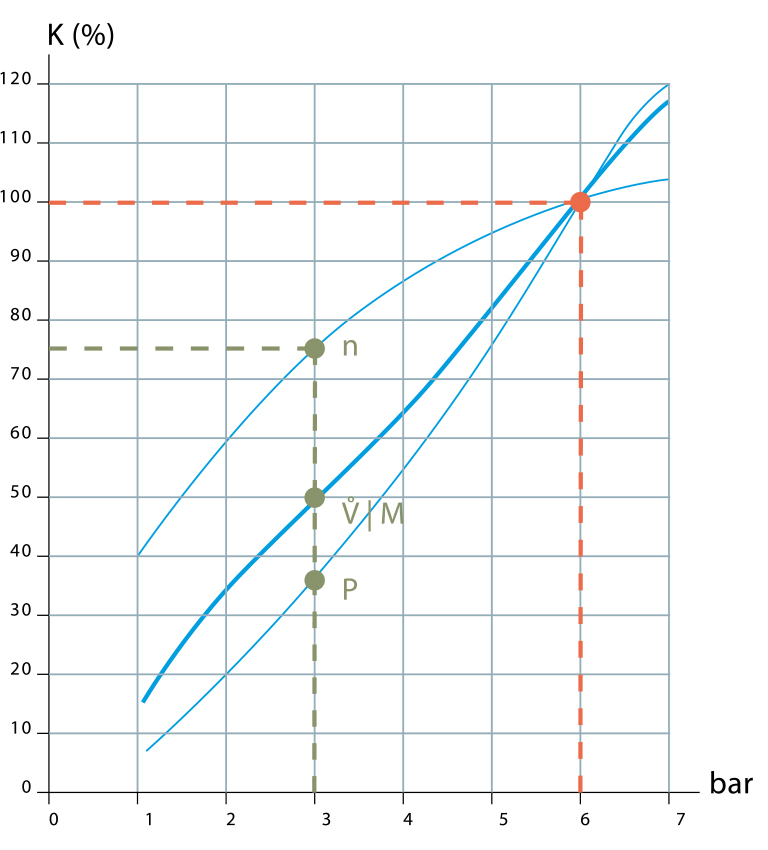
Pneumatic motors can be easily reduced in power via an inlet air throttle or by reducing the operating pressure. This is particularly important when a high duty cycle of the motor is required. Operating a motor at, for example, 3 bar is significantly less wear-intensive than at 6 bar operating pressure. However, since the power or the torque is also reduced when the pressure is reduced, a more powerful motor is chosen to compensate for this. Especially in oil-free operation, this power adjustment can significantly extend the service life (cf. Fig. 2).
Speed control can fundamentally be done via the inlet air as well as the exhaust air. If you want to control the speed without a strong drop in power, the motor should be controlled via the exhaust air. Here, the speed can be reduced by up to 50 percent. We recommend installing speed throttles to enable easy control.