
Are you looking for Ermeto fittings? Order now from maku or inquire

The Parker Ermeto hydraulic tube fittings and cutting ring fittings cover a wide range in industrial tubing. The cutting ring technology is developed since decades and secures your application with perfect sealing. Longetivity is a main point in its focus.
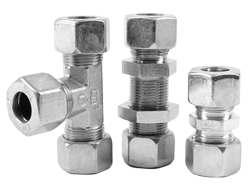
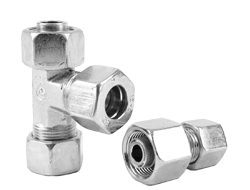
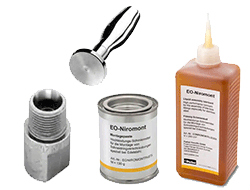
Ermeto Fittings: Technical Facts, Materials, and Practical Applications
Ermeto fittings are suitable connection elements for pressurized pipelines and conduits in the manufacturing and process industries. They combine a compact design with high leak-tightness and reusability. On this category page, you will find customizable fittings and connection parts for steel and stainless steel pipes, as well as brass variants. Differences between types such as EO and EO2 primarily concern the design of the union nut, the number of sealing levels, and the application areas regarding pressure and temperature loads.
Materials and Surfaces
Ermeto fittings are predominantly available in forged steel, stainless steel, and brass. Forged steel provides economical solutions for high pressure loads and is often galvanized or passivated to improve corrosion protection and electrical conductivity. Stainless steel variants, mostly made of austenitic stainless steel, offer corrosion resistance in aggressive environments and for food or pharmaceutical applications. Brass is used at lower pressures and in applications with good corrosion conditions. Surface treatments such as galvanic zinc plating, nickel coating, or passivation influence service life and friction coefficients and must be considered when selecting based on medium and environment.
Designs, Threads, and Connection Types
The product-typical differences between EO and EO2 variants concern the position and shape of the sealing surfaces, as well as compatibility with pipe dimensions. Standard connections include metric pipe ends, BSP/G (cylindrical pipe thread), BSPT/R (tapered pipe thread), and NPT for export-oriented applications. For pressure-tight connections, rolled or cut pipe ends are used. Ermeto systems often utilize a cutting ring or compression ring principle: the cutting ring cuts into the pipe profile, creating a force-fit seal without additional gaskets. Alternatively, variants with flat sealing surfaces and O-ring seals are available if media- or temperature-related requirements necessitate an elastic seal.
Sealing Principles and Media Compatibility
Fittings of the Ermeto family use mechanical sealing by cutting ring, form-fit metal-to-metal contacts, or elastic sealing elements such as PTFE discs and NBR/FKM O-rings. Cutting ring connections offer high leak safety under static and cyclic loads, but are dependent on the material and wall thickness of the pipe. Elastic seals compensate for tolerances and vibrations but are temperature- and media-dependent. PTFE is resistant to many aggressive chemicals, while NBR is well-suited for mineral oils, and FKM is used for high temperatures and aggressive media. Check the chemical compatibility of the seal with the operating fluid before choosing the appropriate variant.
Assembly and Tightening Torques
Proper assembly is crucial for long-term function and leak-tightness. Pipe ends must be deburred, at right angles, and free of deformation. Place the fitting onto the pipe, tighten the union nut hand-tight, and then complete the defined final tightening turn with a wrench. For many cutting ring fittings, the rule of thumb is: hand-tight + 1 to 1.25 turns with a wrench; for cutting rings used multiple times, a re-check may be necessary. For safety-relevant applications, manufacturer-specified tightening torques and tables are binding; use the table to select nut size, pipe diameter, and tightening torque. Incorrectly tightened connections lead to leaks or overstretching of the pipe material.
Quality Criteria and Testing
Essential quality features include dimensional accuracy of the sealing surfaces, surface roughness, material strength, and the precision of the cutting rings. Before commissioning, leak tests with defined test pressure cycles and test media must be carried out. Visual inspection of the contact surface and re-checking of torques after initial commissioning increase operational safety. In critical applications, non-destructive material testing and traceability through batch numbers are recommended.
Application Areas and Industry Specifics
Ermeto fittings are used in hydraulic and pneumatic systems, cooling circuits, lubrication oil systems, compressed air networks, measurement and control technology, and supply lines for manufacturing machines. In the food and pharmaceutical industries, stainless steel variants with suitable seals are preferred. In the oil and gas industry and mechanical engineering, versions with increased strength and special surface treatment for corrosion protection are in demand. When selecting, consider material pairing, temperature range, pressure profile, and possible vibrations from machine operation.
Practical Examples
Practical Example 1 — Hydraulic supply for a workbench: In a manufacturing cell, a central hydraulic supply was implemented using Ermeto EO fittings. 10 mm outer diameter steel pipes were connected to valve islands with cutting ring fittings. Before assembly, pipe ends were deburred and checked with a 0.1 mm tolerance. Connections were tightened hand-tight, then re-tightened with a defined torque. After 72 hours of operation, a leak test was performed at operating pressure; no leaks were detected.
Practical Example 2 — Cooling system in a machine tool: For cooling with coolant lubricant, a stainless steel piping network with Ermeto EO2 components was used. Due to aggressive coolants, FKM O-rings were used in combination with stainless steel fittings. Here, connections in critical areas were marked with thread-locking paint and checked for re-tightening at scheduled intervals to prevent loosening due to vibrations. The use led to stable temperatures and reduced maintenance frequency.
Practical Example 3 — Measuring line for pressure monitoring: In an inline measurement setup, thin-walled pipes were connected to pressure transducers with precision Ermeto fittings. Due to the small wall thickness, special cutting rings were used to ensure damage-free sealing. The pipes were prepared with special pipe clamps to avoid torsion during tightening. The measurement signals remained stable and reproducible.
- Checklist before assembly: Right-angle pipe cut, deburring, suitable cutting ring/seal selection, hand-tightening + defined torque re-tightening, leak test.
Selection Criteria and Specifications
Select fittings according to pipe outer diameter and wall thickness, medium, operating pressure, operating temperature, and required corrosion resistance. Pay attention to compatible thread types and installation dimensions, as well as material pairing to avoid galvanic corrosion. For safety-relevant systems, document test protocols and used component batches. Use manufacturer data sheets for pressure-temperature curves and specific tightening torques. Further technical information and application examples can be found on our technology page: https://maku-industrie.de/technik and for practical applications: https://maku-industrie.de/anwendungsbeispiele.
Compatibility with Pipe Systems and Accessories
Ermeto fittings can be modularly combined with intermediate pieces, elbows, T-pieces, hose adapters, and measuring fittings. When combining, pay attention to geometric tolerances and alignments to avoid stress in the pipeline. Supplementary accessories such as pipe clamps, pipe clips, and decoupling dampers reduce vibration transmission and extend the service life of the connections.
Maintenance and Service Life
Regular visual inspections and periodic leak tests extend the service life of the system. Cutting rings can often be reused, but replacement after several assembly cycles is often recommended, especially for thin-walled pipes or aggressive media. In case of leaks, first check the tightening torque, seal type, and pipe condition. Document every change to the piping system to ensure a traceable service history.
Standards and Certifications
Choose components that comply with relevant standards, especially for pressurized systems and material testing. Conformity to ISO, DIN, or EN standards is a prerequisite in many industries. For safety-critical applications, additional certifications and test reports must be requested.
FAQ
Which pipe materials are compatible with Ermeto fittings?
Typically steel, stainless steel, and brass. The selection depends on pressure, medium, and corrosion requirements. Thin-walled pipes require special cutting rings; for aggressive media, stainless steel and suitable elastic seals such as FKM or PTFE are recommended.
How do I correctly assemble a cutting ring fitting?
Cut the pipe at a right angle and deburr, slide on the fitting, tighten hand-tight, and then re-tighten with a defined wrench (observe manufacturer specifications, common practice: hand-tight + approx. 1–1.25 turns). Check and document; for critical applications, use manufacturer instructions and tightening torques.
When must the cutting ring or seal be replaced?
In case of visible damage, after several assembly cycles, or if leaks occur. For thin-walled pipes or aggressive media, a preventive replacement at defined maintenance intervals is advisable. Documentation and regular inspection dates increase operational safety.