
Order high quality balancers and spring balancers online

Spring balancer MBD-01
Spring balancer MBD-03
Spring balancer MBD-05

Spring Balancer TW-3
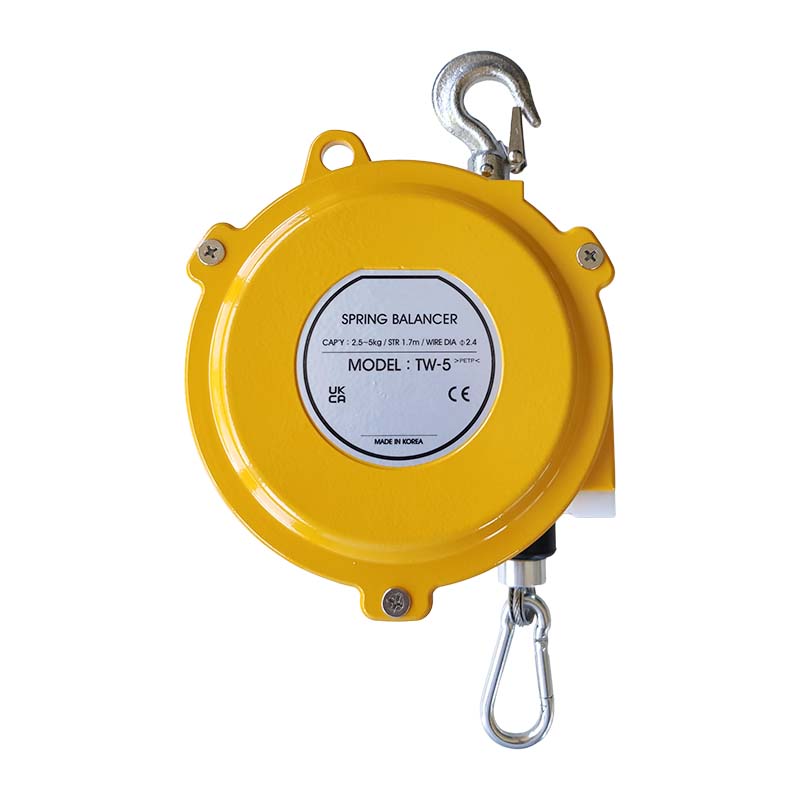
Spring Balancer TW-5

Spring balancer 77001401

Spring Balancer 77000586

Spring Balancer TW-00

Spring Balancer TW-9

Spring Balancer TW-15

Spring Balancer TW-40

Spring Balancer TW-50

Spring Balancer TW-70

Spring balancer BL-3B

Spring balancer BL-5C
Spring balancer BL-7C
Spring balancer BL-10C

Spring Balancer BM-5B
Spring Balancer BM-9B
Spring Balancer BM-14B
Spring Balancer BM-18B
Spring Balancer BM-23B
Spring Balancer BM-30B

Spring balancer 77001300
Spring Balancers & Balancers: Functional Principle, Designs, and Industrial Application
Spring balancers and balancers are mechanical handling devices that compensate for weight forces and hold tools or components in a defined position. They reduce muscle fatigue, increase process speed, and improve occupational safety on assembly lines, test benches, and manual workstations. In industry, balancers are preferred when a constant return force is required over a defined stroke; spring balancers are used where simple, compact return mechanisms suffice.
Core Components and Materials
A balancer typically consists of a housing, a spiral spring or spring package, a cable or chain guide, a damping element, and an end connection (carabiner, hook, or quick coupling). Housing materials are often die-cast aluminum for weight advantage and corrosion resistance, galvanized steel for robust applications, and stainless steel (AISI 304/316) for humid or chemically exposed environments. The cables are made of galvanized steel, stainless steel cable, or high-strength synthetic fibers (e.g., Dyneema) for low return friction and high abrasion resistance. Seals and guides use wear-resistant plastics such as PTFE or POM, as well as NBR or FKM seals for resistance to oils and low chemical exposure.
Spring balancers often use steel wire spirals or flat springs, which are heat-treated for temperature and fatigue resistance. For explosive atmospheres, springs and housings are available in antistatic and ESD-safe versions. Bolts, axles, and bearing bushes should be designed to be wear- and corrosion-resistant; bearings made of bronze-coated bushes or hardened steel bearings extend service life under high cycle counts.
Designs and Connection Variants
Spring balancers and balancers are available in several designs: compact inline models for confined installation situations, swivel versions for accommodating lateral load vectors, adjustable stroke limits, and models with integrated brakes or damping for gentle load deceleration. End connections are standardized as quick-release hooks, swivel hooks to prevent wire rope twisting, threaded bolts, or special tool couplings. For flexible production concepts, balancers with quick-change mechanisms or mounting plates with standard hole patterns for direct machine attachment are available.
Performance Criteria and Selection
Selection depends on payload, lifting height, desired return characteristic, and operating environment. Important parameters include nominal pulling force, maximum stroke, end stop damping, and positioning accuracy. For electrical and fine assembly, balancers with minimal cable play and precise return force are essential. For rough assembly or welding stations, corrosion-resistant, heat-resistant versions with increased abrasion protection are preferred.
Weather and chemical resistance must be considered during selection: NBR seals are suitable for general industrial applications, FKM seals for high temperature and oil loads; PTFE guides offer the lowest friction coefficients in chemical exposure. For food or pharmaceutical applications, food-grade materials and hygienically appropriate surfaces are also available.
Connection and Mounting Tips
Mounting points must be statically designed to absorb the maximum pulling force plus a safety factor. For rotating tools, a swivel hook is recommended to prevent cable twisting. Pay attention to the correct axis direction: balancers should be mounted so that the cable acts perpendicular to the load to minimize lateral loads on guides. Regular visual inspection of the cable, guides, and seals, as well as a documented maintenance interval overview, increase operational safety and service life.
Practical Examples – Structured Applications
Assembly line for electric motors: On an assembly line for equipping electric motors, balancers with 5–15 kg balancing force are installed. The balancers ensure that screwdrivers and manual testing tools remain in an ergonomic position and are easy to grasp during use. The models used have a cable length of 1.5 m, swivel hooks to prevent torsion, and integrated fine adjustment of the tension force, so that for different tool weights, only the spring preload needs to be adjusted. Mounting points are attached to the hall truss with a standard hole pattern; tensile loads are documented by means of a tensile test report.
Welding station with heat exposure: In welding cells, spring balancers made of heat-resistant stainless steel and PTFE guides are used. The seals are FKM-based to tolerate sparks and elevated ambient temperatures. Additionally, models with thermal insulation and a separate cable guide bracket are installed to ensure protection against heat radiation. The spring balancers are dimensioned to hold welded fixtures in position without significant influence.
Quality control / testing machines: On test benches for repeatable force or torque tests, balancers are used for precise positioning of sensor arms. Here, versions with minimal cable play, integrated detent tracking, and high-precision return force are used. Mounting is done directly on the machine guide via a riser plate; additional damping ensures smooth movement when returning to the zero position.
Further practical application examples and industry-specific scenarios can be found at Application Examples.
Maintenance, Safety, and Testing Criteria
Maintenance includes visual inspection of the cable and connections, functional testing of the return force, and replacement of worn seals and guides. Testing criteria should cover the tensile strength of the cable, the spring force within tolerance ranges, and play at the end stop. Documented test intervals, a maintenance record, and the use of original spare parts reduce failures. Safety-relevant installations require a safety factor of at least 2 against the maximum operating load and regular safety checks by qualified personnel.
Standards and Certifications
For industrial balancers, machine directives and partly the requirements of the German Industrial Safety Ordinance (BetrSichV) for lifting accessories apply. Materials and seals should be selected according to relevant standards (e.g., DIN, EN). For use in explosive atmospheres, ATEX certifications/compliant versions are required. Food or pharmaceutical applications often require conformity to hygienic standards and documented material test reports.
When to use a Spring Balancer, when a Balancer?
Spring balancers are compact, cost-effective, and ideal for simple return tasks without precise positioning requirements. Balancers are the choice for ergonomic assembly stations where constant support over a defined stroke, gentle damping, and safe load guidance are required. Decisive factors are load weight, stroke requirement, environmental conditions, and frequency of manipulation.
Further Technical Resources
Technical details on materials, seals, and typical connection variants can be found in our Technical Overview: Technology. There we provide material recommendations, care instructions, and mounting guides.
FAQs
- How do I choose the right pulling force? Determine the weight of the tool plus a 10–20% safety reserve; choose a balancer whose adjustable force range covers this weight and where the desired working point is in the middle of the adjustment range.
- What maintenance intervals are appropriate? Visual inspection and functional check monthly for high usage; semi-annual detailed inspection and lubrication of guides; annual load and tensile test documented according to internal maintenance specifications.
- Can I use balancers in corrosive environments? Yes. Choose stainless steel housing and cable, PTFE or POM guides, and FKM seals; for aggressive media, special coatings and material-certified versions are necessary.