
Order Parker Legris pneumatic function fittings
Parker Legris function fittings (flow control regulators, piloted function fittings, non-return valves, … ) allow you to exert even greater control over your installations. Compact, reliable and easy to install, these fittings can be used in various applications, including: food and beverage, in-plant automotive, printing, textile and water treatment industries, ...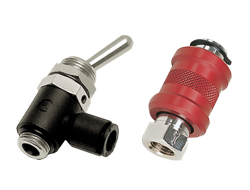


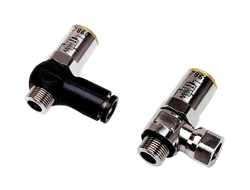


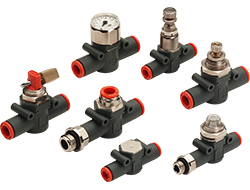
Product Overview: Parker Legris Pneumatic Function Fittings
This category includes Parker Legris function fittings for pneumatic control and supply lines: check valves, exhaust/drain valves, adjustable throttle valves (flow regulators), silencers (exhaust mufflers), and specialized fitting and connection components. Legris stands for modular, easy-to-assemble products made of metal and technical plastics. The components are designed for compressed air, vacuum, and inert gases in manufacturing and process automation.
Product Groups and Functional Principles
Check Valves
Check valves prevent media flow in the reverse direction. Legris check valves are designed mechanically (spring, ball/seat) or with a diaphragm. Typical designs: inline seat valve (straight line), screw-in valve with external thread, push-in connection variants. Materials: nickel-plated brass, stainless steel (AISI 316L), and technical plastic (polyamide PA, POM) for low weight and corrosion resistance. Seals: NBR for standard air, FKM (Viton) for increased temperature and oil resistance, EPDM for steam and aggressive media. Applications: preventing backflow of compressed air in sections, protection of contactors and cylinders, preventing condensate backflow in piping systems.
Exhaust Valves / Drain Valves
Exhaust valves are used for targeted pressure relief or venting of cylinder-side cavities and control circuits. Designs range from manual drain valves (rotary knob, push button) to pneumatically actuated quick exhaust valves (3/2-way modules, screw-in versions). Materials: brass, aluminum, PA; seals usually NBR/PU. Key characteristics: fast response time, low leakage rates, release volume in l/min. Typical applications: pneumatic cylinder end position venting, safety venting of hydraulic blockages, pre-venting of control cabinets.
Throttle Valves / Flow Regulators
Throttle valves control the flow rate and thus the cylinder speed. Variants: adjustable throttle-check valves (combination throttle-check), adjustable throttles with integrated check function, simple regulating throttles (one-way), and finely adjustable micrometer slides. Connection types: push-in for hoses Ø4–16 mm, screw-in threads G/NPT, and hose connection with clamp. Materials: aluminum body with precise adjustment screw, brass, PA versions for budget solutions. Adjustment ranges: from coarse reduction to fine-tuned adjustment for precise cylinder speed. Notes: Always mount throttles in the correct flow direction (at the back for throttle-check valves), the check function prevents reverse adjustment of the throttle.
Silencers / Exhaust Mufflers
Silencers reduce exhaust noise from valves, cylinders, or control circuits. Legris offers porous metal, sintered bronze, and plastic silencers. Materials: sintered bronze for high temperature/pressure resistance, stainless steels for corrosive environments, PA/ABS for economical applications. Key characteristics: decibel reduction (depending on type 10–30 dB), maximum operating pressures up to 16 bar, operating temperatures depending on material (PA typically −20 °C to +80 °C, metal up to +200 °C). Designs: cylindrical, conical, threaded connection G1/8 to G1/2, push-in variants for direct mounting on valves. Application: noise reduction on valve pipes, particle filtration from exhaust air, prevention of contamination in cleanroom-adjacent areas (metallic filters with additional H3 filter stage).
Fittings and Connection Technology
Legris offers a wide range of connection elements: push-in fittings (straight, T-shape, L-shape), compression fittings for copper and stainless steel pipes, threaded adapters (G/BSP, NPT, M-metric), quick couplings, and special variants with venting function. Sealing concepts range from O-rings (NBR/FKM/EPDM) to metallic sealing surfaces and conical threads with PTFE tape or sealant. Pipe diameters: common nominal sizes 4, 6, 8, 10, 12, 16 mm; for metric/imperial threads up to 1/2". Operating pressure: standard up to 16 bar, high-pressure special variants up to 40 bar available. Materials: nickel-plated brass for good corrosion properties, stainless steel for food/chemical processes, PA/POM for weight advantage and electrical insulation.
Material Selection and Sealing Technology
The choice of material determines service life, chemical resistance, and temperature range. Important material-seal combinations:
- Polyamide (PA 6.6) + NBR: Standard combination for compressed air, cost-efficient, temperature range typically −20 °C to +80 °C, good abrasion resistance.
- Nickel-plated brass (CuZn) + NBR/FKM: Universal for industry, good mechanical load capacity; FKM for oil contact or high temperatures up to +150 °C.
- Stainless steel (AISI 316L) + FKM/EPDM: Corrosive environments, food technology; EPDM for steam/hot water resistance.
- Technical plastics (POM, PTFE) + PTFE O-ring: Very low friction, chemically inert, low temperature resistance for PA alternatives.
Selection criteria for seals: media compatibility, temperature, pressure pulses, dynamic vs. static application, abrasion by particles. For frequent plug cycles, O-ring profiles with high abrasion resistance (NBR with additional PTFE coating) are preferred.
Connection Types, Dimensions, and Standards
Common connection types for Legris function fittings:
- Push-in (quick connect) for polyurethane (PU), polyamide (PA) hoses. Common nominal diameters: Ø4, 6, 8, 10, 12, 16 mm. Advantage: quick tool-free assembly, tight connection through clamping ring and O-ring.
- Threaded connections: BSPP/G (parallel), BSPT/NPT (conical), metric internal/external threads (M5, M7, M10 etc.) for direct integration into valve blocks. Seals: sealing ring, PTFE tape, or form-fitting seal for internal cone.
- Compression fitting for metallic pipes: pipe clamp with cutting ring or compression ring, suitable for stainless steel or copper pipes, pressure-resistant and vibration-proof.
- Quick couplings: pluggable connections for frequent disconnections, optionally with self-sealing and locking mechanisms.
Standards and guidelines: Products usually meet requirements according to ISO 4414 (safety in pneumatic systems), ISO 8573 (compressed air quality) and generally comply with RoHS. Material certificates and conformity declarations are available; special certifications (ATEX, FDA, NSF) available upon request.
Technical Parameters and Selection Criteria
Essential parameters for comparison and design:
- Operating pressure: Standard 0–16 bar; short-term pressure peaks must be considered. For special areas: high-pressure variants up to 40 bar.
- Temperature range: depends on material and seal; PA: −20 to +80 °C, brass/FKM: −20 to +150 °C, stainless steel: −40 to +200 °C.
- Flow rate (Kv/Cv): Indication in l/min or m3/h or Cv; important for selecting throttles and check valves. Legris specifies specific Kv values for each type; for short cycle times, choose a larger Kv to minimize pressure losses.
- Leakage rate: According to ISO 15848/ISO 5208 relevant for certain applications; for pneumatic components typically < 0.01 ln/min (depending on the product).
- Response time: Relevant for exhaust valves and check functions; express versions offer millisecond range for fast switching.
Selection process: First determine operating pressure and medium, then temperature range and chemical compatibility, connection and dimensions, finally flow requirement (Kv) and response behavior. For assembly and maintenance, pay attention to standardized connection types to minimize tool and process costs.
Applications and Industries
Parker Legris function fittings are used in the following areas:
- Mechanical engineering and automation: cylinder control, switching valve periphery, overflow lines.
- Manufacturing industry: packaging machines, injection molding tools, conveying technology.
- Food and pharmaceutical industry: stainless steel versions and FDA-compliant seals for process air.
- Automotive manufacturing and assembly lines: vibration-resistant fittings, quick disconnection via quick coupling.
- Medical technology and laboratory automation: low dead volume, residue-free materials, special cleaning processes possible.
Assembly Instructions and Installation
General recommendations for correct assembly and operational safety:
- Before assembly: Deburr pipe end, check for foreign bodies, use appropriate pipe length and chamfers.
- Push-in fittings: Insert hose completely until it stops; perform pull-out test. For reused hoses, check cut surface and replace if necessary.
- Threaded connections: For conical threads, use PTFE tape or liquid sealant evenly and sparingly; observe torques to avoid deformation of sealing surfaces.
- Throttle valves: Observe adjustment direction (arrow marking). For throttle-check valves, ensure the check side is correctly mounted.
- Silencers: Ensure free exhaust possibility; in contaminated environments, regular inspection and cleaning or replacement of sintered elements.
- Leak test: After commissioning, pressure test for leaks (soap solution, ultrasonic detector, or pressure drop measurement); helium mass spectrometry possible for critical applications.
Maintenance, Cleaning, and Material Wear
Maintenance intervals depend on environment and cycle numbers. Recommendations:
- Visual inspection monthly for high usage: seals, body damage, contamination.
- Silencers: replace or backwash depending on contamination; sintered bronze can be desoldered/blown out, plastic filters replaced.
- Check valves: Check spring and seat areas for abrasion; for dust exposure, add filters up/downstream.
- Seals: replace if leakage level increases; recommendation: keep a spare parts kit with O-ring assortment in stock.
- Cleaning: For food/pharma, treat stainless steel components with suitable cleaning/disinfecting agents; check plastic components for compatibility.
Safety Aspects and System Integration
Safety-relevant points for selection and application:
- Pressure relief before maintenance: Depressurize systems, ensure cylinders are secured.
- Temperature changes: Consider thermal expansion at plastic/metal transitions; use flexible connections to avoid stress.
- Moisture management: Condensate separation and filters before components prevent corrosion and cavitation in valve seats.
- Vibration protection: Use retaining rings or pre-assembled locking rings for clamp/push-in fittings.
- Inline monitoring: Plan pressure and flow measurements at critical points to detect leaks early.
Procurement, Variants, and Configuration Notes
Legris offers modular system solutions: standard components are immediately available, special versions by material, seal, or connection dimension can be configured. Ordering information:
- Article codes usually distinguish material, connection, diameter, and seal (e.g., LGR-CKV-G1/4-6-NBR for check valve G1/4 to hose Ø6 mm with NBR seal).
- Special requests: stainless steel materials, special coatings, FDA-compliant seals, customer-specific packing inserts.
- Delivery times: Standard items within a few days; special parts depending on design 2–6 weeks.
- Pricing: Tiered pricing for large quantities, customization affects price due to additional processes (certificates, material traceability).
Typical Sources of Error and Troubleshooting
Problem causes and countermeasures:
- Leaks at push-in: Hose not fully inserted, damaged hose, contaminated clamping ring. Countermeasure: shorten hose, reinsert, check sealing ring.
- Reduced flow: incorrect throttle direction, contaminated filter/sieve, incorrectly sized throttle. Countermeasure: check flow direction, clean, adjust Kv size.
- Check valve does not prevent backflow: spring breakage, seat wear, particles between ball and seat. Countermeasure: replace component, provide filter.
- Silencer clogged: exhaust air contains moisture/particles. Countermeasure: install condensate drain, replace or clean silencer.
Practical Examples
Example 1 — Packaging line: Use of throttle-check valves (push-in Ø6 mm) on gripping cylinders for speed control; check valves for holding during cycle changes; silencers on exhaust ports for noise reduction.
Example 2 — Food processing: Stainless steel check valves with EPDM seals, hygienic design, regular cleaning in CIP process, quick disassembly via compression fittings.
Example 3 — Manufacturing with high cycle rates: Metallic throttles with micrometer adjustment for precise speed control, reinforced springs in check valves to prevent backflow during pressure surges.
Technical Documentation and Support
Technical data sheets (TDS), installation instructions, CAD models (STEP/IGES), and material certificates are available for each product. For design questions, we recommend load case analysis: pressure, temperature, cycle frequency, medium, environmental conditions. For special applications, application engineers support with selection, pressure drop calculation, and service life estimation.
Search Engine Optimization (SEO) — Relevant Keywords
For category optimization, relevant search terms are: Parker Legris function fittings, Legris check valve, pneumatic throttle valve, Legris exhaust valve, pneumatic silencer, Legris push-in fitting, Legris G1/8 check valve, brass/PA pneumatic fitting, Legris stainless steel fitting, pneumatic flow control. Content should include technical parameters, application examples, and material information to cover long-tail search queries.
Concluding Remark
Parker Legris function fittings offer material- and form-specific solutions for precise control, protection, and venting in pneumatic systems. Selection is based on pressure, temperature, medium, connection type, and flow requirement. Standard components accelerate assembly; special versions ensure long-term process stability in demanding environments.
FAQs
- What connection sizes are available for Legris function fittings?
- Common nominal sizes: hose OD Ø4, 6, 8, 10, 12, 16 mm; threads: G/BSPP, NPT, M-metric (e.g., M5, M10) up to 1/2". Special connection variants available upon request.
- Which seals are suitable for oil-containing compressed air?
- For oil-containing media, FKM (Viton) or special NBR compounds are recommended; EPDM is not oil-resistant. Check material compatibility with lubricants.
- How often should silencers be changed or cleaned?
- Interval depends on particle load and humidity. In dust-free environments, check every 6–12 months; clean/replace immediately if visibly clogged or pressure loss occurs. Sintered metal types can be cleaned depending on contamination.