Parker Check Valves for Flow Control
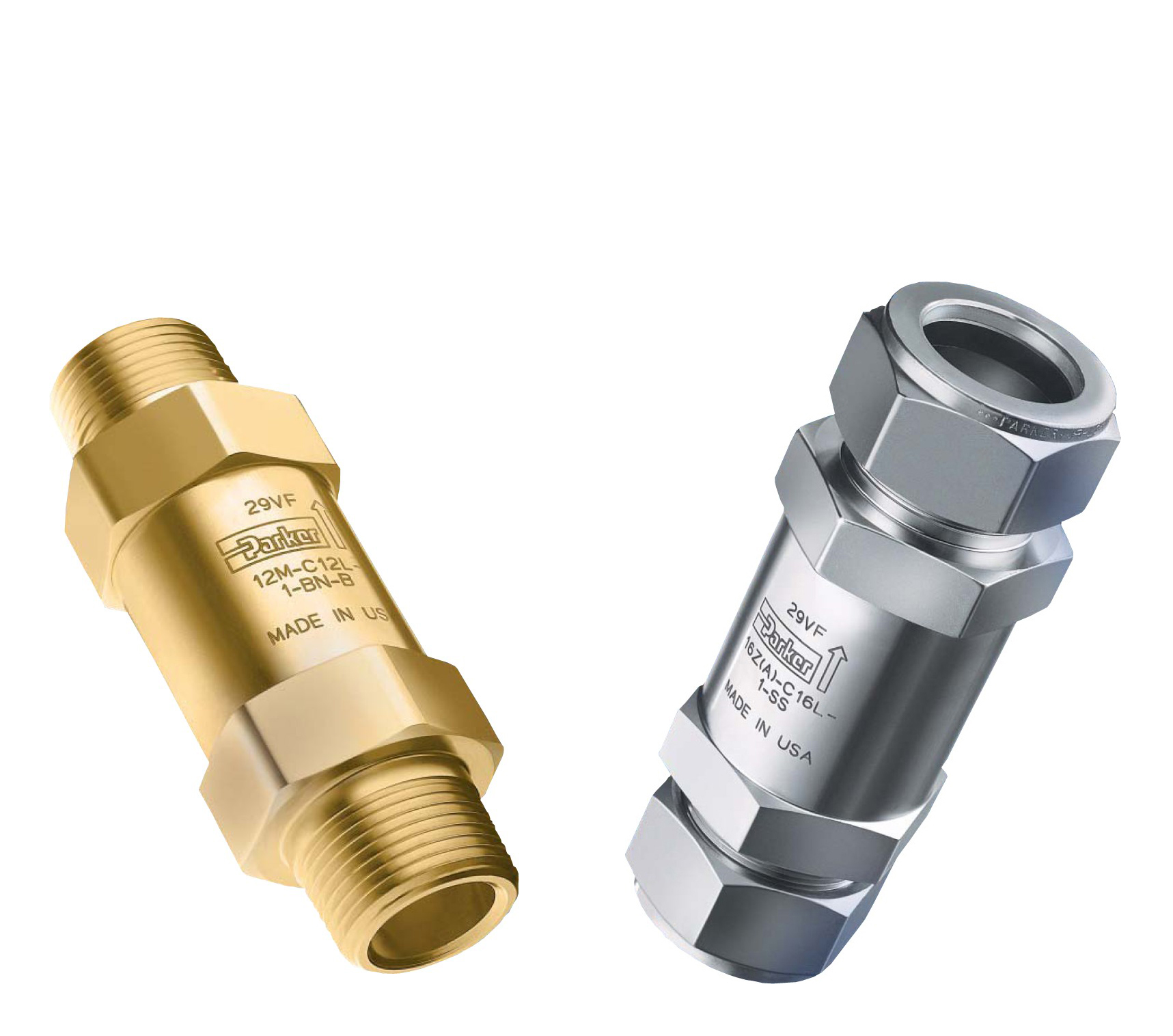
The Parker Series C check valves are designed for the flow control of fluids and gases in one direction. Application areas include the chemical process industry, oil and gas production and transport, the pharmaceutical industry, the paper and pulp industry, and energy supply companies.
The solid block construction is for the defined flow of gases and liquids in only one flow direction. A wide selection of valves made of stainless steel and brass is available here. For applications that require a good seal and reliable re-closure.
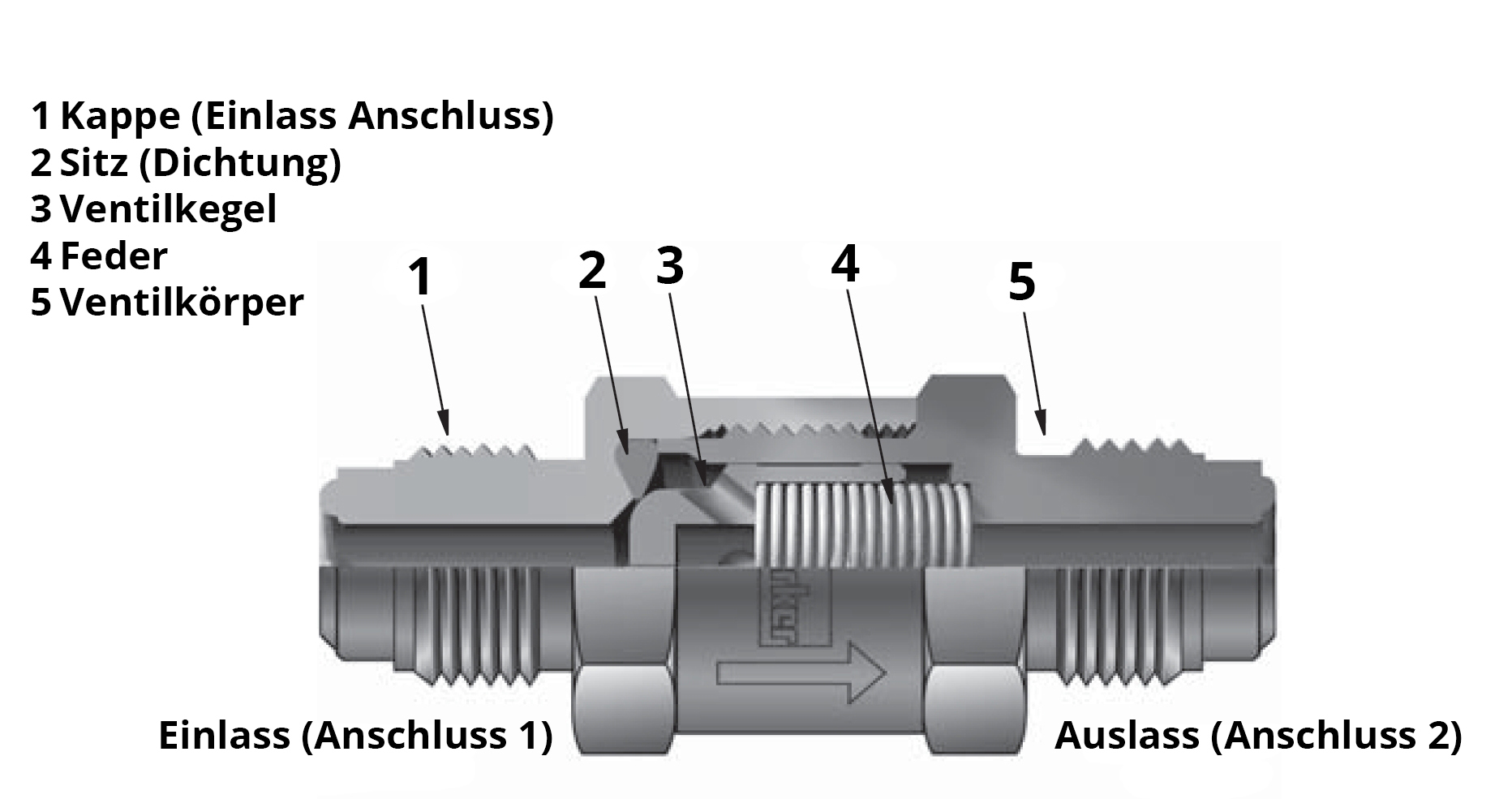
Parker check valves have a straight-through design to keep pressure loss as low as possible, and a piston design with a stop to prevent spring over-stress. The piston and the elastic O-ring seat design guarantee a leak-proof seal with maximum flow performance, and the elastic O-ring seal prevents leaks under high flow conditions.
Vorteile und Eigenschaften:
- resilient, specially shaped, blow-out proof seats
- rear poppet stop minimizes spring load
- 100 percent factory tested for cracking and reseal pressure
- Cracking pressures: 1/3, 1, 5, 10, 25, 50, 75, and 100 psi
- Connections: NPT female and male thread, CPI™, A-LOK®, UltraSeal, VacuSeal, BSP, SAE, and Seal-Lok®
- HCT (Heat code traceability)
Öffnungs- und Schließverhalten:
BCP stands for "Below Cracking Pressure" (unter Öffnungsdruck). Cracking pressure is defined as the inlet pressure at which a detectable flow is measured. Reseal pressure is defined as the outlet pressure at which the check valve closes bubble-tight.
Beispiel:
For a valve with a spring whose nominal cracking pressure is 25 psi (1.72 bar), the actual cracking pressure is between 20 and 30 psi (1.38 and 2.07 bar). The reseal pressure range in this case is between 16 and 20 psi (1.10 and 1.38 bar). Check valves with a nominal cracking pressure of 3 psi (0.21 bar) or less require a back pressure of up to 4 psi (0.28 bar) to close bubble-tight.