
Accessories for Mannesmann Demag grinding spindles with pneumatic or electric drive
Optional and required accessories for Mannesmann Demag spindles.
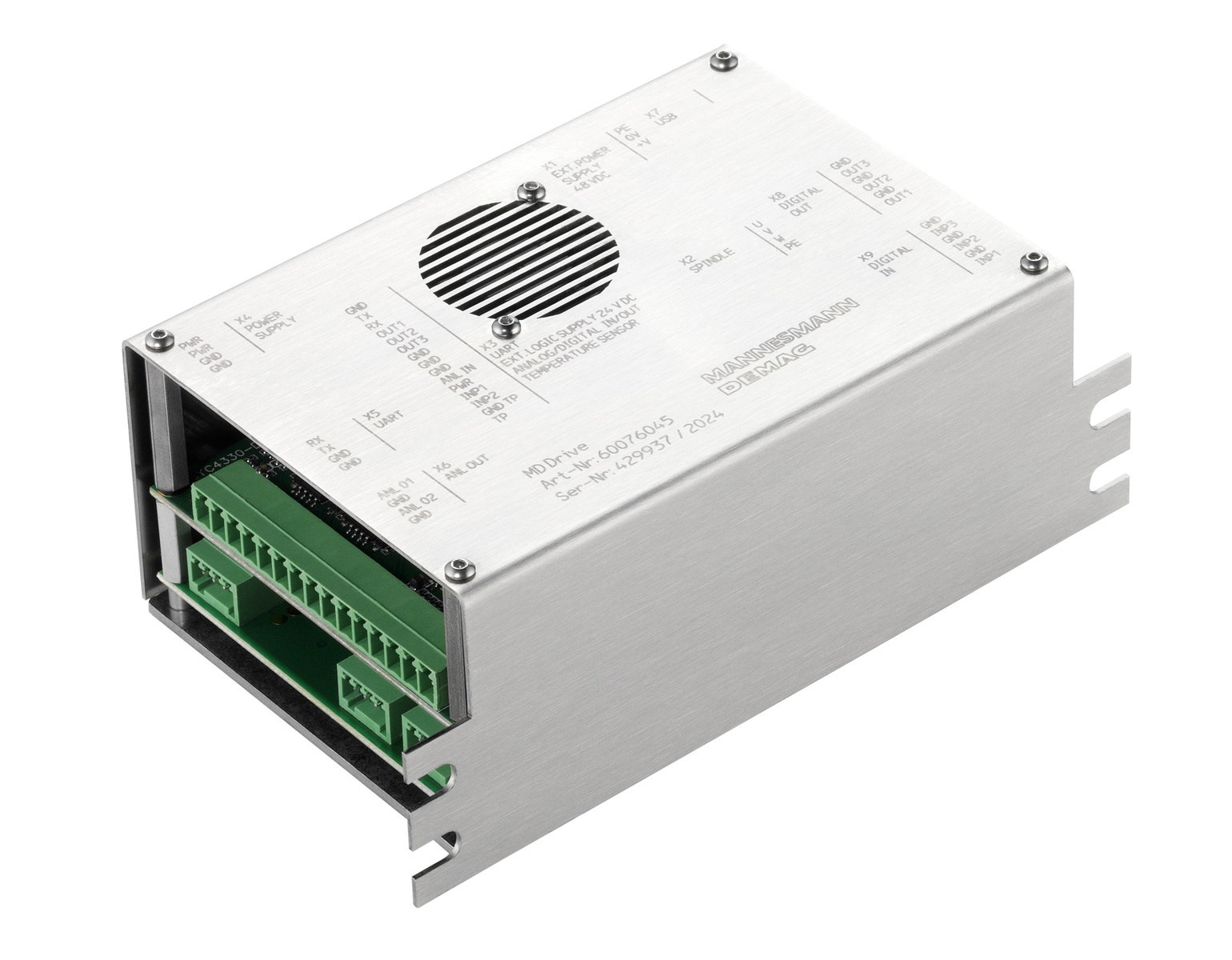
MD Drive Frequency converter for BME 80-4500 WS
Price on request


MD Drive Frequency converter for BME 40-6500 WS | BME 40-6500 B
Price on request

Accessories for Grinding Spindles — Precision, Sealing, and Interfaces: Controlled Selection
Appropriate accessories for grinding spindles determine process stability, surface quality, and availability of your grinding machines. Crucial factors include materials, designs, connections, and sealing concepts, as they directly influence power transmission, coolant-lubricant guidance, maintenance intervals, and vibration behavior. This text provides clear guidance on the selection, integration, and practical application of collets, chucks, sealing systems, coolant-lubricant connections, bearing modules, and temperature monitoring, supplemented by concrete practical examples and notes on compatibility testing.
Material Selection and Surface Requirements
Select accessory materials based on stress and environment: For rotating precision parts such as chucks and collets, hardened tool steels with inductive surface hardening or martensitic chromium steels are standard, as they minimize wear and runout errors. Corrosion-resistant applications, for example with emulsions or hydrogen peroxide-containing coolant-lubricants, require stainless steels (AISI 316 / 1.4401) or high-strength duplex alloys. Reduced-friction mantle surfaces often utilize micro-undulating honing or PVD/nitriding coatings to lower initial friction and frictional heat. For seals and shaft seals, elastomers such as NBR, FKM (Viton), or EPDM should be compared: NBR offers good oil resistance, FKM high temperature and chemical resistance, EPDM excellence for glycol and steam applications. Selection criteria include temperature range, media compatibility, and abrasion resistance.
Designs and Geometric Requirements
The shape of the accessory determines mounting effort and balancing behavior. Precision chucks are available in single-part or multi-part designs; fully enclosed chucks minimize coolant-lubricant ingress into the shaft center, while multi-part versions allow flexible jaw adjustment. Collets and clamping sleeves must meet runout and tolerance classes (e.g., H7, h6) and be dynamically balanced at high speeds. Connection surfaces on the spindle (conical, flange, shrink-fit systems) influence transmission stiffness: Morse or SK taper are widely used, shrink-fit chucks generate the highest runout accuracy, induction-hardened flange surfaces reduce local wear. Pay attention to the correct fit designation on the spindle (e.g., DIN 69871, MAS-BT) before ordering accessories.
Connections, Interfaces, and Sealing Concepts
Connections for coolant-lubricant, vacuum, or air should be standardized and service-friendly. Screw or quick couplings with defined sealing values and reusable O-rings simplify maintenance. For coolant-lubricant supply, internal feed-throughs with sealing nozzles and rotary sealing carriers, or external hose solutions are available. Rotary unions with ceramic seat pairs or mechanical seal systems ensure media separation at high RPMs. When using compressed air or vacuum connections, the selection of the seal (e.g., PTFE fiber reinforcement, graphite inserts) is crucial for temperature shocks and cyclic loading. Key factors are static and dynamic tightness, service life until readjustment, and interchangeability of wear parts.
Coolant Guidance and Management
The type of coolant-lubricant supply influences the grinding pattern, tool life, and cleaning effort. Internal coolant-lubricant channels with targeted nozzle geometry reduce abrasive ingress and ensure reproducible wetting of the contact zone. External nozzles allow flexible cones and spray angles but increase susceptibility to splashing and emulsion carryover. For high-pressure cooling (up to several hundred bar), pressure-resistant feed-throughs with reinforced sealing sets and hardened connection threads are necessary. For abrasive media, ceramic-coated lines and wear-resistant cartridges are preferred. Thermal management is achieved through temperature monitoring on the spindle outer sleeve and, if necessary, through oil circulation and cooling coils in the spindle housing.
Rolling Bearings, Bearing Modules, and Vibration Control
Bearing types influence the axial and bending stiffness of the spindle. Precision ball bearings, tapered roller bearings, or hybrid bearings with ceramic rollers address different requirements: Ceramic rolling elements reduce heat generation and are more corrosion-resistant, ball bearings with preloaded cages offer high runout accuracy, while tapered roller bearings absorb higher axial loads. Bearing modules with integrated lubricant reservoirs minimize maintenance intervals; for high speeds, non-contact labyrinth seals are preferred, while for media contact, mechanical seals are necessary. Vibration-damping components, such as viscoelastic bearing bushes or active balancing kits, reduce resonance phenomena and improve surface quality.
Sensor Technology, Thermal Management, and Condition Monitoring
Temperature, vibration, and speed sensors in the accessories enable condition-based maintenance. Temperature sensors (PT100/NTC) in bearings and spindle housing detect heat increase; accelerometers and speed sensors identify imbalances or bearing defects early. Interfaces to controls are via standardized fieldbus protocols or IO-Link, facilitating integration into Industry 4.0 systems. Pay attention to EMC-protected sensor modules and pluggable connections for quick interchangeability.
Practical Integration — Structured Practical Examples
Practical Example 1 — Retrofit of a Grinding Spindle for High-Pressure Cooling: A grinding spindle was converted from external coolant supply to internal high-pressure supply. Procedure: Selection of a rotary union with ceramic mechanical seal seats, replacement of chucks with pressure-resistant shrink-fit chucks, installation of reinforced connection threads and high-pressure O-rings made of FKM. Result: More uniform coolant distribution, 20–30% reduced tool wear, and minimized emulsion carryover.
Practical Example 2 — Service Life Extension through Bearing Module Change: In a series with increased axial loads, standard ball bearings were replaced by a preloaded tapered roller bearing module, and a temperature-monitored lubricant module was additionally installed. Procedure: Measurement of shaft fit, adaptation of the housing flange, installation of a PT100 sensor in the bearing cover. Result: Doubling of operating time between maintenance and lower scrap rate due to running pattern disturbances.
Practical Example 3 — Sealing Optimization for Abrasive Media: When using abrasive coolant-lubricants, a dual sealing system was installed: an external labyrinth, and an internal mechanical seal pair with graphite inserts and PTFE support. Procedure: Selection of wear-resistant materials, regular visual inspection of metal surfaces, implementation of a replacement interval for mechanical seal components. Result: Significantly reduced leakage rates and longer service life of the seals.
Compatibility Testing and Ordering Information
Before ordering, check serial numbers, dimensional tolerances, and taper standards of the spindle. Compare connection dimensions with manufacturer specifications and request balancing protocols for rotating assemblies. Pay attention to the interchangeability of sealing components and the availability of wear kits. Document installation conditions and lubricant types to avoid jeopardizing warranty claims. For technical details and precise product selection, visit supplementary technical pages and specific application examples: https://maku-industrie.de/technik and https://maku-industrie.de/anwendungsbeispiele.
Recommended Accessory Types
- Chucks, collets, shrink-fit systems, sealing sets, rotary unions, bearing modules, temperature sensors
FAQ
Which seal is best suited for abrasive coolant-lubricants?
For abrasive media, combined systems consisting of an external labyrinth seal and an internal mechanical seal with wear-resistant seal rings (graphite/PTFE) and metal support rings offer the best balance of sealing and service life. Additional protection through ceramic-coated channels reduces abrasion.
How do I choose the right chuck design for precise grinding tasks?
Crucial factors are runout requirements, repeatability, and coolant-lubricant guidance. Shrink-fit chucks provide the highest runout values, multi-part jaw chucks allow flexibility in workpiece diameters; check available runout tolerances (µm range) and dynamic balancing data.
Which sensors are useful for early detection of spindle damage?
A combination of temperature sensors (PT100), accelerometers for vibration tracking, and speed sensors offers reliable early detection. Integration via IO-Link or fieldbus allows alarms and automated maintenance planning.