
Spindles for chamfering and drilling by Mannesmann Demag for your robot
Robot grinding spindles by Mannesmann Demag for challenging applications at robotic workstations for automated chamfering and drilling.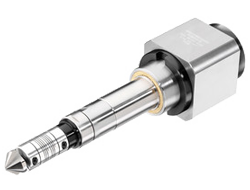
Mannesmann Demag Spindles for Countersinking and Drilling for Your Robot
Mannesmann Demag robot spindles offer precise, low-vibration, and durable drive solutions for automated countersinking and drilling processes. These spindles are specifically designed to meet the demands of robotic workstations: compact designs, high torque densities, plain and rolling bearing configurations, as well as specific sealing and cooling concepts allow for reproducible cutting results in both series production and individual parts. The range of applications, cutting parameters, tool holders, and connection types determine the economic efficiency of each cell. This text provides technical guidance on designs, materials, interfaces, sealing solutions, cooling, integration into robot kinematics, and practical application examples.
Design Principles and Configurations
Mannesmann Demag robot spindles are available in various configurations: slender tapered housings for confined spaces, short flange designs for direct robot arm mounting, and modular spindle units with interchangeable heads. The spindle bed often consists of hardened steel or tempered alloys to minimize deformation under continuous load. Speeds range from low half-speeds to high full-speeds; the choice influences bearing, cooling, and coating requirements. Rolling or precision full-ball bearings reduce play and increase service life under high radial and axial loads. For heat-sensitive applications, thermally stabilized housing variants are available to minimize thermal expansion and ensure machining accuracy.
Material Selection and Surfaces
The spindle shaft and housing material are central factors for stiffness and durability. Standard materials include tempered steel, case-hardened steel, and, for corrosive environments, stainless steels (AISI 316). For reduced friction and increased wear resistance, hard material coatings (TiN, DLC) are used on critical components. Contact surfaces and guides are often hardened and ground to reduce micro-play. The choice of coating also influences the clamping and wear behavior when using HSS or carbide tools.
Connection and Interfaces
Robot integration requires standardized flange and tool holders. Typical interfaces include HSK, ISO, or custom tapered holders. Electrical connections are realized through compact motor cable management and integrated three-phase drives; optional encoders (absolute or incremental) provide feedback for closed-loop control. Pneumatic and hydraulic interfaces are provided for internal coolant supply or clamping systems. When selecting, attention must be paid to the protection class (IP protection classes) and cable strain relief to ensure that the robot's swivel and rotational movements do not stress the cables.
Sealing Concepts and Cooling
For countersinking and drilling processes where coolant contact is frequent, Mannesmann Demag spindles offer multi-stage sealing systems: labyrinth seals, dynamic elastomer seals, and optionally additional cover discs prevent the ingress of coolants and particles into sensitive bearing areas. For high-pressure cooling, reinforced sealing solutions and pressure-balanced bearing housings are relevant. Cooling is optionally performed with internal cooling through the spindle axis, external ring channel flushing, or via a housing cooling jacket. Active spindle cooling stabilizes thermal length changes and minimizes repeatability errors during long series runs.
Cutting Data, Tools, and Process Parameters
For reproducible countersinking results, feed rate, speed, tool geometry, and coolant must be coordinated. Carbide countersinks are considered standard for long tool life in steel and cast iron, while HSS tools are economical in less abrasive materials such as aluminum or soft steels. Drilling processes with countersinking functions often require stepped cycles: pilot drilling, main drilling, deburring. Chip-breaking tool coatings and targeted chip evacuation in the robot cell increase process reliability. Tool holders with integrated clamping systems shorten setup times and reduce cycle times.
Automation Integration and Control
Mannesmann Demag spindles are suitable for direct mounting on the robot arm as well as for stationary installation solutions. Integration into robot controllers is achieved via standard protocols (EtherCAT, Profinet, CANopen) for speed and power monitoring. Encoders and temperature monitoring provide status data for predictive maintenance. Mechanical quick-change flanges and hydraulically locked flange adapters enable quick tool changes without manual intervention. To reduce sources of error, cable routes should be laid so that they do not chafe in the workspace or along moving axes.
Compatibility with Materials and Applications
The spindles cover a wide range of materials: structural steels, alloy steels, cast iron, non-ferrous metals such as aluminum and copper, fiber-reinforced plastics, and thin-walled sheets. For abrasive or difficult-to-machine materials, reinforced bearing packages and special lubrication concepts are available. In sheet metal processing, spindles with high dynamics and short duty cycles are in demand, while in girder and machine component manufacturing, higher torque reserves and thermal stability have priority.
Practical Examples
Case 1 – Automated countersinking on control cabinet sheets: A robot loads sheet metal plates with pre-drilled holes. The Mannesmann Demag spindle with internal cooling and HSK holder ensures clean countersinking, low burr formation, and constant countersink depths. Integrated temperature monitoring prevents overheating during series runs. The spindle is mounted directly on the robot flange, and cable management uses guided drag chains to ensure freedom of movement. Standardized interfaces allow speed to be controlled via the robot controller, so material changes can be automated in the process flow.
Case 2 – Drilling in cast housings with balancing: For high radial forces, roller-bearing spindles with reinforced bearing housings are used. Dynamic balancing of the spindle-tool combination is performed before the process. The use of carbide drills with TiAlN coating reduces wear, while a combined flushing and suction device safely removes chips. The spindle operates in a vibration-damping mounting flange to minimize transmissions to the robot joints.
Case 3 – Micro-machining in medical technology: For precise countersinking in thin-walled titanium components, thermally stabilized spindles with precision bearings and absolute encoders are used. Low cutting forces and low-vibration machining reduce distortion. Finely dosed internal cooling minimizes material heating and ensures reproducible surface qualities.
Selection Criteria and Specifications
Select the spindle according to the machining task, material, desired repeatability, and cycle times. Pay attention to the ratio of torque to speed, bearing life, protection class, and available tool holders. Determine whether internal cooling, active cooling, or special seals are required and whether encoder feedback is needed for closed-loop processes. For quick orientation, the following selection criteria can be used:
- Machining task (countersinking vs. drilling), material, desired surface quality, installation space, cutting data, connection types, and maintenance intervals.
Service, Maintenance, and Spare Parts
Regular inspections of seals, lubricants, and bearing conditions extend service life. The use of condition monitoring reduces unplanned downtimes. Mannesmann Demag offers spare parts such as bearing packages, seal kits, tool holders, and complete spindle heads. Documented inspection intervals and a predictable spare parts concept are essential for automated manufacturing cells.
Further Information
For technical data sheets, integration instructions, and application reports, please visit the technology and application pages: Technology and Application Examples. There you will find specifications, connection diagrams, and practical reports on the design of robot spindles.
FAQs
1. Which spindle holder is best for quick tool changes?
For fast and precise tool changes, HSK holders are recommended due to their form-fit connection and excellent concentricity. Alternatively, hydraulic or mechanical quick-change systems offer minimal tool change effort with repeatable positioning.
2. Which sealing technology effectively protects bearings with internal cooling?
Combinations of labyrinth seals and dynamic elastomer seals, as well as pressure-balanced bearing housings, have proven effective. For high-pressure internal cooling, additional protective discs and external shut-off mechanisms should be used to prevent coolant from entering the bearing zone.
3. How does spindle selection affect cycle time in the robot cell?
Spindle selection affects cycle times through available speeds, acceleration values, tool change time, and thermal stability. Spindles with high power density and short response times, as well as those with integrated quick-change systems, significantly reduce cycle times and increase productivity.