
Parker Push-to-Connect System – The Clever Alternative to Flared or Compression Fitting Systems
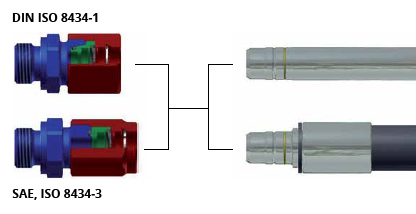
As the only push-to-connect system for hose and/or rigid tube connections, UPTC simply and securely connects both components permanently. In the DIN version, it can be combined with all 24° fitting studs according to ISO 8434-1. In the SAE O-Lok® version, however, UPTC can be used with the 90° ORFS stud according to ISO 8434-3. For particularly tight installation spaces, compact, customized solutions can be offered.
Regardless of the system previously used, switching to the safe and cost-effective UPTC push-to-connect fitting can be done easily and without any effort. The fittings are delivered in a fully assembled state with a union nut. The final assembly is carried out by simply pushing the tube or hose in. All fitting studs according to DIN ISO 8434-1 or SAE, ISO 8434-3 can be combined with the respective UPTC nut.

• Brake hydraulics
• Compressed air lines
• Spare parts/maintenance
• Cab tilt hydraulics
• Fuel systems
• (Engine) cooling systems
• Clutch hydraulics
• Steering hydraulics
• Pneumatic brakes
• Shifting hydraulics
• Pressure systems
• Lubrication systems
• Pilot control systems
• Brake systems
• Fuel systems
• Clutch hydraulics
• Steering hydraulics
• Pneumatic brakes

• Pressure systems
• Lubrication systems
• Pilot control systems
• Brake systems
• Fuel systems
• Clutch hydraulics
• Steering hydraulics
• Pneumatic brakes
- Minimization of assembly errors through simple plugging
- Significantly reduced assembly time
- Permanently tight hydraulic system
- Savings potential: Space – Weight – Part variety
- Optimal design of the installation situation
- Broad product range and worldwide availability
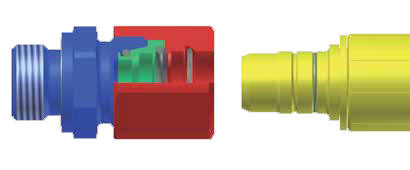
Both pre-assembled components are simply plugged together.
Attention: The Parker system is the only push-to-connect connection to follow the DIN and SAE standards and is therefore not compatible with push-to-connect systems from other manufacturers.
Insert the tube or hose. The marking groove, or the dust seal, must no longer be visible. Briefly pull on the tube or hose to ensure that the push-to-connect fitting has engaged. Screw-in studs can be screwed in at the hex of the stud or the UPTC nut.
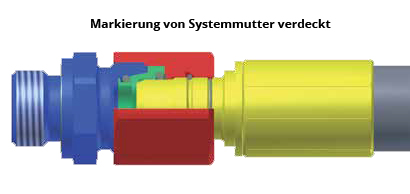
Simple
- Visual assembly control
- Marking inside the nut = clear assembly result
Secure
- Locking ring engages
- Connection is held in the fitting
Tight
- Elastomer seal
- 100% leak-free
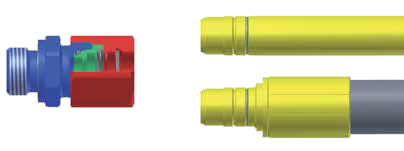
Parker Universal Push to Connect is a unique push-to-connect system for tube and hose connections due to its flexibility.
Repair – The repair is easy to handle:
- The push-to-connect fitting can be easily replaced with standardized series components. Tube repairs are carried out, for example, by assembling Progressive Rings (PSR) or EO-2 functional nuts with a new tube.
- When replacing the hose, the use of hose fittings with a 24° sealing cone with O-ring (DKO fittings) is recommended.
- The UPTC connection system is maintenance-free. Within the scope of the usual line checks, the Parker push-to-connect fittings are to be visually inspected.
Reassembly
- To loosen the push-to-connect fitting, the union nut is unscrewed with a conventional open-end wrench.
- Before restoring the connection, check that the spacer ring is installed and that the O-rings and back-up ring are not damaged.
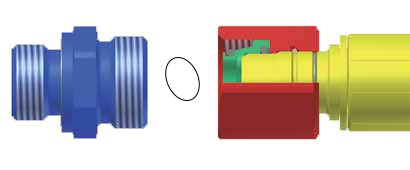
During disassembly, the nut is detached from the fitting stud.
The patented push-to-connect system is not detachable.
- Dismountable and mountable like common screwed connections. Also works with heavy soiling.
- No special tools are required.
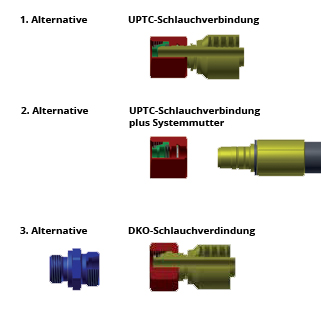 For on-site repair, UPTC hose connections can be replaced by standard DKO hose connections.
1. Ideally, the system is undamaged. The nut is on the nipple. Loosen the nut. You can reuse the system.
2. For example, when replacing the hose, replace the nut, the hose, and the fitting (all components except the stud).
3. In case of repair, the Parker DKO system can also be used.
What does UPTC stand for?
UPTC stands for: "Universal Push To Connect," a universal push-to-connect system for tubes and hoses.
In which areas of application is UPTC currently used?
UPTC targets areas of application where time can be saved by optimizing the assembly process, for example, in series assembly on the line.
Which components does a UPTC connection consist of?
UPTC consists of a standardized DIN or SAE fitting body with a nut permanently mounted at the factory. In addition, there is a hose fitting or a correspondingly shaped tube that is inserted into the UPTC fitting.
What unique selling propositions does UPTC offer?
UPTC uses standardized fitting bodies and is therefore available with a wide range of products. It can be used with tubes and hoses.
What makes UPTC a leak-free and particularly safe connection?
UPTC is soft-sealing. Assembly is carried out by simple plugging. No torque needs to be applied.
What are the assembly advantages of UPTC?
Assembly is carried out by simple plugging. No torque needs to be applied. This means a significant time advantage compared to the assembly of screwed connections, such as DKO connections, compression fittings, etc. Furthermore, the simple assembly significantly reduces the possibility of errors.
How can one tell that the assembly was correct?
UPTC has a visual assembly control. The connector has a yellow sealing ring to protect the connection from external contamination. If the connector has been pushed in far enough that this ring is no longer visible, the assembly has been correct.
What temperature ranges does UPTC cover?
UPTC has an HNBR seal. It is suitable for ambient temperatures from -40° C to +150° C.
Which tests have been carried out?
Extensive static and dynamic pressure tests, temperature tests, vibration tests, flex-impulse tests, handling tests, and other tests have been carried out.
In which sizes is UPTC available?
UPTC is available in diameters 6, 8, 10, 12, 15, 18, and 22 mm, for SAE -4, -6, -8, -10, -12, and -16.
What coating is available in the standard version?
UPTC is delivered standard with the Parker CF coating. This is a Cr(VI)-free galvanization.
With which sealing materials is UPTC available?
The UPTC connection is always delivered with HNBR seals. On the fitting side, it can be combined with seals made of NBR or FKM. The choice depends on the occurring temperature.
Is UPTC suitable for applications where vibrations occur?
UPTC has been successfully tested with vibrations. However, generally no statement can be made without taking the strength of the vibrations into account. Since vibrations can lead to wear in the long term, they should be kept as low as possible. Appropriate avoidance measures include setting tube or hose clamps and decoupling the vibrations from the hydraulic lines.
Is UPTC suitable for applications where twists or rotational movements occur?
± 1° is permissible. However, it must be generally noted that twists should be absorbed, for example, by hose clamps. Otherwise, wear will occur in the push-to-connect fitting and the service life will be reduced.
How is a UPTC connection released again?
UPTC can be released by unscrewing the union nut and repeatedly reassembled by screwing the nut back on. The nut always remains firmly connected to the hose connection or the tube. Repeated plugging is not possible.
Are there customer-specific special solutions?
Yes, customized solutions can be offered according to the areas of application. For example, "Cartridge" versions, with very compact dimensions, are already in use.