
Order air motors from 1,2 kW up to 4,4 kW and accessories by Mannesmann Demag here
Air motors are very robuste and unproblematic drives that are suitable for all industrial applications. It is a proven solution for many drive engineering requirements. The air motor features a high torque when starting and is fully variable on a large revolution scale.The robust planetary gears of the motors up to 1,2 kW ensure the necessary reduction for the required speed under load.
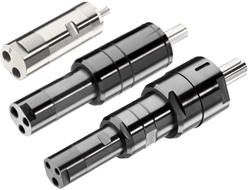
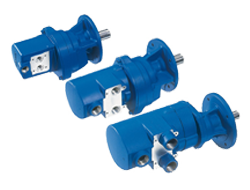
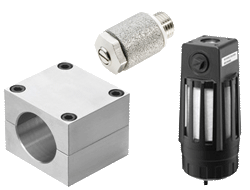
Pneumatic Motors: Selection, Technology, and Applications (Mannesmann Demag, up to 1.2 kW / 4.4 kW)
The Pneumatic Motors category from Mannesmann Demag includes compact, robust drive solutions with power outputs up to 1.2 kW and up to 4.4 kW, designed for industrial manufacturing, maintenance, and mobile applications. The focus is on variable torque, high power density, and operational reliability under harsh environmental conditions. The motors shown here are available in right-hand rotation, with reversibility, and optional holding brakes and extensive accessories. This text provides technical criteria for selection, design and material information, details on connections and seals, as well as practical application examples including notes on combination with control and and safety technology.Power Classes, Operating Data, and Characteristic Curves
Pneumatic motors are primarily divided into two power classes here: up to 1.2 kW for finer assembly and manual workstations, and up to 4.4 kW for stationary workshop and machine drives. Important characteristic values include no-load speed, nominal torque, maximum pressure (typically 6–10 bar), and specific air consumption at nominal load. Mannesmann Demag motors are characterized by linear characteristic curves during load changes and good controllability via air flow throttling or proportional valves. For selection, it is crucial to compare the application's load curve against the motor's characteristic curve to avoid over- or under-dimensioning.Designs, Shafts, and Mounting
Available designs range from compact, cylindrical versions for hand tools to robust flange motors for stationary mounting. Shaft variants include smooth shafts, slotted shafts for key hubs or keyless connections, and hollow shafts for feed-throughs. Standard mountings are flange, foot, and threaded holes according to industrial standards; customer-specific adapters are possible. For torque-critical applications, the use of a slotted shaft with a feather key or a key hub is recommended to minimize flank pressures.Materials, Surfaces, and Protection Classes
Housing materials are predominantly die-cast aluminum or spheroidal graphite iron-specific alloys for weight reduction and corrosion resistance; cast steel housings are offered in highly stressed environments. Shafts are usually made of hardened chrome steel (e.g., 42CrMo4) or corrosion-resistant stainless steel for applications involving moisture or cleaning processes. Surface treatments range from anodizing, passivation to powder-coated variants. Protection classes are typically IP54 to IP65 depending on the sealing concept and brake unit; for applications with high foreign particle content, additional protective covers or filters before the connection are recommended.Connections, Air Preparation, and Sealing Technology
Air connections usually comply with standardized threads (e.g., G1/4", G3/8") and are implemented via quick couplings or hose fittings. For precise operation, pressure stabilization, fine filtration, and oil mist operation must be checked: moisture separators, fine filters (≤10 µm), and adjustable pressure regulators are part of the basic equipment; for high lubrication requirements, oil mist or dosing lubrication systems are used. Seals generally use NBR for general use and FKM (Viton) or PTFE-based sealing systems for higher temperatures, aggressive media, or increased chemical resistance. For cyclic loading, the seal clearance should be checked to avoid creasing and premature wear.Control, Reversibility, and Brake Functions
Reversible variants allow direction changes via pneumatic directional control valves or electric solenoid valves with a pneumatic signal. Reversing should be designed with smooth transitions to avoid hydraulic shocks and overshoots. Holding brakes are available mechanically or magnetically actuated; spring-applied holding brakes are suitable when holding is required in a de-energized state. Brake discs and friction linings are interchangeable; for high switching frequencies, maintenance-friendly brake packages should be chosen.Wear, Maintenance, and Service Life
Sources of wear include bearings, seals, and friction surfaces within the motor design. Replacement intervals depend directly on operating pressure, air purity, and lubrication. Maintenance-friendly designs offer replaceable bearing bushes and easily accessible seal bores. Service life specifications are often given in operating hours at specified pressure and air quality; a semi-annual inspection of connection joints, seals, and the brake significantly extends operating time.Application Fields and Practical Examples
In the automotive and assembly industry, pneumatic motors are used as drives for feed and positioning units when explosion-proof or oil-insensitive drives are required. In paint booths and cleaning areas, corrosion-resistant versions are advantageous because electric motors can be affected by spray mist. In woodworking and metalworking, they serve as drives for grinding units or rotating spindles when simple speed control and high start cycles are required. Mobile repair stations use standardized connection threads and quick couplings for quick tool changes. Practical Example 1: Assembly cell with variable torque requirement. A pneumatic motor up to 1.2 kW drives a planetary gear, which is finely controlled via a throttle with pressure-controlled feedback; the nominal load is monitored by torque sensors, and if exceeded, automatic reversal to a safe parking position occurs. Practical Example 2: Grinding unit in a paint line. A stainless steel motor with FKM seals operates with increased moisture; the airflow is routed through a condensate separator before the motor, the holding brake prevents overrun at standstill and allows safe tool changes. Practical Example 3: Mobile repair cart on a construction site. A 4.4 kW motor with quick couplings and a key-hub-driven shaft supplies various attachments (impact wrench, cut-off grinder). Air preparation is centrally located on the cart; the pressure line is equipped with a check valve to safely block the tool in case of pressure drop.Accessories, Spare Parts, and System Integration
Accessories include couplings, reducers, flanges, brake components, damping elements, and adjustable air supply units. For integration into automated processes, pressure sensors, proportional valves, and galvanically isolated control lines are available. Spare parts kits primarily contain sealing rings, bearings, brake packages, and filter elements. For customer-specific requirements, coordination of air preparation and control with our technical specialists is recommended; further information can be found at maku Industrietechnik and specific applications at Application Examples.Safety and Explosion Protection Aspects
Pneumatic motors are fundamentally advantageous in hazardous areas because they do not provide ignition sources through electric current. Nevertheless, precautions against unintentional starting, pressure loss, and discharges are required. Safety valves, pressure monitoring, and mechanical interlocks of the brake are standard measures. For applications in potentially explosive atmospheres, certified versions and coordination with the Ex environment are mandatory.Selection Criteria — Briefly Summarized
* Match torque and speed requirements against the motor characteristic curve; define air quality and necessary lubrication; select shaft and mounting variant suitable for the machine interface.FAQs
1. What air preparation is required for Mannesmann Demag pneumatic motors?
At least a pressure regulator, fine filter ≤10 µm, and condensate separator; for high operating frequency or longer downtime, use oil mist or dosing lubrication; for hygienic or corrosive environments, recommend additional fine filtration and dryers.
2. How do I choose between 1.2 kW and 4.4 kW motors?
Based on the required continuous power and maximum load peaks: For continuous, higher loads or strong starting torques, the 4.4 kW class; for precise, light to medium applications, the 1.2 kW class. Always compare the load profile against the characteristic curve and check the air supply (pressure & volume flow).
3. Which sealing materials are recommended for high temperatures and chemical exposure?
For temperatures above 120 °C and aggressive media, FKM or PTFE-based seals should be used; NBR is suitable for general applications up to approximately 100 °C. Material selection depends on cleaning agents, temperature cycles, and media contact.