
Buy low-priced high quality T-stud fittings online


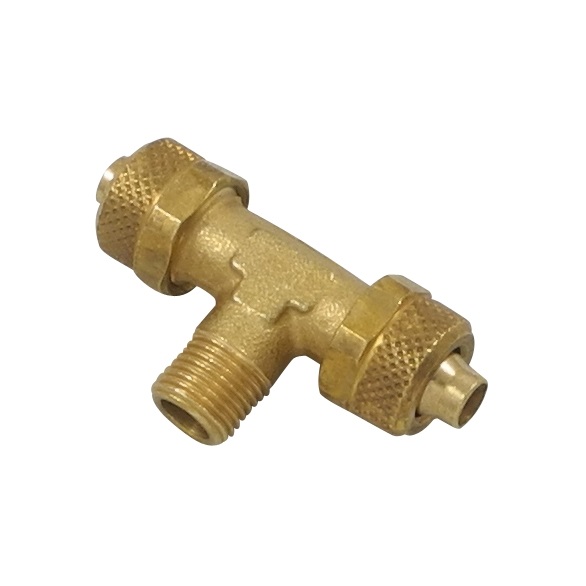


Technical Overview of T-Threaded Fittings
T-threaded fittings compactly connect three line sections in a space-saving design and are the first choice when hose branches in fluidic systems require robust materials and reproducible sealing conditions. The brass version offered here (Parker Rectus) prioritizes corrosion resistance, mechanical strength, and ease of assembly. Typical fields of application include cooling circuits, pneumatic and hydraulic preliminary stages, laboratory and process industries, as well as retrofittable connections in series machines.
Materials and Surfaces
The standard brass variant offers a balanced combination of strength and machinability. Galvanic nickel or chrome layers increase surface hardness and reduce friction during screwing. For increased chemical resistance, brass alloys with higher copper or zinc content, as well as optional nickel-plated versions, are available. In applications with aggressive media, alternative materials such as stainless steel (on request) or corrosion-resistant coatings should be considered. Material properties such as tensile strength, hardness, and thermal conductivity influence sealing behavior and fatigue strength and must be taken into account during system design.
Designs and Thread Concepts
T-threaded fittings are designed as a one-piece screw-in component that has an internal or external thread for mounting into a component and provides two lateral connections for hoses or pipes. For connection to built-in components, metric internal threads (e.g., M10x1, M12x1) or imperial variants are generally used. The connection ends are optionally designed as a hose barb for direct hose mounting, as a flare connection for pipe systems, or with a screw thread for accommodating union nuts. Precise thread tolerances and a defined tightening torque specification prevent leaks and mechanical deformations at the seat.
Seals, Sealing Principles, and Leakage Rates
The tightness of T-threaded fittings is based either on metallic compression or soft elastomer sealing. Metallic seals (cylindrical or conical seating surfaces) are durable and temperature-resistant but are not suitable for joining irregular sealing surfaces. Elastomer seals made of NBR, FKM (Viton), or EPDM offer better adaptation to surface roughness and are more cost-effective for medium pressures. In selected Parker Rectus models, a combination of metal and elastomer seals is available to permanently minimize static leaks. Leakage classes depend on operating pressure and medium; typical leakage rates in correctly assembled systems are in the ppm range for gases and in the droplet range for liquids.
Connections, Hose and Pipe Compatibility
The most common connection variants are hose barbs with grooves for hose clamps, conical connections with union nuts for screwing into pipelines, and push-in variants for quick assembly. Commercial hose diameters typically range from 4 mm to 12 mm; larger nominal sizes are also available for special designs. Hose materials such as NBR, PVC, PUR, or silicone influence the choice of seal and assembly force. For direct connection without a clamp, hoses with sufficient wall thickness and slip reduction should be used. Pipe connections require flaring or clamping technology matched to the pipe material to guarantee permanent tightness under changing thermal loads.
Operating Conditions and Pressure/Temperature Ranges
The permissible operating pressures for T-threaded fittings made of brass, depending on dimension, seal, and assembly, range from vacuum to several 100 bar under static load. Under dynamic loads, the permissible values are reduced; therefore, vibration decoupling and operating fluid testing are recommended. Temperature ranges are determined by the sealing material: NBR approximately -30°C to +100°C, FKM -20°C to +200°C. Metallic seals allow for higher temperature resistance but require higher installation forces and more precise surfaces.
Assembly and Quality Assurance
Correct assembly is crucial: clean threads, check sealing element, apply tightening torque according to manufacturer's specifications, and support connection lines against lateral forces. Repeated loosening and tightening can damage sealing surfaces; after several services, replacement of the seal is recommended. After assembly, check the connection for leaks under operating pressure and document test values for quality assurance. For series installations, the use of torque wrenches or predefined screw-in devices is recommended to achieve reproducible results.
Practical Examples
Example 1 — Cooling Circuit in Machine Maintenance: In a machine tool, a nickel-plated brass T-threaded fitting was installed in the coolant supply to connect an additional return line for particle separation. The conical metallic seat seal achieved permanent tightness at fluctuating temperatures. The assembly was carried out directly into an existing G 1/8 threaded bushing, and the two lateral hose connections were secured with hose clamps.
Example 2 — Pneumatic Supply Network: In an assembly plant, a T-threaded fitting with push-in side connections was used to supply actuators in a row. The quick plug-in function reduced assembly time and sources of error; NBR seals prevented power losses due to pressure drop. A pre-pressure test after 24 hours of documentation confirmed a permanent leakage rate of less than 0.1%.
Example 3 — Retrofitting in Laboratory Systems: For a sample collection unit in a chemical laboratory, a brass T-fitting with an FKM seal was chosen to temporarily handle more aggressive media. The fitting was screwed into an M12x1 internal thread; three hose lines with different nominal sizes were connected with suitable hose cross-sections. The tests showed no chemical interactions within the operating time.
Compatibility and Accessories
For secure system integration, we offer suitable connection and sealing sets, union nuts, hose clamps, and built-in components. Usable components and test procedures are described on the Technology page. For specific applications, we recommend consulting practical descriptions under Application Examples to compare assembly and testing processes.
Selection Criteria for Purchasing
Select T-threaded fittings based on operating pressure, medium, temperature range, required corrosion resistance, connection sizes, and assembly frequency. Consider compatibility with existing mounting bushings and the required seal type. For series projects, mechanical test cycles, material certificates, and traceability of batches in the supply chain should play a role.
- Relevant selection criteria: Material (brass/surface-treated), seal (NBR/FKM/metal), connection type (hose/push-in/union), thread (metric/imperial), operating data (pressure/temperature), testing and assembly requirements.
Maintenance and Lifespan
Regular visual inspection, functional testing under pressure, and, if necessary, replacement of the seal at defined intervals extend the lifespan. Corrosive environments require more frequent inspections. Mechanical stresses due to vibrations can be reduced by strain relief and flexible hose lines. Document replacement cycles and test results to comply with audit and quality requirements.
Procurement and Specification Assistance
When purchasing online, pay attention to exact product specifications regarding thread, connection dimension, and seal type. Use the filter options in the shop to select nominal sizes, material, and application area. For project-related requirements, technical data sheets and test certificates assist in selection; specific questions can be clarified via technical contacts or the product configurator.
FAQs
1. What media are brass T-threaded fittings suitable for?
Brass T-threaded fittings are suitable for many non-aggressive liquids, pneumatics, coolants, and hydraulics up to defined pressure and temperature ranges. For aggressive chemicals or high-purity applications, alternatives such as stainless steel or specific sealing materials should be chosen.
2. How do I determine the correct seal?
Choose the seal according to medium chemistry, temperature range, and pressure. NBR is universal for oil and air applications, FKM for higher temperatures and chemical resistance, EPDM for water and steam. Metallic seals are considered durable at high temperatures and pressures but require precise surfaces.
3. Which assembly errors most frequently lead to leaks?
Common errors include incorrect tightening torques, contaminated sealing surfaces, repeated retightening without changing the seal, and lack of strain relief for the lines. Use torque specifications, clean contact surfaces, and check seals before installation.