
High quality compressed air manifolds in various forms
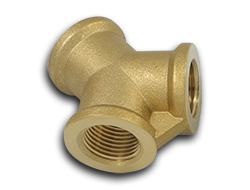
Manifolds for compressed air and hydraulics as female-y, equal ended cross, 2-way, 3-way, wall-mounted and multi-port manifolds made of different materials.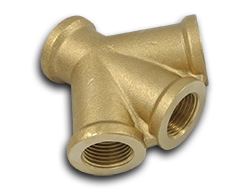
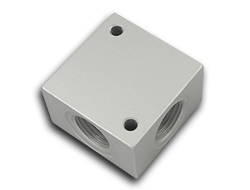

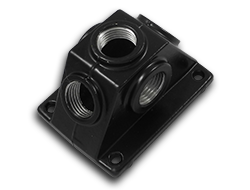

Precise Manifolds for Compressed Air and Hydraulics: Selection, Design, and Application
Manifolds are central components in compressed air and hydraulic systems. They direct media, optimize piping topologies, and reduce leakage points through compact designs. On this page, you will find **manifolds** in numerous designs such as **Y-fittings**, **cross fittings**, 2-way and 3-way manifolds, wall outlets, manifold blocks, and manifold strips. Crucial factors include material selection, connection type, sealing concept, and pressure/temperature range. The correct combination of these parameters ensures operational safety, leak-tightness, and service life in industrial applications.Construction and Designs
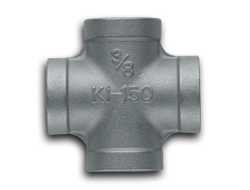
Manifolds fundamentally differ in geometry and manufacturing method. A **Y-fitting** reduces flow losses through smooth internal contours and is suitable for applications with increased volume flows. **Cross fittings** offer symmetrical branching but are more sensitive to pressure drop and backflows than segmented manifold blocks. 2-way and 3-way manifolds are space-saving when multiple consumers are supplied via short pipe runs. Wall outlets combine mounting and feed-through functions for control cabinets or machine enclosures. Manifold blocks and strips concentrate individual connection points and enable centralized pressure measurement, shut-off, and protection.Materials and Workpieces
Material selection depends on the medium, pressure, temperature, and environment. Brass offers high corrosion resistance and good machinability for compressed air and oil. Stainless steel (e.g., 1.4301/1.4404) is mandatory in corrosive environments, food technology, or cleaning processes. Aluminum reduces weight with lower demands on leak-tightness and wear, suitable for mobile systems and lightweight construction. Technical plastics such as PA, POM, or PVDF are used for aggressive media or in electrically insulated applications. For hydraulic systems with higher pressures, hardened steels or hardened stainless steel are common. Material choice also influences permissible operating temperatures and compatibility with sealing materials.Connections, Threads, and Mounting Features
Connections vary between cylindrical threads (BSPP/BSPT), metric screw-in threads, quick-release couplings (DQ/Rectus standards), push-in tube connections, and flange connections. BSPP threads are standard in many pneumatic applications; BSPT is used where a seal is required by a tapered thread. Quick couplings allow tool-free consumer replacement; push-in connections reduce assembly time with low leakage rates. Flange connections and screw connections are used in hydraulic manifold blocks to evenly distribute high-pressure loads. Mounting holes, support surfaces, and wall fastenings are crucial features for integration into machines for wall outlets and manifold strips.Seals, Leakage Rates, and Media Compatibility
Seals define long-term leak-tightness. Standard materials are NBR (nitrile) for general compressed air and oil applications, FKM (Viton) for higher temperatures and aggressive oils, EPDM for water/glycol mixtures, and PTFE coatings or PTFE seals for chemically aggressive media. Hydraulic applications with high pressures often use sealing elements with metal bells or multi-acting O-ring seats. The correct hardness (Shore-A) and chemical resistance are crucial to prevent plasticizer attack, swelling, or cracking. Tested leakage rate specifications and pressure test certificates should be available for safety-relevant installations.Performance, Pressure Ratings, and Temperature Ranges
Compressed air manifolds are usually designed for operating pressures up to 16 bar; special versions reach 20 bar and more. Hydraulic manifolds often meet pressures up to 250 bar and significantly higher, depending on material and fittings. Temperature ranges for standard components extend from -20 °C to +80 °C; special seals and materials extend this range to -40 °C to +200 °C. Important parameters include volume flow (l/min), pressure loss per branch, and permissible pressure surges. For pneumatic control circuits, rapid pressure changes and small dead spaces are relevant, while in hydraulic load circuits, pressure surges and fatigue behavior play a greater role.Practical Application Examples
**Example 1 – Paint Shop, Compressed Air Supply:** A brass Y-fitting (BSPP 1/2" → 2×1/4") is mounted near the drag chain to supply a paint spray system and a dryer nozzle via separate lines. Due to the smooth transition geometry, the pressure loss remains below 0.2 bar at 400 l/min. EPDM seals prevent resinification by solvents and ensure maintenance-free operation for months. **Example 2 – Hydraulic Press, Multiple Supply:** A manifold block made of hardened steel with flange connections distributes hydraulic oil to four cylinder units. Each outlet is equipped with a bleed and measuring port, allowing pressure measurements without disassembly. FKM O-rings and metal plug connections ensure leak-tightness at 250 bar and 80 °C operating temperature. **Example 3 – Assembly Machines, Compact Distribution:** An aluminum manifold strip with push-in connections (6 mm) is mounted on the machine's rear wall. Pneumatic grippers receive stable airflow via short hose runs; the strip integrates a central shut-off and a combined filter-regulator valve that stabilizes pressure fluctuations to ±0.1 bar. This reduces downtime and simplifies quick changes of grippers.Selection Criteria and Integration
To select the appropriate manifold, compare operating pressure/temperature, medium, volume flows, connection types, and space requirements. Check whether measuring points, shut-off valves, or check valves need to be integrated. For frequent maintenance cycles, quick couplings or push-in connections are advantageous. For safety-relevant systems, documentation of material certificates, pressure tests, and sealing material is essential. Our product pages contain technical data sheets and CAD models for integration into your design. Further technical background information can be found at https://maku-industrie.de/technik and practical reports at https://maku-industrie.de/anwendungsbeispiele.Maintenance and Operational Safety
Regular visual inspection for corrosion, damage, and leaks reduces the risk of failure. In compressed air systems, cyclic draining of condensate at collection points is recommended; in hydraulic systems, regular oil changes and particle filter changes. Seals should be checked at maintenance hatches and replaced if abraded or hardened. Screw connections must be assembled with a defined torque to avoid stress distortions and leaks. Documented inspection intervals and a stock of spare parts for critical seals ensure quick repair.Designs and Typical Specifications
Our categories cover standard dimensions and special designs: Y-fittings in 1/8" to 1" nominal size, cross fittings with up to 4 outlets, manifold blocks with integrated measuring and shut-off devices, and modular manifold systems that can be mounted on rails. Material options: brass, aluminum, stainless steel, technical plastic. Sealing material: NBR, EPDM, FKM, PTFE. Connection variants: BSPP/BSPT, metric threads, push-in, quick coupling, flange. Pressure ranges: pneumatic up to 16–20 bar, hydraulic up to several 100 bar. Temperature ranges, volume flow data, and CAD data are stored with each product.A List of Typical Decision Points
- Medium, operating pressure, temperature range, connection type, material, seal, integration of measuring and shut-off elements
FAQs
Which seals are suitable for compressed air with light oils?
NBR seals are standard for compressed air with light oil additives. For higher temperatures or more aggressive additives, FKM is recommended. For unknown media, a material compatibility test is required.
How do I choose between a Y-fitting and a manifold block?
Y-fittings reduce flow losses and are suitable for higher volume flows along a line. Manifold blocks are more compact, offer central consumption management as well as measuring and shut-off options, and are better suited for complex multi-consumer topologies.
Which connection types are recommended for frequent consumer changes?
Quick couplings and push-in connections enable quick, tool-free changes and reduce downtime. Pay attention to compatibility with hose diameter, permissible pressure, and leakage rate specification.