
General Information About O-Lok® Fittings
The O-Lok® fitting consists of four elements: a fitting body, a sleeve, a Trap Seal, and a union nut.
Over 40 different fitting bodies are available for specific applications. A groove is incorporated on the face that holds the Trap Seal in position, thus preventing its loss during assembly.
In addition, all O-Lok® shaped parts are forged to achieve greater strength and durability. Straight fittings are made from cold-drawn bar steel. The cold drawing process guarantees consistent dimensional tolerances, improved strength, and uniform surface quality.
In the original design with its straight sides, the seal could detach from the groove under certain tolerance conditions between the seal and the groove. In 1998, Parker introduced an improved version of the O-Lok® fitting as standard production in all manufacturing facilities – the CORG groove. The international designation "CORG" stands for "Captive O-Ring Groove," which prevents the loss of the seal during final assembly. International standards for ORFS fittings include two designs for the groove.
Due to its design, the Trap Seal offers excellent sealing properties. Ranging from low pressures, such as during low temperatures in winter when machines are stored, to high pressures during high-temperature cycles.
Smaller O-Lok® union nuts are cold-pressed to achieve a denser material structure, which in turn enables a more resistant component. Larger union nuts are made from hot-forged steel blanks with high strength.
The preferred method for producing an O-Lok® tube connection is the Parker Parflange® process to create the 90° flare at the tube end. A support sleeve is used to support the flared flange or the tube and simultaneously provides a clamping surface for the union nut. After the Parflange® process, the union nut is permanently fixed to the tube end and strengthens the connection. The O-Lok® tube connection using the Parflange® process can be produced with both metric and imperial tubing by selecting the appropriate sleeves and tools. To enable the Parflange® machine to produce robust and reinforced tube end connections, Parker Parflange® sleeves are manufactured with exact tolerances according to the geometric requirements. The use of non-approved components can lead to connection failure during operation.
The braze sleeve is fixed to the tube end by silver brazing, as the name suggests. Thus, brazing ensures a strong and tight connection. The braze sleeve has a flat contact surface so that the union nut can pull the tube end to the fitting. O-Lok® braze sleeves are manufactured in compliance with precise tolerances. Tightly tolerated dimensions are necessary to create a flat, smooth sealing surface for the seal and to ensure the appropriate gap for silver brazing to the tube. By selecting the appropriate braze sleeve, the O-Lok® connection can be produced with metric or imperial tubing.
O-Lok® braze sleeves are manufactured in both normal and reduced sizes. The reducing sleeve makes it possible to adapt larger face seals to smaller tube ends.
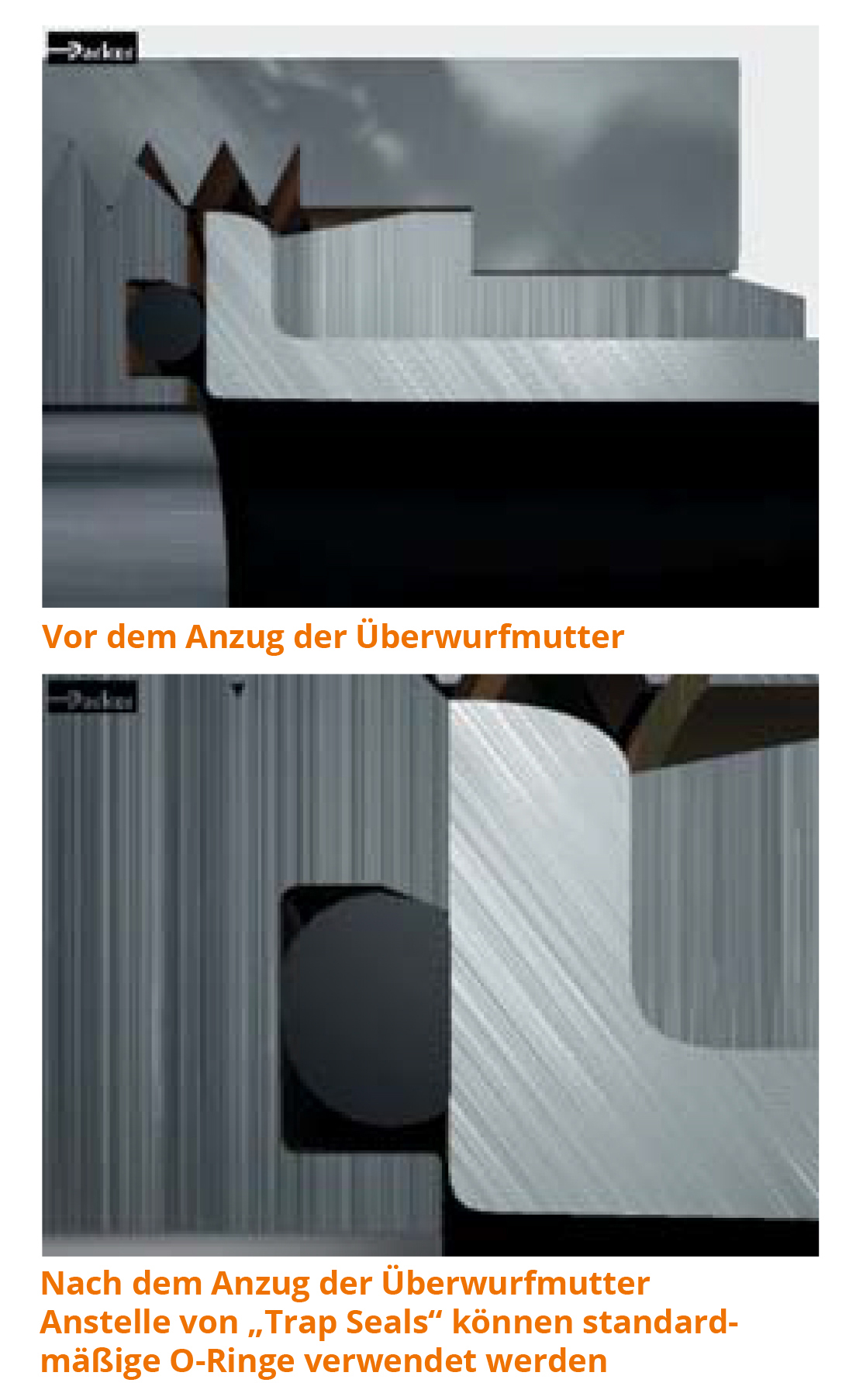
A seal is non-removably integrated into a special groove on the O-Lok® fitting face. When tightening the union nut onto the fitting body, the seal is compressed between the body and the sealing surface of the tube flange or the braze sleeve to achieve a tight, effective seal.
The meeting of the two surfaces when tightening the union nut causes a noticeable increase in the assembly torque. The assembly is completed at this point by firmly tightening the wrench to the assembly torque.
The significant increase in torque conveys a "secure feeling" and minimizes the risk of overtightening. Since the sealing surfaces are flat and perpendicular to the assembly forces, they remain practically free of deformation during assembly, which allows the O-Lok® fitting unlimited reusability. The seal should be checked during every disassembly and replaced if necessary.
The Parker Flange Seal system offers a reliable, fast, and economical method to connect a tube line with a hose line or tube line to tube line. This system replaces conventional brazing onto a face O-ring seal with a modern preparation method. Since brazing is no longer necessary, several advantages arise – flexibility of batch size and production location, a secure end result, fewer manufacturing steps; all with the possibility of cost savings.
The Flange Seal system is an evolution of the proven Parflange® process to attach a 90° flange to a tube end. A custom-made rubber-metal seal is placed between the flange face of the tubing and the hose/tube assembly. Rubber knobs are arranged on the outer diameter of the seal so that it can be securely positioned within the tube union nut or the hose end before assembly. The seal is compressed between the two sealing surfaces during assembly, creating a leak-free connection.
- eliminates potential leaks and reduces costs
- reduced assembly costs
- leak-free connection, low assembly and rework costs
- guaranteed reliable sealing
- reduces tube preparation costs
- flexible, smaller batch size, lower storage costs
- safer process
- reduces costs and complexity
- better utilization of asset value
- corrosion-resistant: galvanized tube can be used
- compact solution
Leak-Free
The O-Lok® fitting system offers an absolutely tight connection thanks to its elastomeric seal design. O-Lok® fittings are part of the "Dry Technology" product family.
Pressure Ratings
With pressure ratings up to 630 bar, the O-Lok® system meets the requirements of current high-pressure hydraulic systems.
Highest Stress
In addition to high-pressure resistance, O-Lok® fittings are extensively tested and have proven themselves in the most demanding applications involving the effects of pressure impulses and vibration; they are establishing themselves as the "first choice" fitting for construction equipment.
Trap Seal
Prevents wiping out and thus reduces maintenance costs due to leaks during operation. The seal can optionally be replaced by a standardized O-ring.
Robust, Adjustable Screw-In Connections
Exclude possible assembly errors caused by excessive screwing in of elbow or tee fittings. This reduces warranty claims in case of unnoticed assembly errors.
Cr(VI)-Free Surface
The O-Lok® fittings comply with the requirements of European Directive 2000/53/EC.
Corrosion Resistance
O-Lok® fittings achieve protection of at least 120 hours against white rust, thus exceeding the industry standard.
Flexibility
O-Lok® is available in stainless steel and brass versions. By choosing the fitting bodies and replacing standardized O-rings, it is possible to adapt the O-Lok® system to the greatest possible temperature fluctuations and special fluids.
Hose or Tube Connections
O-Lok® fittings can be used equally for tube fittings or high-performance hose adapters.
Simplest Tube End Preparation
The Parflange® tube preparation system creates a 90° flange at the tube ends to produce a first-class sealing surface for the O-ring seal assembly.
The New Flange Seal System
replaces the costly brazing of hose-to-tube and tube-to-tube connections.
Tube Materials
O-Lok® fittings can be used with most tube materials – such as carbon or stainless steel, copper, and aluminum.
Metric or Imperial Tubes
Both systems can be used either imperial or metric by simply exchanging the support sleeve. Customer-specific specifications for the tube can be implemented without changing the fitting. O-Lok® is one of the few fitting designs that enables this option.
Selection of Standard Sizes
The O-Lok® system is available in sizes from 6 mm / ¼˝ to 50 mm / 2˝ for tubes or in comparable hose sizes.
Easiest Assembly
Since the tube flaring in O-Lok® is done mechanically, the O-Lok® fitting is extremely easy to assemble; due to low assembly torques compared to other fittings operating at similar pressures.
Torque Overload Capability
Parker O-Lok® tube fittings are capable of withstanding up to twice the specified assembly torque without causing damage or failure.
Noticeable Assembly Stop
During final assembly, metallic surfaces come into contact with each other, clearly signaling the contact to the fitter. After that, a short firm tightening completes the connection. This small assembly angle makes it significantly easier to assemble the fittings in hard-to-reach areas or in confined spaces.
Simple Visual Inspection
Checking the quality of the tube flaring is simple and therefore reliable due to the design.
Easy Installation
O-Lok® fittings and the corresponding tube ends both have a flat surface. As a result, tube lines are easier to install (butt fitting) and in case of maintenance, it is easier to disassemble the hydraulic components without having to take the entire line apart.
Large Delivery Spectrum
O-Lok® is standardly available in over forty basic fitting types, which is crucial for the system's flexibility.
Standardized
Parker O-Lok® fittings comply with the corresponding international standards (SAE J1453 & ISO8434-3); this means that specifying fitting systems is easier and more cost-effective than with comparable in-house standards.