
Order 2 way manifolds made of brass and brass nickel plated


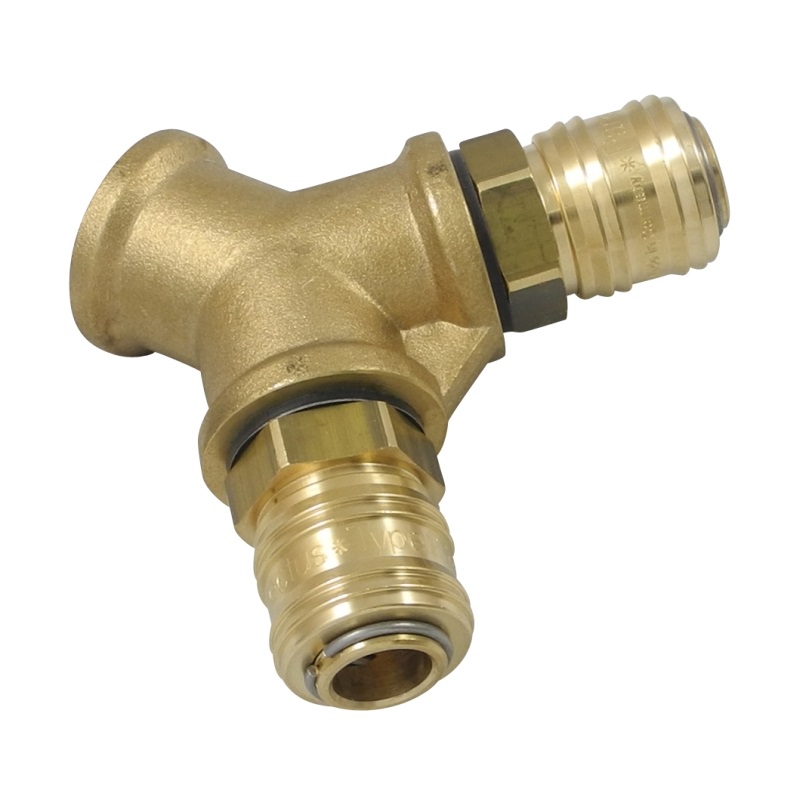

2-Way Manifold in Brass and Nickel-Plated Brass — Technical Details and Selection Criteria
2-way manifolds made of brass and nickel-plated brass are compact connectors for splitting a compressed air or fluid circuit into two consumers. In industrial manufacturing environments, material selection, sealing technology, connection sizes, and mounting options determine continuous operation and leak-tightness. Brass offers high corrosion resistance, good mechanical strength, and is compatible with common compressed air applications as well as many technical media. Nickel plating increases surface hardness, reduces friction in screw connections, and improves corrosion protection in humid or slightly aggressive environments. Our manifolds are designed for common connections of 1/4", 3/8", and 1/2" and are available with or without pre-assembled quick couplings.
Materials and Surface Finish
Brass alloys for industrial fittings follow standardized compositions (e.g., CuZn36Pb2), which provide a balanced combination of toughness and machinability. Nickel-plated versions are usually based on a galvanic nickel coating of 5–20 µm on the brass surface; this coating increases wear resistance and interface resistance during frequent plugging and turning operations. For critical applications with increased chemical requirements, check the specific alloy and nickel quality, as phosphate-containing media or aggressive cleaning agents can lead to localized material attack.
Connections, Thread Types, and Seals
For 2-way manifolds, the connection types are crucial for installation effort and leakage risk. Common thread forms are BSP (G), NPT, and metric pipe threads; for compressed air systems, BSP(G) and push-to-connect fittings are most common. Sealing is achieved depending on the connection with PTFE thread sealant, O-rings, or conical sealing surfaces. For O-ring seals, we generally use NBR (nitrile rubber) for compressed air up to ~80 °C, FKM (Viton) for higher temperatures and chemical resistance, or EPDM for water systems and hot vapors. Quick couplings often have integrated Viton or NBR seals; here, the selection depends on pressure, temperature, and medium.
Overall Lengths, Flow Rate, and Pressure Drop
The hydraulic performance of a 2-way manifold is determined by the inner diameter, housing shape, and inner surface. Brass manifolds with smooth inner walls and larger flow cross-sections reduce pressure drop and minimize pressure surge frequencies in long distribution lines. When selecting, note: for 1/4" connections, the maximum volume flow is limited, while 3/8" and 1/2" allow significantly higher flow rates. For regularly operated consumer points in mechanical engineering, it is recommended to simulate or measure the pressure drop over the specific line length and the number of parallel consumers to avoid underpressure at the end device.
Design Variants and Mounting Types
Manifolds are designed as T-pieces, flangeable block manifolds, or compact inline manifolds. T-pieces offer simple installation in existing piping networks; block manifolds allow modular mounting of several manifolds in series or on a mounting rail. Mounting options include threaded studs, mounting flanges, or clamping tabs. In dynamic applications, vibration-eccentric mounting points should be avoided, and additional decoupling or screw locking devices should be used.
Corrosion Protection, Maintenance, and Service Life
The service life of a manifold largely depends on installation, operating environment, and maintenance intervals. Nickel-plated surfaces often prevent surface corrosion in production halls with high humidity or aerosols. Maintenance measures include regular visual inspection for corrosion spots, functional testing of quick couplings, and replacement of seals after operating cycles or temperature changes. To extend the service life, it is recommended to document replacement intervals and use original replacement seals.
Application Areas and Structured Practical Examples
2-way manifolds are used wherever a supply line needs to be split into two consumers — from compressed air workbenches to machine tools and test benches. Practical examples describe typical installation locations, error patterns, and solution steps.
Practical Example 1: Installation on a pneumatic workbench in series production. A 2-way manifold with 1/4" BSP connections and a pre-assembled quick coupling connects the main supply line to two hand tools. Before use, the leak-tightness is checked, and the O-rings are inspected for lubricant compatibility with the compressed air additives used. For regular tool changes, the pre-assembled quick coupling with a wear-resistant NBR sealing system is recommended to minimize operating times.
Practical Example 2: Integration into an assembly cell with coolant supply. Here, a 2-way manifold made of nickel-plated brass with EPDM seals is used to divide the main coolant line into two parallel flushing circuits. The nickel plating reduces deposits on the surface and facilitates cleaning; EPDM ensures resistance to emulsions and elevated temperatures. For installation, flange connections with PTFE thread sealant are used to ensure a chemically resistant seal against coolants and lubricants.
Practical Example 3: Replacement of a corroded manifold in a paint shop. Due to high humidity and solvent residues, a standard brass manifold was replaced with a nickel-plated version with FKM seals. Before installation, the lines were vented, and the sealing surfaces were cleaned. The material combination significantly increased the service life of the fitting; leakage risks due to chemical attack were minimized.
Selection Aid for the Right Manifold
Select 2-way manifolds according to the following practical criteria:
- Media compatibility (check sealing material), connection size (1/4", 3/8", 1/2"), surface treatment (nickel-plated for increased corrosion resistance), form factor (T-piece, block, inline), quick coupling options (pre-assembled vs. retrofittable), operating temperature, and permissible operating pressure.
Installation Instructions and Test Steps
During installation, the following steps are relevant: cleaning of connection threads and sealing surfaces, use of appropriate sealing technology (PTFE thread for cylindrical threads, O-ring for rotationally rigid connections), controlled tightening of screw connections with manufacturer's torque specifications, and leak test at operating pressure. For quick couplings, check spring function and seal condition; multiple plugging cycles may require re-lubrication or replacement of seals. For safety-relevant machines, supplement the assembly with labeling of supply lines and document the materials and seal types used.
Compatibility with Components and Systems
2-way manifolds are compatible with standard couplings, hose lines, and quick-release fittings. When integrating into systems, pay attention to material pairing (e.g., brass to steel screw connection can lead to galvanic corrosion), permissible operating temperature, and media-induced aging of the seals. For high-pressure or vacuum applications, special versions with reinforced sealing systems and, if necessary, locking nuts are recommended.
Service, Spare Parts, and Standards
For industrial applications, we offer replacement seals, quick coupling inserts, and pre-assembled mounting solutions. Check product specifications for conformity with standards (e.g., EN, ISO for threads and material certificates). For in-depth technical advice and application cases, visit our technical page at https://maku-industrie.de/technik or see specific application examples at https://maku-industrie.de/anwendungsbeispiele.
FAQs
1. Which seal is best suited for compressed air?
For standard compressed air applications, NBR O-rings up to ~80 °C are recommended due to good abrasion resistance and favorable chemical resistance. For higher temperatures or contact with oils and solvents, FKM (Viton) is preferable.
2. When should I choose nickel-plated manifolds instead of bare brass?
Choose nickel-plated manifolds in conditions of increased humidity, frequent plugging cycles, or when abrasive particles and slight chemical stresses occur. Nickel plating reduces surface wear and corrosion tendency and facilitates cleaning.
3. Can I retrofit quick couplings to a manifold?
Yes, many manifolds are designed with standardized connections to which quick-coupling-compatible inserts can be mounted. Pay attention to thread type, sealing flange, and compatible coupling types; for high-pressure or safety-relevant applications, pre-assembly by qualified personnel is recommended.