
Turbine grinders for excellent processing quality
With their particularly high speeds, the compressed air-driven turbine grinders ensure excellent processing quality. The high concentricity of the models enables long continuous running times.

Turbine grinder GT 1000 D
Price on request

Turbine grinder GT 652 D
Price on request
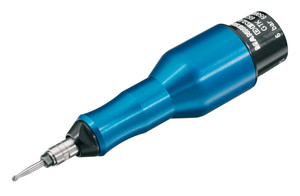
Turbine grinder GTK 1000 D
Price on request
Turbine grinder GTK 652 D
Price on request

Turbine grinder GTV 1100
Price on request
Turbine Grinders for Excellent Machining Quality
Turbine grinders are specially developed grinding machines that enable very uniform material removal on sensitive and hard-to-reach component areas due to high speeds and compact, flat designs. They combine high surface finishes with controlled chip removal and are suitable for precision processes in the metalworking industry, mold making, and the finishing of welds and rotor surfaces. **Crucial for the choice of a turbine grinder are power density, design, abrasive mounting, and the possibility of connection technology integration.**Construction, Designs, and Materials
Turbine grinders typically consist of a drive housing with an internal rotor, a turbine stage for high speed stability, and a standardized spindle mount for various abrasive tool holders. Housings and shafts are often made of hardened steel or aluminum alloys to improve vibration damping and heat dissipation. Models for continuous use often feature hard material coatings or corrosion-resistant stainless steel inserts. The grinding head shape varies: from slender, angularly adjustable headpieces for hard-to-reach internal contours to wider, rigid heads for surface grinding. **The choice of material influences weight, heat generation, and service life.**Power, Speed, and Control
Turbine grinders operate with air or electric motors. Pneumatic turbines offer a high power-to-weight ratio and operate at very high speeds with a constant characteristic curve; they are often the first choice in explosive atmospheres. Electric variants provide more precise speed control and more torque at lower speeds, which is advantageous for rough preliminary machining. Pay attention to no-load and load speeds, which can predominantly range between 20,000 and 120,000 rpm. For reproducible processes, the integration of speed control and torque limitation is recommended. **Controllability and torque are crucial for process stability and grinding pattern.**Abrasives, Mounts, and Seals
The selection of abrasives and their mounts determines surface quality and process costs. Turbine grinders support disc, pin, and felt tools, as well as non-woven and flap grinding wheels. Common mounting systems are clamping and quick-change attachments with standardized collets (e.g., 3 mm, 6 mm, 1/8"). For rotating felt or polishing attachments, plug-in or screw-on clamping systems are available. Seals in the spindle area are crucial for wet applications or when coolants are used; high-quality models use labyrinth seals or O-rings made of FKM/EPDM to prevent the ingress of abrasive particles. **Compatibility between mount, abrasive, and seal determines efficiency and service life.**Connections, Air Consumption, and Ergonomics
Pneumatic turbine grinders require standardized compressed air connections (typically 6–8 bar) with quick couplings according to ISO standards; compressed air filters, oilers, and pressure reducers should be integrated into the supply line to maximize turbine service life. Electric variants require flexible cables with kink protection and possibly frequency converters for speed modulation. Ergonomic handles, vibration-damping handpieces, and low overall height improve operating comfort and reduce fatigue in series processes. **Plan connection and supply infrastructure before installation to avoid downtime.**Application Areas and Practical Use
Turbine grinders are used where low material removal with high surface quality is required. In mold and tool making, they smooth cavities after EDM work, remove burrs from injection channels, and optimize surfaces for polishing. In the maintenance of turbine or pump impellers, they remove burrs from blade roots and restore flow surfaces. In weld seam processing, they reduce roughness before coating processes and create defined approach radii. **Process reliability increases through reproducible speeds, suitable abrasives, and coordinated cutting parameters.** Practical example 1: In a medium-sized component plant, a pneumatic turbine grinder with a narrow head is used for post-processing bore shoulders and flat surfaces. With a 3 mm collet and a non-woven disc at 80,000 rpm, fine burrs are removed without compromising the H7 fit tolerance. The air supply is equipped with a filter-regulator-oiler; O-ring seals prevent contamination damage from metal dust. Practical example 2: In a mold making company, an electrically driven turbine grinder is used to prepare the surface of plastic injection molds after fine grinding for **RTV polishing processes**. Due to the finely adjustable speed and the use of felt polishing attachments, an Ra value reduction of up to 30% is achieved, which reduces rework and shortens cycle times. A feed rate of 0.05 mm per pass serves as the cutting parameter. Practical example 3: In the maintenance of turbine impellers, turbine grinders are used for local smoothing of cavitation damage. Here, wider grinding segment mounts and cooled airflow are used to avoid thermal overload of the material surface. After several controlled passes, the roughness is consistently returned to the permissible range, and a subsequent surface coating is applied.Materials and Process Parameters
Turbine grinders process steel, stainless steel, aluminum, bronze, titanium alloys, and a variety of non-metallic materials such as epoxy resins and glass-fiber reinforced plastics. For hard steels, grit 80–120 with diamond-coated or CBN-optimized carrier media is recommended; for aluminum, non-woven tools improve the surface finish, while for soft metals and plastics, finer grits or soft felt mounts are used. Temperature management is critical: tool temperature limits should be observed depending on the material to avoid annealing or thermal damage. **Specific parameters must be coordinated based on component geometry, material, and desired roughness.**Maintenance, Upkeep, and Spare Parts
Regular maintenance includes filter and oil changes for pneumatic systems, checking seals, inspecting the clamping mount for concentricity, and balancing rotating components. Spare parts should be available: turbine rotor, bearings, seal kits, collets, and grinding head covers. Document service life and wear patterns to optimize cycle times and reduce downtime. For further technical information and application examples, visit our technical page: https://maku-industrie.de/technik and the collection of real-world applications at https://maku-industrie.de/anwendungsbeispiele.Selection Criteria for Purchase
Make your selection based on the following points:- Primary material and desired surface roughness
- Required speed and torque ranges
- Connection type (pneumatic/electric) and existing infrastructure
- Compatible abrasive mounts and availability of spare parts
- Ergonomics and ease of maintenance
Integration into Manufacturing Processes
Turbine grinders can be used manually or stationary in machining cells. When integrated into automated lines, standardized interfaces for positioning systems, force/torque monitoring, and tool changes are necessary. In series production, process validation with a test protocol for surface roughness and dimensional accuracy is recommended to minimize rework. Documented testing and release steps increase reproducibility with changing operators.Safety and Environmental Aspects
Wear appropriate protection against particles and noise. Ensure extraction near the machining zone and use processes with minimal dust generation if possible. When using coolants, proper recirculation and filtration must be provided. Dispose of used abrasives and contaminated sealing materials according to applicable regulations.FAQs
Which turbine grinder design is suitable for narrow bores and channels?
Narrow, angularly adjustable headpieces with small collets (e.g., 3 mm) and thin non-woven or flap discs are best suited; pneumatic variants offer the best power-to-weight ratio and high speeds here.
How do I prevent thermal damage to difficult-to-machine materials?
Use reduced feed rates, finer grit, intermittent work cycles, and air or external cooling. Pay attention to the material's temperature limits and monitor component temperature during machining.
Which seals are recommended for use with abrasive particles?
Labyrinth seals combined with high-quality O-rings made of FKM or EPDM, as well as an upstream air filter/separator, are recommended to prevent the ingress of particles into bearing and rotor areas.