
Accessories for our grinding machines
There are accessories or spare parts for many compressed air grinders and grinding machines.




Accessories for Grinding Machines from Various Manufacturers
These accessories for grinding machines from various manufacturers are aimed at production managers, maintenance personnel, and toolmakers who require precise, durable, and compatible components. The focus is on dimensional accuracy, material compatibility, and ease of assembly to minimize downtime and stabilize process quality. The selection includes spare parts for mechanical, pneumatic, and electrical assemblies, as well as consumables, seals, and interfaces for automation solutions.
Components and Designs
Grinding machine accessories differ in design and connection: shafts, chucks, and surface grinding wheel holders come in standardized dimensions (e.g., DIN/ISO specifications), while adapters and reducers are often custom-made intermediate pieces. Typical materials include hardened tool steel (1.2842, 42CrMo4), stainless steel (AISI 304/316) for corrosive environments, and light metals and high-strength plastics for non-load-bearing parts. For guides and linear bearings, case-hardened steels or chrome steel versions with H9/H7 tolerances dominate for high repeatability. Grinding wheel flanges are often offered as slotted or backlash-free versions; measures against imbalance are mandatory for rotating parts.
Electrical connection components include connectors according to IEC/EN standards, motor connection cables in H07RN-F or PUR versions for flexible machine layouts, and EMC-compliant shielding. Sensor accessories for limit positions, thickness measurement, or vibration monitoring use standardized signal types (4–20 mA, 0–10 V, IO-Link) and are available in protected versions up to IP67.
Seals, Bearings, and Rolling Bearings
Seals and shaft seals are crucial for keeping coolants and grinding dust away from sensitive bearings. Elastomers such as NBR, FKM (Viton), or EPDM are selected according to the medium and temperature; FKM for oil and heat-resistant applications, EPDM for aqueous coolants. Labyrinth seals and wipers complement simple radial shaft seals when abrasion or abrasive media are present. Rolling bearings should be selected according to the load case as deep groove ball bearings, tapered roller bearings, or angular contact ball bearings; for high axial loads, combined bearing packages offer better rigidity. Lubrication intervals, grease class (NLGI), and filtration requirements must be observed to maximize bearing life.
Clamping Technology and Workpiece Holders
Workpiece clamping systems range from manual vises to quick-clamping devices and pneumatic or hydraulic clamps for series processes. Material contact surfaces are often hardened or coated (e.g., nitriding, chrome plating) to reduce wear. Gripping jaws can be manufactured as modular inserts; in precision applications, ceramic or hardened contact surfaces are used to reduce contamination and abrasion. For round workpieces, round chucks and centering mandrels offer reproducible positioning in combination with contoured jaws.
Abrasives and Consumables
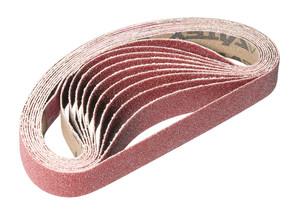
Abrasive belts, discs, non-woven & felt discs are specified by grit type (aluminum oxide, silicon carbide, Cubic Boron Nitride CBN, diamond) and bond (resin, ceramic). CBN and diamond tools for hard or hardened steels provide longer tool life but require precise coolant guidance and suitable workpiece clamping. Abrasive belts with different grit series and coatings are suitable for profile machining or deburring. Felt discs in conjunction with polishing fleeces and pastes produce defined surface roughness and gloss levels. The correct grit and bond are crucial for surface specifications (Ra, Rz values) and workpiece temperature.
Vacuum and Extraction Technology
Extraction systems for grinding dust and coolants reduce fire and health risks. Components include filter inserts (deep to high-efficiency, HEPA options), hose connections with quick couplings, cyclone separators, and vacuum elements for clamping devices. Tools and housings must be antistatic if metallic or carbonaceous abrasion occurs. For wet machining, oil-water separators and cyclone pre-separators are useful for removing residues from the coolant and extending maintenance intervals.
Interfaces for Automation
Accessories for integration into manufacturing cells include fieldbus and Ethernet components, pneumatic connections with quick couplings, electrical motor starters, and frequency converters with controllers for speed and torque control. Mechanical connections require repeatable reference points, e.g., keyways, ball centering pins, or precise flange dimensions. Safety components such as safety doors with safety edges, light curtain adapters, and emergency stop interfaces are often project-specific but must be selected in accordance with standards (e.g., EN ISO 13849).
Practical Examples
Practice 1 – Serial fine machining of tool axes: A production line uses grinding machines from various manufacturers. For consistent results, hardened clamping jaws with interchangeable inserts are mounted and controlled by pneumatic quick-clamping cylinders at 6 bar. The axes are machined using a CBN-equipped surface grinding wheel; coolant is supplied via nozzle systems with finely dosed flow rates. Bearings are lubricated with NLGI 2 grease, intervals are determined by condition monitoring via vibration sensors. The combination of precisely fitting jaws, defined torque, and CBN grinding wheel significantly reduces scrap and downtime.
Practice 2 – Reconditioning of hardened tools: In maintenance, hardened milling cutters are reground. Diamond-coated grinding wheels with a ceramic bond are used; the clamping device is equipped with ceramic contact surfaces to avoid contamination. The machine uses IO-Link sensors to record the tool geometry before and after the grinding process; the dimensions are automatically documented in the control system.
Practice 3 – Integration into a robot cell: To automate a deburring station, an adapter-based interface was developed that connects different grinding machines via a flange with 4x M8 bolts and a precise centering bore. Pneumatic supply lines with quick couplings enable quick exchange. An extraction system with a HEPA filter protects the robot axes from abrasion. Motor control via Ethernet/IP allows synchronization of speeds with the robot path.
Check Compatibility
Before ordering, check: flange dimensions, shaft diameter, keyways, tolerance classes, connection types (electrical/pneumatic), Ingress Protection (IP protection class), and media resistance of sealing materials. For mixed configurations from different manufacturers, adapters with defined centering fits and documented load capacity are the most reliable solution. Technical drawings and 3D models should be compared; CAD data facilitates integration into existing design data.
Maintenance and Replacement Intervals
Regular inspections of seals, bearings, and abrasive levels are necessary. Check sealing rings for cracks and shrinkage, measure shaft and flange play, check the imbalance of rotating parts, and document the service life of abrasives per material and feed rate. Proactive stocking of critical spare parts such as shaft seals, bearing assemblies, and grinding wheels prevents unplanned downtime.
Further technical background on materials, testing methods, and application recommendations can be found on our technology page https://maku-industrie.de/technik and specific application examples at https://maku-industrie.de/anwendungsbeispiele.
Quick Selection Guide
- Select accessories according to the application: precision machining, series production, or maintenance.
FAQs
1. Which sealing materials are suitable for coolants?
For aqueous coolants, EPDM is recommended; for oil or heat-exposed applications, FKM (Viton) is advantageous. NBR is cost-effective but shows limitations at higher temperatures and with certain oils.
2. How do I find the right abrasive for hardened steels?
For hardened steels, CBN or diamond-based abrasives are preferable. Selection criteria include material hardness, desired surface roughness, and machining speed. Ceramic-bonded CBN segments offer high material removal rates with stable form.
3. What should I consider when integrating accessories from different manufacturers?
Pay attention to exact flange and shaft dimensions, tolerance classes, reference bores, and mounting types. Mechanical centering (e.g., dowel pins), standardized connection dimensions, and tested adapters reduce assembly errors and ensure reproducible process quality.