
Vertical grinder for cutting, roughing, grinding and smoothing
Heavy work can be carried out with the vertical grinders, especially in steel construction, mechanical engineering, reinforced concrete construction and in foundries. Their high performance makes this possible.

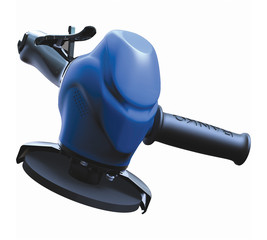

Vertical Grinders for Cutting, Roughing, Grinding, and Smoothing
Vertical grinders are stationary machine tools with a vertically arranged spindle axis, suitable for precise cutting, roughing, and surface finishing operations in industrial manufacturing. They combine high material removal rates with controlled cooling and dust or emulsion extraction, making them particularly useful in metalworking, steel construction, mold and tool making, and the finishing of cast and forged parts. The machine integrates mechanical robustness, modular drives, and variable clamping and conveying technology to reproducibly process complex geometries and tight tolerances.
Structure and Designs
Vertical grinders are available in several designs: compact bench machines for single-part processing, vertical gantry machines for long workpieces, and swivel-mounted units for profile processing. Core components include the unit with spindle and ball/plain bearings, a friction-locked drive system (direct drive or V-belt), the grinding table or transport device, and an adjustment or feed mechanism with servo drive or hydraulic axis. Spindle designs vary between ground high-performance shafts with ceramic seals for wet operation and air-cooled precision spindles for dry processing. For high material removal rates, lubricant-cooled spindles with additional sealing systems are common.
Choice of Drive and Control Technology
The decision between electric direct drives and belt-driven motors influences dynamics, torque, and maintenance intervals. Direct drives offer fast speed changes, uniform torques, and lower vibrations, allowing for the use of finer abrasive grain structures. Belt drives absorb shocks and are advantageous for coarse roughing processes. Modern vertical grinders integrate CNC or PLC-controlled axes with synchronized feed profiles; the control system must coordinate cutting parameters, spindle speed, coolant supply, and extraction performance. For series production, the programming interface (e.g., EtherCAT, ProfiNet) is crucial for connection to Manufacturing Execution Systems (MES).
Abrasives, Tools, and Clamping Concepts
The selection of the abrasive depends on the material, process objective, and cooling system. Corundum or silicon carbide grinding wheels are standard for steel, aluminum, and cast iron; CBN and diamond tools are used for hardened steels and superhard materials. Grain shape, bond (resin, ceramic), and porosity control material removal, self-sharpening, and coolant behavior. Clamping concepts range from magnetic clamping plates to vacuum clamping systems and hydraulic vises; for serial length processing, roller or chain conveyors are integrated. The alignment of the workpiece to the vertical axis and a defined support surface are crucial for reproducibility and parallelism.
Seals, Cooling Systems, and Extraction Technology
In wet operation, labyrinth seals, PTFE lip elements, and NBR or FKM O-rings are used to protect the spindle and bearings from abrasive media. For high temperatures and aggressive coolants, fluorinated elastomers are recommended. The coolant supply must be volumetrically controllable; fine spray nozzles ensure local temperature adjustment and reduce thermal deformation. Extraction technology is not an add-on: volumetric airflows, filter fineness, and mounting location of the extraction hood determine dust class, cleaning intervals, and explosion protection requirements. In potentially explosive atmospheres, ATEX-compliant extraction systems and conductive filter materials are mandatory.
Materials and Typical Application Scenarios
Vertical grinders process steels (unalloyed, alloyed, hardened), aluminum, cast materials, non-ferrous metals, hard materials (ceramics, cemented carbide), and plastics. For steel parts, diamond-coated CBN/diamond segments are often used for preliminary grinding, followed by final grinding with fine-pored resin bonds. For cast and forged parts, a combination of a roughing wheel and a lamella brush-based finish is often useful to prevent burr formation. For aluminum, open bonds with cooling are necessary to prevent clogging. For plastic or composite materials, lower cutting speeds and special abrasives are used to prevent material buildup and lubricating films.
Connection and Integration Aspects
Electrical connection values depend on motor power; typical peaks range from 1.5 kW for compact devices to >30 kW in production lines. Machines should have standardized interfaces for I/O, emergency stop, and safety doors; redundant sensors and door monitoring are necessary in automated cells. Pneumatics for clamping and cleaning functions require pressure preparation (0.6–1.0 MPa) and oil-free air for precise sealing function. The integration of a central coolant system simplifies maintenance, reduces emulsion changes, and enables filter monitoring via level and conductivity measurement.
Maintenance, Availability, and Lifecycle
Maintenance plans focus on bearing condition, seal integrity, abrasive balancing, and filtration performance. Vibration analysis and limit values for bearing play are early indicators for replacement cycles. Regular balancing of grinding wheels reduces bearing load and improves surface quality. Spare parts strategies should prioritize spindle components, seal kits, grinding wheels, and filters as critical spare parts to minimize downtime. In production environments, predictive maintenance with vibration, temperature, and flow monitoring is recommended.
Process Parameters and Quality Control
Key process variables include cutting speed (m/s), infeed (mm), grit size, bond, and coolant supply. For steel roughing processes, cutting speeds typically range between 20–35 m/s; fine grinding may require 10–20 m/s. Infeeds from a few tenths of a millimeter to millimeters influence roughness and burr formation. Inline measuring systems (laser, coordinate measuring machines) allow direct closed-loop control of infeed and peripheral speed. Documented process parameters ensure batch traceability and reduce rework.
Practical Examples
Example 1 — Cutting long shaft stubs: A workpiece 1,200 mm long is supported on rollers, fixed to the cross-feed, and vertically cut with a diamond wheel. The machine uses a direct drive, 18 kW spindle power, coolant via spray nozzles, and an extraction hood with a HEPA filter. The result is a burr-free cut with a cutting surface temperature below 80 °C, eliminating the need for post-processing.
Example 2 — Roughing forged parts: Blanks made of alloy steel are pre-roughened on a gantry vertical grinding machine with a belt drive. Coarse ceramic wheels, hydraulic clamping devices, and synchronous feed are used. After two passes and throttled coolant supply, dimensional accuracy and defined burr edges are achieved; for subsequent finish grinding, CBN is used.
Example 3 — Smoothing cast parts before coating: On a bench vertical grinding machine, cast surfaces are processed with grit 120–220 and a fine bond. The machine uses vacuum clamping, pneumatic feed, and low-viscosity coolant to achieve a surface roughness below 2 µm Ra. This is followed by a quality inspection via optical profilometer.
- Important selection criteria: material, desired roughness, cycle time, abrasive type, cooling system, drive type, interface for PLC/MES, extraction capacity.
Integration into Production Lines
Vertical grinders can be integrated into conveyor systems, robotic cells, or assembly lines. For fully automatic processes, gripper or palletizing solutions, reference points for zero-point clamping systems, and specifications for material supply must be defined. The correct coordination of cycle time, buffer stock, and post-processing steps determines line efficiency. Visit our technology page for further information on integration: https://maku-industrie.de/technik and see specific application examples at https://maku-industrie.de/anwendungsbeispiele.
Safety and Normative Requirements
Machines must be CE-compliant and meet safety requirements such as interlocked safety doors, emergency stop, protective covers, and personnel interlocks. For abrasive dusts, explosion protection (ATEX) and filter class selection must be observed. Occupational safety aspects include noise level limitation, hazard zone marking, and ergonomic control panels.
Conclusion
Vertical grinders are robust production tools for precise cutting, roughing, and finishing processes. Planning priorities include abrasive selection, coolant management, sealing and extraction concepts, and connection to control systems and peripherals. The goal is reproducible component quality with high availability and low maintenance.
FAQs
1. Which grinding wheel is suitable for hardened steel?
For hardened steel, CBN-bonded grinding wheels with a ceramic bond are recommended; they offer high heat resistance, low wear, and consistent roughness values.
2. How is the spindle seal designed for wet operation?
Combinations of labyrinth seals and lip seals with PTFE elements are common; for aggressive coolants, fluorinated O-rings (FKM) are used. Revision intervals depend on operating conditions and filtration effectiveness.
3. Which parameters most strongly influence surface roughness?
Grit size, bond, peripheral speed, and infeed are the primary influencing factors; additionally, the amount of coolant affects thermal effects and clogging, which directly impacts the result.