
Buy compressed air angle grinders in high quality
With compressed air angle grinders, you can effortlessly process even larger workpieces with high performance.
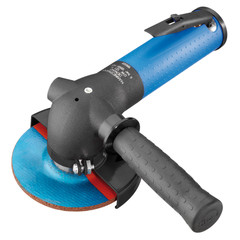
Buying High-Quality Pneumatic Angle Grinders
Pneumatic angle grinders offer significantly different characteristics in industrial use compared to electric devices: they are lighter, impervious to electrical interference, deliver constant power under variable load, and can be used in explosive atmospheres. When purchasing and selecting pneumatic angle grinders, technical parameters, connection compatibility, leak-tightness, and maintainability are paramount. This text focuses on specific features, concrete applications, and practical selection criteria for manufacturing companies.
Performance Specifications and Operating Parameters
Key metrics include no-load speed (rpm), grinding disc diameter, torque, air consumption (l/min), and the required supply pressure in bar. Typical industrial devices deliver no-load speeds between 6,000 and 12,000 rpm with disc diameters from 75 to 125 mm. Higher speeds allow for finer grinding patterns but result in greater thermal stress on the work surface and tools. Torque is relevant for applications with high material removal volumes; for robust removal of weld seams or chamfers, a model with higher starting torque should be chosen. Air consumption often ranges between 200 and 400 l/min; the piping dimensioning and the compressor must continuously meet this demand, otherwise, the speed will drop, and the work result will deteriorate.
Connection, Air Preparation, and Pneumatics
For industrial processes, the correct pneumatic installation is crucial. Devices typically require an operating pressure of 6 to 8 bar. To ensure service life and performance, a filter, a pressure regulator, and an oil mist separator or an automatic lubricator (FRL unit) must be provided in the compressed air line. Moisture damage, foreign particles, and insufficient lubrication lead to premature wear of pistons, bearings, and valves. Metal pipes or oil-resistant hydraulic hoses with appropriate quick couplings are recommended. Common connection sizes are 1/4" or 3/8" NPT/BSP; observe machine specifications. An inline lubricator with adjustable drip rate significantly increases the lifespan of pneumatic drives.
Components, Seals, and Material Selection
Die-cast aluminum housings reduce weight and improve heat dissipation, while steel or magnesium housings offer particular robustness. Pistons and cylinders should have hardened surfaces and precise ground fits. Operating environments with aggressive coolants or high dust content require seals made of NBR, FKM (Viton), or PTFE-spun materials to ensure oil and chemical resistance as well as temperature tolerance. Ball bearings with sealing rings increase service life compared to open bearings. The selection of the flange and clamping system (spindle thread, M14, M10) directly influences tool compatibility and safety.
Safety, Protection, and Ergonomics
Safety aspects are inextricably linked to the choice: metal protective guards, lockable trigger locks, non-slip grips, vibration-damped side handles, and effective noise insulation. Geared drives should be designed so that no sudden forces are transmitted to the operator if the disc jams. Many models offer anti-kickback clutches or freewheel clutches. Ergonomics reduce operating errors and increase productivity; lightweight devices with a balanced center of gravity and multiple grip positions are advantageous for prolonged use.
Tools, Clamping Systems, and Abrasives
The selection of the grinding disc depends on the material and application: for stainless steel, acid-free, fine-grained grinding discs or flap discs with ceramic grit are recommended; for cast iron, coarse Al₂O₃ grits; for aluminum, compact, non-clogging abrasive bodies. Flange systems and clamping nuts (e.g., M14) must match the machine and accessories. Backing pads for flap discs, polishing discs with hook-and-loop fastening, and cut-off wheels made of composite material extend the range of applications. Compatibility with safety guards must be checked.
Practical Application Examples
Autogenous welders in repair manufacturing use 125 mm pneumatic angle grinders with medium speed to grind visible weld beads flush, followed by a flap disc with ceramic grit for finishing. In sheet metal processing, 75 mm models are used to remove burrs from punched edges, with the small disc size allowing work in tight radii. In foundry finishing, more robust devices with reinforced bearings are required to deburr casting burrs on heavy castings; here, attention must be paid to dust-tight seals and effective extraction. When assembling aluminum profiles, softer grinding discs are used to avoid overheating and discoloration.
Concrete practical example 1: A maintenance mechanic processes a 10 mm thick steel plate, roughly removing material with a 125 mm roughing disc, then switching to an 80-grit flap disc for edge smoothing. The compressor consistently delivers 8 bar at 300 l/min; an inline oil supply ensures constant speed and extended gearbox lifespan.
Concrete practical example 2: In assembly, a 75 mm pneumatic angle grinder is used to deburr along weld seams on thin-walled stainless steel pipes. The low mass of the tool reduces vibration input and prevents deformation. A shielded air outlet and an additional dust extraction adapter ensure a clean workplace and longer disc life.
Maintenance, Upkeep, and Spare Parts
Regular maintenance increases availability: daily checking of the air supply for moisture, weekly lubrication of precision bearings according to manufacturer specifications, and monthly checking of flange play and threads are standard. Wear parts such as ball bearings, seals, clamping nuts, and protective guards should be stocked as spare parts. Documented maintenance facilitates fault diagnosis in case of decreasing performance. In the event of leaks, the sealing profiles and O-rings should be checked first before more extensive repairs are undertaken.
Selection Criteria for Purchasers
When procuring, it is important to weigh performance, ergonomics, connection compatibility, ease of maintenance, and spare part availability against each other. For use in explosive atmospheres, ATEX-certified models are required. Cost considerations should focus on life cycle costs rather than just the purchase price: higher initial investments in more robust equipment pay off through longer service lives and reduced downtime.
Practical checklist for selection:
- Required disc size, no-load speed, torque, air consumption, operating pressure, connection size, sealing materials, housing material, certified protection classes (e.g., ATEX), maintenance requirements, and availability of spare parts.
Further Information and Application Examples
Technical details on pneumatics, air preparation, and connection solutions can be found at https://maku-industrie.de/technik. Concrete practical examples from industrial projects are documented at https://maku-industrie.de/anwendungsbeispiele. Use these resources to coordinate the selection and integration of pneumatic angle grinders into your production processes.
FAQs
Which operating parameters are most important for selecting a pneumatic angle grinder?
Primarily pay attention to no-load speed, air consumption (l/min), required operating pressure (bar), disc diameter, and available torque. These parameters determine whether the device reliably performs the planned machining tasks under real process conditions.
How do I avoid premature wear on pneumatic angle grinders?
Use clean, dry, and filtered compressed air, an upstream FRL unit (Filter-Regulator-Lubricator), regular lubrication, high-quality seals (NBR/Viton/PTFE), and replace bearings and seals early according to maintenance intervals.
Which grinding discs are suitable for stainless steel and aluminum?
For stainless steel, finer, acid-free grinding discs or flap discs with ceramic grit are suitable to minimize heat damage and discoloration. For aluminum, non-clogging, soft abrasives are necessary; if required, use polishing felts or abrasive polishing pastes to avoid oxidation and material adhesion.