
Order accessories for grinding tools by Mannesmann Demag at the same time
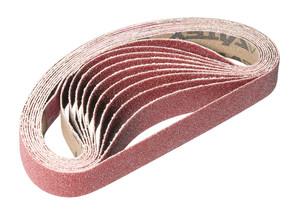
Order sanding belts, sanding sheets, holders, sanding arms,... for compressed air grinding tools by Mannesmann Demag from maku.




Order accessories for Mannesmann Demag grinding tools at the same time
Accessories for Mannesmann Demag grinding tools include components that significantly increase performance, service life, and process reliability in mechanical processing. On this category page, you will find suitable spare and complementary parts for hand grinders, eccentric grinders, belt grinders, and accessories for stationary grinding units. Material selection, design, and connection type are crucial, as only then can grinding wheels, backing pads, clamping, and damping elements interact optimally.
Materials and Material Selection
The selection of the right material for accessories influences abrasion resistance, temperature behavior, and service life. Backing pads and grinding plates are typically made from glass fiber reinforced plastic (GFRP), aluminum, or hardened steel. GFRP offers good damping with low weight, aluminum increases heat dissipation and stiffness, and hardened steel is preferable when maximum load capacity and plane-parallel precision are required. Grinding wheel adapters and clamping nuts are often made of alloyed steel or brass to prevent discoloration and contact corrosion. Elastic elements such as rubber buffers, seals, and O-rings consist of NBR, FKM, or EPDM — NBR for oil and abrasion resistance, FKM for high temperatures and chemical resistance, EPDM for UV and weather resistance.
Designs and Dimensions
For frictionless operation, the appropriate design is crucial: the diameter and hook-and-loop or clamping systems of the grinding plates must precisely match the clamping mount of Mannesmann Demag tools. Typical diameters range from 28 mm for fine grinding attachments to 150 mm and more for eccentric grinders. The height and web profile of the plate influence the surface pressure distribution; flat plates are suitable for planar work, curved plates for contour grinding. Adapter plates and mounting sleeves are available in versions with internal thread, external thread, quick-release mount, or locknut system. Pay attention to the thread pitch and the author identification (M8, M10, M14, 5/8"-11) of the Mannesmann Demag tools, otherwise the accessories will not fit mechanically.
Connections, Clamping Systems, and Safety
Grinding accessories include connecting elements such as clamping nuts, hex adapters, and quick-release systems. For high-frequency and eccentric grinders, balanced clamping nuts are required to reduce vibrations. For stationary mounts, flanges and mounting plates offer precise alignment. Electrical connection components such as connector housings or cable glands are important for tools with integrated motors and must comply with the machine's IP protection classes. Additionally, safety elements such as circlips, locknuts, and vibration dampers are part of the accessories to prevent loosening under load. For safety-relevant parts, you should pay attention to certifications and material tests.
Seals, Bearings, and Lubrication
Seals protect bearings and motor components from grinding dust and coolants. Suitable designs include flat gaskets, O-rings, and lip seals, each matching the temperature and chemical load of the process. Bearings as accessories are predominantly supplied as sealed angular contact ball bearings or deep groove ball bearings; they are usually filled with special greases for high speeds and temperature stability. For wet grinding applications, bearings and seals must be corrosion-resistant, for example, with stainless steel or coatings. Use greases that are compatible with the sealing materials to avoid swelling or embrittlement.
Abrasives, Plates, and Backing Pads
The compatibility of abrasive and backing pads is central to surface quality and productivity. Grinding wheels differ in grit type (SiC, aluminum oxide, ceramic), grit size, and bond (resin-bonded, ceramic). Ceramic grits retain their cutting properties longer with high cutting force, aluminum oxide is universally applicable, SiC is preferred for non-ferrous materials. Backing pads and support plates must promote heat dissipation and ensure a plane-parallel position to avoid fraying and ripple formation. For flexible grinding pads, lamellar carriers are useful, for hard applications, closed pads.
Application Areas and Practical Examples
Accessories can be precisely adapted to process requirements. Practical examples show relevant decisions and effects: In the contract manufacturing of a steel constructor, an M14 adapter was replaced by a hardened aluminum adapter to improve heat dissipation when deburring large plates; the service life of the grinding wheels increased by 30 percent. In the surface processing of aluminum profiles in the furniture industry, GFRP backing pads with soft rubber inserts were used to avoid edge abrasion and produce the surface without rework. In a mechanical engineering company, the switch from standard NBR O-rings to FKM seals in wet processes eliminated failures due to chemical attacks and allowed planned maintenance intervals to be met. For precise contour grinding fragments in tool manufacturing, a combination of curved pads and ceramic grinding wheels is often used to produce shapes quickly and reproducibly.
Further technical information and application examples can be found on the overview page Technology and in the collection of specific applications under Application Examples.
Selection Criteria for Purchasing
When ordering accessories for Mannesmann Demag grinding tools, you should check the following core criteria: fit accuracy to thread and mounting system, material properties regarding temperature and chemicals, dynamic balancing for rotating parts, sealing degree for wet applications, and ease of maintenance. An expert opinion on material and test standards, agreed with the supplier, reduces downtime and rework. Also, consider the availability of spare parts and repair kits, as identical components are needed over longer production runs.
Maintenance, Replacement Intervals, and Storage
Regular inspection and timely replacement of wear parts extend the service life of the entire machine. Check magnetic clamping surfaces, plate flatness, sealing rings, and bearings for wear. Diagnostic criteria include increased vibration, temperature rise at the mount, and visible imbalance. Store grinding wheels dry, at a controlled temperature, and properly according to manufacturer specifications to prevent degradation of the bond. Spare parts should be identical in batches to avoid incompatibilities.
Compatibility Check Before Ordering
For a quick compatibility check, compare manufacturer specifications for thread, mounting diameter, and plug-in system. In case of uncertainties, we recommend providing technical drawings or photographs of the mount so that the correct accessories can be supplied. For customized solutions, we offer adjustments in material and configuration.
- Typical accessory categories: backing pads, adapters, clamping nuts, seals, bearings, vibration dampers, hook-and-loop and adhesive systems, grinding wheel carriers
Ordering Information
Order accessories for Mannesmann Demag grinding tools together with the main tool to minimize delivery times and avoid assembly errors. Use the product filters on the page to select by diameter, thread, and material, or contact technical sales for matching and custom designs.
FAQs
Which thread sizes are common for Mannesmann Demag grinding tools?
Common sizes are M8, M10, M14, and 5/8"-11; check the tool's nameplate or technical drawing before ordering to correctly choose thread pitch and direction.
Which sealing materials are suitable for wet grinding with coolant?
FKM is recommended for high chemical resistance and temperature stability, or EPDM for less aggressive media; NBR can be used with oil-containing coolants, but is chemical-dependent.
How do I know if a backing pad needs to be replaced?
Replacement indicators include visible deformations, embedded deposits, reduced flatness, increased vibrations, and irregular grinding patterns; in case of any suspicion, compensation checks and, if necessary, replacement should be carried out.