
Pistol grip nutrunners for constant fastening
Cleco nutrunners as pistol grip for high quality fastening with compressed air. The pistol grip ist available in T- and P-design.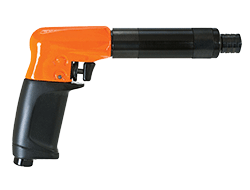
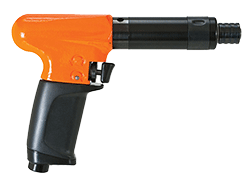
Pistol-Grip Torque Screwdrivers for Consistent Fastening
Pistol-grip torque screwdrivers combine ergonomic handling with reproducible torque control for industrial series fastening applications. Cleco pistol-grip torque screwdrivers are designed for continuous operation with compressed air and offer stable control characteristics, short reaction times, and long service life. The pistol grip is available in T-form and P-form, covering different access and force vectors in the manufacturing process. This category addresses users in metalworking, assembly of aggregates, gearbox manufacturing, and all areas where consistent screw connections and short cycle times are crucial.
Construction and Materials
The housings of pistol-grip torque screwdrivers are predominantly made of aluminum alloys or glass-fiber reinforced plastics to achieve an optimal balance between stability and weight. Drives and planetary gears are made of hardened steels; critical bearing points use rolling bearings with special lubrication intervals for high-performance cycles. Drive shafts and clutches can be equipped with ceramic coatings or hardened inserts to minimize wear at high cycle rates. The selection of seals depends on media and temperature: NBR seals for standard oils and moderate temperatures, FKM/Viton for higher temperatures and aggressive lubricants, PTFE for best possible chemical resistance. Materials for outputs and bits should be roughly chromated or nitrocarburized to reduce corrosion and increase service life.
Drive and Control Technology
Pneumatic torque screwdrivers offer constant torque over defined pressure ranges; integrated pressure reducers and fine adjustment screws are available for precise settings. Torque control is performed mechanically via clutch mechanisms with definable release characteristics or electronically via inline torque sensors in combination with feedback to assembly systems. Parameterizable shut-off torques, adjustment ranges, and readjustment mechanisms enable integration into lines with process monitoring. Air intake filters with compressed air oilers ensure long-term stable lubrication of the gearbox; alternative self-contained lubrication reservoirs are available for sensitive production environments to avoid oil mist.
Connections, Hoses, and Fittings
Compressed air connections follow common industrial profiles: 1/4" and 3/8" BSP/NPT for handheld devices, quick couplings according to ISO 6150-A, and universal flat-face couplings to minimize leakage. Hoses should be designed for operating pressures up to 10 bar; for higher peak pressures, reinforced spiral hoses or steel lines are preferable. Silencers at the outlet reduce noise emissions, while inline moisture separators separate condensate before the filter and regulator. The selection of connectors and hose diameters influences response behavior and torque transmission; for long line lengths, a larger inner diameter is recommended to minimize pressure losses.
Seals, Maintenance, and Service Life
Maintenance intervals depend on operating hours and environmental conditions. Typical intervals for seal replacement are between 1,000 and 5,000 operating hours; proactive replacement in case of increased air consumption or performance loss prevents quality degradation. Lubrication interval and oil quality are crucial for bearing life. In explosion-proof areas, special sealing materials and antistatic coatings, as well as ATEX-compliant versions, are required. Spare parts kits for seals, bearings, and pistons are available as kits and reduce downtime.
Application Areas and Process Integration
Pistol-grip torque screwdrivers are suitable where operator frequency, accessibility, and reproducibility play a role: assembly of engine blocks, gearbox construction, line and rack assembly, maintenance of large assemblies, and series production of fasteners in steel and aluminum components. The pistol grip facilitates quick hand changes and reduces fatigue during repetitive cycles. For inline integration, versions with clockwise/counter-clockwise rotation, signal feedback, and shaft or hex drives for direct tool integration are available. For automated positioners, mounting flanges and mounting holes are provided ex-works.
Ergonomics and Usability
T-form pistols offer a neutral hand position with high torque transmission, while P-form pistols reduce reach angles and are preferable in confined installation spaces. Grip materials with a structured surface improve grip stability with oily hands; vibration-damping inserts reduce transmission to the hand. Weight compensation through internal masses or additional weights allows fine-tuning for different production environments. Controls are clearly positioned, often with locking for continuous operation and mechanical reset functions to prevent unintentional starts.
Practical Application Examples
Practical example 1: In gearbox manufacturing, a Cleco P-form pistol-grip torque screwdriver is used to fasten the securing screws on bevel gear housings with 40 ± 2 Nm. An adjustable pressure reducer sets the air pressure so that the mechanical release clutch cleanly disengages upon reaching the target torque. The device is connected to a 3/8" quick coupling; inline fine filters prevent particle ingress, and FKM seals are used due to temperature stress.
Practical example 2: In an assembly line for electric motors, a T-form pistol is used to tighten the housing screws with 12 Nm. The tool alignment allows ergonomic component changes in less than five seconds. An electronic signal from the torque screwdriver reports each successful fastening cycle to the MES and documents the fastening data batch-specifically.
Practical example 3: In the maintenance of a production line, a technician replaces a worn bit holder on-site. The spare parts kit includes a piston ring, guide bush, and O-ring; replacement takes less than 20 minutes, followed by a functional test with a defined target torque and air pressure. A self-contained lubrication reservoir is used to avoid oil mist.
Selection Criteria Before Purchase
Choose a model based on target torque, accessibility, connection to control systems, and required cycle times. Check material compatibility, sealing materials, and required certifications (e.g., ATEX, ISO 5393 noise level). Pay attention to the availability of spare parts kits and service contracts, as well as the possibility of integrating the tool into existing lines with data acquisition. Further technical information and data sheets can be found under Technik and specific application examples under Anwendungsbeispiele.
- Typical connection and parameter variants: 1/4" and 3/8" air connection, quick coupling according to ISO, mechanical release clutch, electronic torque feedback.
Quality Assurance and Process Reliability
To ensure reproducible fastenings, the integration of feedback systems that log shut-off torques and cycle times is recommended. Statistical process control (SPC) with batch formation allows early detection of deviations. Calibration schemes for torque sensors and regular audit plans for sealing and lubrication intervals reduce unforeseen failures. For critical assemblies, the combination of mechanical release and electronic verification is useful to minimize tolerances and guarantee traceability.
Scope of Delivery, Accessories, and Spare Parts
Standard scope usually includes the pistol with standard bit holder, air connection, silencer, and operating instructions. Optional accessories include extended bits, angle attachments, torque adapters, PE protective sleeves, replacement seal kits, and mounting brackets. For production lines, manufacturers offer assembly kits with mounting flanges and remote control interfaces. Spare parts should be available as pre-assembled kits to reduce downtime.
Conclusion
Pistol-grip torque screwdrivers provide a robust, maintainable, and process-reliable solution for industrial fastening. The right combination of material, seals, connections, and control options determines service life and process stability. Use technical data sheets and application examples to select the appropriate model and check service and calibration options before commissioning.
FAQs
1. Which pistol grip form is suitable for confined spaces, T-form or P-form?
The P-form is preferable in confined installation situations as it has lower reach requirements; the T-form offers better leverage and ergonomic neutral positioning for repetitive high-torque fastenings.
2. Which seal is recommended for elevated temperatures and oil contact?
FKM/Viton seals are the preferred choice for higher temperatures and oil contact; for aggressive chemicals or extreme stress, PTFE-based solutions should be considered.
3. How often should seals and bearings in the torque screwdriver be maintained?
Maintenance intervals vary depending on use, typically seal changes every 1,000–5,000 operating hours are advisable; check bearings and lubrication according to manufacturer specifications and immediately in case of performance loss.