
Buy low-priced PVC-hoses by Parker Legris online

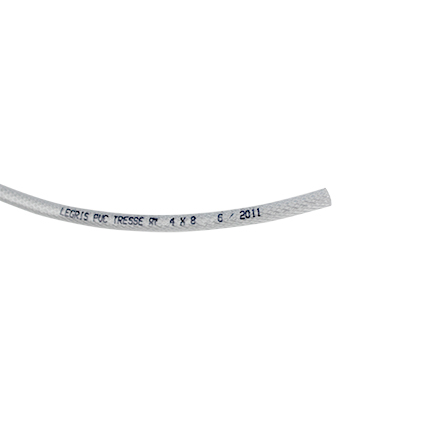
Properties and Construction of Parker Legris PVC Braided Hoses
Parker Legris PVC hoses with braided reinforcement consist of transparent, low-plasticizer PVC with integrated fabric layers of polyester or high-strength textile filament. The braided reinforcement increases pressure resistance and prevents longitudinal and transverse expansion under operating pressure, providing the hose with dimensionable pressure and vacuum properties. The translucent material allows for visual inspection of media flow, particles, and contaminants, which is crucial in food and technical production processes.
Material Properties and Approvals
Parker Legris PVC is often food-grade according to common standards (e.g., EU regulations for food contact and FDA-compliant raw materials). Typical properties include good transparency, low gas permeability compared to soft silicone solutions, moderate chemical resistance to diluted acids, alkalis, and alcohols, and high abrasion resistance due to the braided reinforcement. Temperature range, flexibility, and resistance vary depending on the compound: Standard PVC braided hoses typically operate from -10 °C to +60 °C; special formulations allow for temporarily higher temperatures or better cold flexibility.
Construction Variants and Designs
Parker Legris offers PVC braided hoses in various wall thicknesses, fabric layers (single or multi-layered), and inner diameters. Common designs include smooth inner surfaces for minimal pressure loss and easy cleaning, as well as structured outer layers for better handling. Special versions feature antistatic additives, UV stabilization, or increased plasticizer resistance, depending on the industry and application.
Pressure and Vacuum Behavior
The braided reinforcement stabilizes the wall against bulging under pressure and improves vacuum performance. For each nominal size, there is a pressure class specified in bar. In practical applications, it is important to consider the safety factor relative to the maximum operating pressure and to apply temperature and bending radius corrections, as pressure resistance decreases at elevated temperatures.
Applications in the Food and Process Industry
In the food sector, Parker Legris PVC braided hoses are used where visual inspection, moderate pressure requirements, and chemical resistance to cleaning agents are necessary. Typical applications include: beverage filling systems, tank filling, extraction lines for liquid ingredients, hose connections on mixers, laboratory feeds, and supply lines in bakery and dairy technology. The transparency allows for immediate detection of turbidity, air bubbles, or product contamination, simplifying quality assurance.
Practical example: In a beverage filling plant, a 12 x 16 mm Parker Legris PVC braided hose connects the dosing pump to the filling machine. The braided reinforcement prevents bulging at 3 bar operating pressure; the smooth inner surface reduces residues, and visibility allows for inline inspections without downtime.
Practical example: In a dairy, a 19 x 25 mm hose is used for basket emptying. After each batch, a CIP rinse with warm alkaline cleaner is performed. The chemical resistance of the PVC and the reinforced wall thickness allow for multiple cleaning cycles, provided temperature and exposure time are maintained.
Industrial Applications Outside Food Production
In addition to the food industry, PVC braided hoses are used in general production, paint shops, low-pressure pneumatic setups, for drainage, low-pressure compressed air, and in cooling circuits. Their mechanical robustness makes them suitable for applications with frequent handling and localized abrasion.
Connections, Fittings, and Seals
The choice of the correct connection type influences tightness and ease of maintenance. Suitable connections include stainless steel hose clamps, crimp or press fittings, push-on barbed fittings, and quick couplings. For food-related applications, stainless steel 1.4301/1.4401 fittings with suitable seals (EPDM, FDA-compliant NBR, or silicone depending on temperature and medium) are the common choice.
Sealing materials: EPDM offers good resistance to hot water and many cleaning agents, NBR is better against oils and fats, FKM (Viton) for high temperatures and aggressive chemicals, silicone for high flexibility at low temperatures. The combination of hose material, clamp type, and seal determines the maximum permissible operating pressure-temperature combination.
Installation Instructions
When attaching hose ends to barbed or cartridge fittings, sufficient overhang must be provided so that the hose clamp or crimp securely fixes the hose. Before installation, inner surfaces must be checked for foreign bodies. Observe the bending radius: tight radii increase local pressure and reduce flow; it is recommended to adhere to manufacturer specifications. For chemical media, samples for compatibility tests are required, as additives in PVC can react with some solvents.
Cleaning, Sterilization, and Service Life
PVC braided hoses are suitable for CIP (cleaning-in-place), provided that temperature and chemical loads do not exceed material limits. Hot water periods above 60 °C shorten service life; strong oxidizing agents (e.g., concentrated peroxides) attack PVC more severely than neutral cleaners. Sterilization by steam is only possible to a limited extent; instead, in sensitive areas, interchangeable disposable lines or silicone-based alternatives are often used.
Service life depends on mechanical stress, media, temperature cycles, and cleaning cycles. Regular inspection for cracks, bulges, and discoloration is necessary. Replacement intervals should be determined operation-specific based on test results and manufacturer specifications.
Selection Criteria and Dimensioning
For the correct hose selection, inner and outer diameter, wall thickness, operating pressure, temperature range, chemical compatibility, bending radius, hose length, and food approvals are crucial. Transparent PVC with braided reinforcement offers advantages in visual inspection and mechanical stability but is not the best choice for high-temperature or highly oily media. For each application, a comparison between pressure requirements, temperature load, and cleaning chemistry is necessary.
Practical example: For a syrup feeding line, a hose with double braided reinforcement is chosen to absorb viscoelasticity and fluctuations in operating pressure. The fittings are equipped with EPDM seals to ensure hot water cleaning and moderate acid exposure.
Compatibility, Storage, and Handling
PVC hoses should be stored cool, dry, and protected from light to prevent embrittlement and plasticizer loss. UV exposure leads to discoloration and material degradation; for outdoor applications, UV-stabilized variants should be chosen. When handling, pay attention to kinks and sharp edges; cut edges must be cleanly deburred.
Compatibility Testing
Before use in new processes, compatibility tests with product and cleaning media are required. These include visual inspection after exposure, mechanical measurements of the cross-section, and pressure tests under real temperature conditions. For technical details and standard measurements, use Parker Legris product documentation or consult technical advice, e.g., at https://maku-industrie.de/technik/.
Why Parker Legris PVC Braided Hoses?
Parker Legris combines industrial quality with food-compliant material selection and transparent design for process safety. Available variants cover a wide range of operating conditions, from simple conveying tasks to hygienically relevant applications, with the braided reinforcement providing a balanced combination of flexibility and pressure stability. For specific application examples and installation cases, visit https://maku-industrie.de/anwendungsbeispiele/.
Technical Recommendations Before Ordering
Define inner diameter and wall thickness based on volume flow and expected pressure peaks. Determine pressure class, temperature range, and required approvals. Select connection types and seal type according to medium and cleaning procedure. Request material certificates and FDA/EU declarations of conformity from the supplier if food contact is involved.
FAQs
1. Are Parker Legris PVC braided hoses food-grade?
Many Parker Legris PVC braided hoses are formulated for food applications and comply with common EU/FDA requirements; exact conformities are product- and batch-specific and must be confirmed by certificates.
2. What are the maximum operating pressure and temperature range?
The maximum operating pressure varies depending on the nominal size and fabric layer; typical values are in the low to medium bar range. Standard temperature ranges are approximately -10 °C to +60 °C; special compounds allow for extended ranges; refer to product data sheets for exact figures.
3. Are these hoses suitable for CIP/SIP procedures?
PVC braided hoses can be used for CIP, provided that temperature and chemical loads do not exceed material limits. Complete sterilization (SIP) by hot steam is limited; check manufacturer specifications and perform compatibility tests.