
Order 2 way manifolds made of brass and brass nickel plated


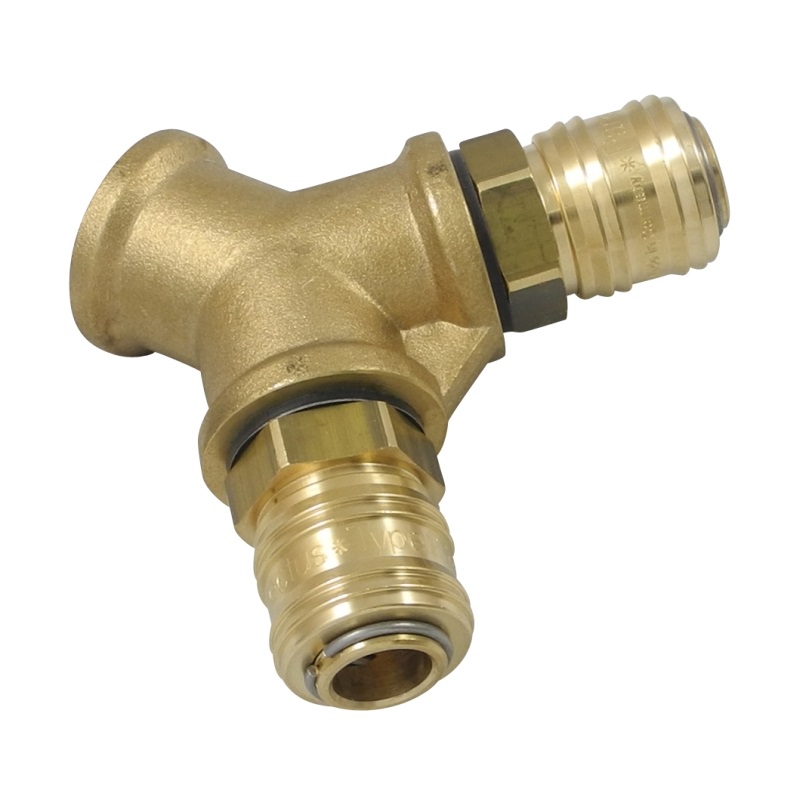

2-Way Manifolds Made of Brass and Nickel-Plated Brass: Technical Selection Criteria and Application
2-way manifolds made of brass or nickel-plated brass are compact components for splitting a medium flow into two outlets with minimal pressure loss. Typical applications include pneumatic controls, low-pressure hydraulics, medium distribution in production lines, and supply points for tools and measuring devices. Key selection criteria are material, thread or pipe connection type, sealing material, leak-tightness during pressure changes, and the availability of pre-assembled quick couplings.
Materials and Corrosion Protection
Brass offers an excellent combination of machinability, strength, and corrosion resistance against humidity and non-aggressive aqueous solutions. For enhanced resistance in more aggressive environments or for aesthetically demanding installations, nickel-plated brass is available: nickel plating increases surface hardness, improves chemical resistance to slightly acidic and alkaline media, and reduces abrasion on connection surfaces. For specific requirements, such as food or drinking water applications, attention must also be paid to the alloy (e.g., CW617N) and potential dezincification resistance. In explosive atmospheres or with highly abrasive media, stainless steel is preferred; brass manifolds can only be used there after specific testing.
Designs and Dimensions
2-way manifolds come as compact T-pieces, Y-variants, or flat multi-manifolds with a central inlet and two symmetrical outlets. The most common nominal sizes in the shop cover industry requirements: 1/4", 3/8", and 1/2". Important criteria are the inner diameter and wall thickness of the manifold channel, as these directly influence the volume flow and pressure loss. In air applications, a channel that is too small at high flow rates leads to a noticeable pressure drop and heat generation; in fluid applications, the flow velocity increases, which carries erosion risks at connection edges.
Connection Types and Sealing Systems
Connection options range from cylindrical pipe fittings to tapered pipe threads (BSPT/NPT), compression fittings, and quick couplings. Cylindrical threads (BSPP) are common for re-sealable connections, while tapered threads create a better sealing effect through conical compression. Seals typically consist of NBR for general purposes, FKM/Viton for higher temperatures and chemical-resistant applications, or EPDM for steam applications. In pneumatic systems, integrated O-ring seats or PTFE washers are often installed in the thread to achieve leak rates below 1·10^-6 mbar·l/s. When using quick couplings, compatibility of the sealing system with the coupling design must be ensured, as dynamic seals require different materials than static screw connections.
Pre-assembled Quick Couplings: Advantages and Variants
2-way manifolds with pre-assembled quick couplings save assembly time and reduce leakage points. There are two main variants: passive coupling ends, which are factory-assembled, and paired systems, where the manifold contains the coupling socket and the plug side is connected by the user. Quick couplings differ in locking mechanism (form-fit vs. sealing slide), flow cross-section, and locking type (spring clip, screw lock, bayonet). For applications with frequent coupling, more robust locking mechanisms and wear-resistant seals are recommended. Pay attention to markings for flow direction and valve technology (closed or open passage when uncoupling) – the latter influences the residual pressure behavior of the supply lines.
Factors Influencing Performance Data
Performance specifications such as maximum pressure, permissible temperature, and flow must be matched with system requirements. Brass manifolds typically achieve operating pressures up to 16 bar for water and 10 bar for lubricated air, depending on the sealant and thread design. Temperature specification is often determined by the O-ring selection: NBR up to approx. +90 °C, FKM up to +200 °C. For expansions and thermal load changes, soft seals are preferred over medium expansion, where rigid metal-to-metal seats tend to leak. For vacuum applications, check leak rate specifications and prefer designated vacuum seals or special brass alloys with low gas permeability.
Assembly and Installation Position
The assembly of 2-way manifolds requires torque control on screw connections, suitable sealants (PTFE tape or liquid sealants for tapered threads), and, if necessary, alignment of the outlets to minimize kinking stress on connecting lines. For flexible hoses, kink protection and strain relief are important to prevent tensile forces from being transferred into the thread. Installation plastic protection, e.g., against mechanical damage in conveyor lines, extends service life. For differentiated temperature cycles, expansion joints or hose systems with length compensation are required to avoid stress on the manifold.
Practical Application Examples
Practical example 1: In an assembly island for compressed air supply to two pneumatic hand tools, a 2-way manifold with 1/4" connections and pre-assembled quick couplings is used. The manifold is made of nickel-plated brass to prevent corrosion caused by cooling lubricant aerosols. By choosing FKM O-rings, leak-tightness is maintained despite increased temperature loads from nearby hot couplings. The manifold is fixed with a pipe clamp against vibration; this eliminates the need for readjustment of the couplings during shift changes.
Practical example 2: In a water-carrying measurement setup station, a 2-way 1/2" manifold divides the inlet into two calibration cells. To minimize measurement errors, a manifold with a smooth, large inner cross-section was chosen; all seals are made of EPDM to ensure long-term stability during temperature cycles and low permeation. The manifold connections are firmly screwed; in case of maintenance, a shut-off upstream allows pressure-free removal of the cells.
Practical example 3: In a paint shop, a nickel-plated brass 2-way manifold supplies two spray guns with compressed air, thereby reducing the number of separate supply lines. The quick couplings are designed so that the gun valve remains closed when uncoupled, minimizing paint deposits in the line. Cleaning cycle and filtration are matched to material compatibility.
Quality Criteria and Tests
Series-tested manifolds should have undergone pressure tests (hydraulic test) and leak tests under temperature changes. Measured values for permissible leakage current, breaking torque of screw connections, and corrosion resistance provide information about long-term behavior. For safety-relevant applications, batch information and material certificates (e.g., EN or ASTM references) are useful. In the online offer, you will find technical data sheets and drawings that enable precise design: https://maku-industrie.de/technik.
Purchase Recommendation and Selection Aid
Choose a manifold based on the following briefly summarized criteria:
- Medium and pressure/temperature range, select suitable sealing materials
- Connection type (1/4", 3/8", 1/2") according to hose/line and flow dimensioning
- Nickel plating for increased corrosion exposure or aesthetic requirements
- Pre-assembled quick coupling for frequent changes, otherwise screw connections for permanent installations
- Test certificates and material proofs for safety-critical applications
Further Information and Service
Technical background information on materials, seals, and testing procedures, as well as concrete application examples, can be found compactly on our technology page and in the application example collection: Technology, Application Examples. For project-related designs, we provide flow calculations and material proofs upon request.
FAQs
1. Which seal is the best choice for compressed air in 2-way manifolds?
For standard compressed air applications up to approx. +90 °C, NBR offers the best price-performance ratio. For higher temperatures or oily media, FKM O-rings are preferable.
2. When is a nickel-plated version useful?
Nickel plating is recommended for increased corrosive loads (e.g., aerosols, humid environments) as well as for frequent mechanical stress on the surface; it also increases wear resistance at contact surfaces.
3. Can I later convert a manifold with a pre-assembled quick coupling?
Yes, many manifolds allow the exchange of coupling sockets for tapered threaded fittings; however, check the thread and seal format as well as manufacturer's instructions regarding warranty. When converting, the re-testability of the leak-tightness must be ensured.