- Categories
- Quick Couplings & Plugs
- Hoses
- Blow-Guns
- Fittings
- Connectors
- Function Fittings
- Service Units
- Air Motors
- Grinding Technology
- Motors for Drilling
- Robot Deburring Spindles
- Fastening Technology
- Booster
- Solenoid valves & valves
- Compression fittings
- Workplace Design
- Spring Balancers / Balancers / Hose
- Isolating Valves
- Ermeto hydraulic tube fittings
- SensoControl
- Subject Areas
- Brands
- Technology
- Info
Protection from 1000 volts with insulated adapters
By using high-voltage insulated adapters and quick-change adapters from Apex, you can increase the safety of your team when working on high-voltage systems. This includes potential hazards from high voltage contact, live parts, short circuits and tool grounding. Optimize protection measures by combining the adapters with Apex's free-spinning u-GUARD attachments. This effectively reduces or eliminates the risk of bruising, even when wearing gloves.
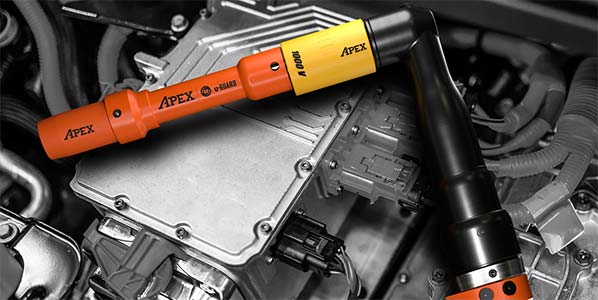
968158PT Isolated quick change adaptor
968614PT Isolated quick change adaptor
968157PT Isolated quick change adaptor
968883PT Isolated quick change adaptor
NC-EXEI-252 Isolated socket adaptor
NC-EXEI-374 Isolated socket adaptor
NC-EXEI-504 Isolated socket adaptor
Insulated Adapters for Protection up to 1000 Volts: Technical Overview and Application
Insulated adapters and quick-change chucks for screwdriving tools are specified to reduce electrical hazards on high-voltage systems up to **1000 volts**. Unlike conventional adapter solutions, these components combine electrical insulation materials with mechanically precise connection technology. Crucial design parameters include material composition, creepage distances, dielectric strength, contact connections, and sealing systems. The products in this category are aimed at users in automotive manufacturing, energy systems, test benches, and maintenance teams who regularly work on high-voltage plug connections, battery housings, and power distributors.Materials and Construction
Insulated adapters typically consist of a multi-layered construction: an inner core of high-strength tool steel or alloyed chrome-vanadium steel ensures power transmission and torsional rigidity to precisely transfer the torque of the screwdrivers. This core is encapsulated via an injection molding process or chemical bonding agents with a **high-modulus insulating jacket** made of glass-fiber-reinforced polyamide (PA), PEEK, or comparable high-performance plastics. Alternatively, thermosetting systems with ceramic fillers are used when increased temperature or flame protection requirements exist. Important for electrical safety are the dimensioned creepage and air clearances according to IEC/EN standards. The insulation layer is designed to provide sufficient safety distance to the metallic core at 1000 V operating voltage. Additionally, reinforced outer sleeves are often integrated to mechanically repel impacts, chemicals, and abrasion without impairing the insulation function.Connections, Interfaces, and Designs
Insulated adapters are available in several designs: short hand-shaft adapters for manual screwdrivers, longer extension adapters for hard-to-reach areas, and quick-change chucks for automated screwdriving systems. Plug connections conform to common tool standards (e.g., 1/4", 6.35 mm hexagon) and are designed with precise locking mechanisms to ensure positive and friction-locked transfer. For use with impact wrenches and process-reliable torque machines, reinforced locking grooves and hardened detent mechanisms are installed. The contact point to the bit is often designed with an insulating inner sleeve that ensures continuous electrical separation up to the tool tip. In quick-change chucks, spring-loaded locking elements are additionally designed so that they do not form a conductive bridge under voltage. Special versions also offer an integrated keyway to guarantee alignment accuracy at high torques.Seals, Surfaces, and Environmental Protection
In environments with oil, coolants, or corrosive media, seals and surface treatments are essential. Insulated adapters use highly resistant fluororubber seals (FKM/Viton) or EPDM for temperature and chemical resistance at transition points. Outer surfaces are often provided with ceramic coatings or passivating resins to minimize abrasion and chemical attacks. These measures reduce the risk of insulation materials forming micro-cracks through which moisture can penetrate. Moisture and contamination are major factors for creepage current formation and reduction of dielectric strength.Testing and Certification
Products in this category are typically tested according to IEC 60900 and DIN EN 60900 if they are intended for work on live parts. Test procedures include electrical dielectric strength testing, creepage current measurement, and mechanical endurance tests under load cycles. Production batches are frequently sampled with electrical insulation tests, and critical dimensions are monitored using a coordinate measuring machine (CMM) to ensure dimensional accuracy and locking function.Practical Examples – Structured Application
Example 1: In the assembly of high-voltage battery systems in electric vehicles, an insulated extension adapter is used to reach interior screw connections on the battery box. The adapter consists of a hardened core for transmission stability and a glass-fiber-reinforced polyamide jacket with a specific creepage distance. The assembler uses an electrically insulated torque screwdriver, which is positively connected by the quick-change chuck. The combination of insulation and precise locking reduces the risk of a short circuit in case of unintentional contact with battery terminals. Example 2: In the maintenance of charging stations for electric buses, insulated bits with quick-change chucks are used to disassemble chargers without switching off the protective devices. The adapters have integrated O-ring seals at the transitions to prevent the ingress of dust and moisture. Before starting work, an insulation test of the tool and a visual inspection of the creepage distances are carried out, as prescribed in the operating instructions. Example 3: In test benches for electric drives, insulated quick-change chucks are used in combination with test adapters that allow rapid repeatability of screwdriving operations. The chucks have a ceramic-reinforced outer layer to withstand high cycle rates and abrasive loads. The test ranges are calibrated so that the electrical insulation is maintained over the entire cycle duration and documented test evidence is provided.Selection Criteria for the Right Solution
When selecting insulated adapters, the following criteria are decisive: operating voltage (here: **1000V**), expected mechanical load, environmental conditions (temperature, chemicals, moisture), compatibility with existing bits and screwdriving systems, and required test and approval standards. Technical drawings of the connection areas and an indication of the maximum transmissible torques are required for process integration. For automated production lines, the mass and center of gravity of the adapters should also be known to avoid vibration and balancing problems with robot arms. Recommendation: Before series procurement, test prototypes with test procedures under real conditions. Documented test protocols (electrical and mechanical) are part of the acceptance and should be integrated into quality assurance.Compatibility and Accessories
Insulated adapters are compatible with common screwdriving tools and bits, provided that standards and dimensions match. For special applications, there are adaptations with suitable switching or torque interfaces, as well as color-coded outer sleeves for quick identification of insulation classes. Replacement seals, O-rings, and separate maintenance kits extend the service life and maintain electrical safety. Further technical information and detailed application cases can be found on our technology page: https://maku-industrie.de/technik and on the page with concrete application examples: https://maku-industrie.de/anwendungsbeispiele. * Key advantages: tested dielectric strength up to 1000V, robust power transmission, resistant to industrial media, and easy integration into automation processes.Maintenance and Test Cycles
Regular visual inspection for cracks, material changes, and damage to the insulation layer is mandatory. Electrical insulation measurements at specified intervals (e.g., annual repetition or after defined operating hours) should be documented. Damaged adapters must not be reused. For replacement parts, original seals and manufacturer specifications must be used to maintain the certified insulation values.Procurement and Storage
When storing, dry, dust-free conditions with moderate temperatures are preferable. Direct sunlight and aggressive vapors should be avoided, as they can accelerate material aging. For procurement, it is advisable to request batches with test certificates and to check the long-term availability of the same assembly to minimize process changes.FAQs
1. For which applications are insulated adapters up to 1000V suitable?
Insulated adapters up to 1000V are suitable for assembly, maintenance, and testing of HV battery systems, charging infrastructure, power electronics, and electric drives, where work in the immediate vicinity of live parts is required and operational protective measures are maintained.2. How is the electrical safety of an insulated adapter tested?
Tests include electrical dielectric strength testing, creepage current and insulation measurements according to IEC/EN standards, mechanical endurance tests under load, as well as visual and leak tightness checks. Test protocols are documented and are part of the batch release.3. Which maintenance measures extend the service life?
Regular visual inspections, documented insulation measurements, replacement of damaged seals with original parts, and storage in a dry environment minimize aging processes and maintain the specified dielectric strength.Functional cookies are absolutely necessary for the functionality of the web shop. These cookies assign a unique random ID to your browser so that your unhindered shopping experience can be guaranteed over several page views.
Marketing cookies are used to display advertisements on the website in a targeted and individualized manner across multiple page views and browser sessions.
Tracking cookies help the shop operator to collect and evaluate information about the behaviour of users on their website.
Service cookies are used to provide the user with additional offers (e.g. live chats) on the website. Information obtained via these service cookies may also be processed for site analysis.


