
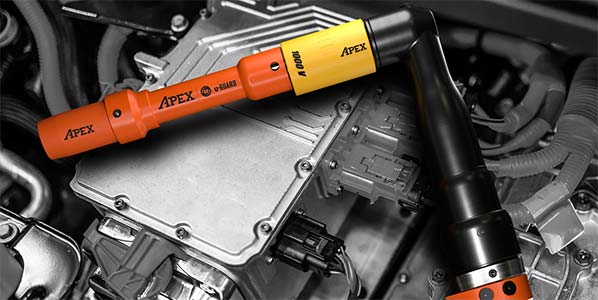
Isolated adaptors protect up to 1000 Volts
With Apex's high-voltage insulated adapters and quick-change adapters, you can increase your team's protection from electrical hazards on high voltage systems. This applies to hazards associated with high voltage contact, live parts, short circuits and tool grounding.
Combine the adapters with Apex's free-spinning u-GUARD attachments and effectively reduce or eliminate the risk of crush injuries, even when wearing gloves.
approx. 17 workdays

968158PT Isolated quick change adaptor
Isolated quick change adaptor, Square Drive 3/8", Output Hex 1/4"
€1,084.09
approx. 17 workdays

968614PT Isolated quick change adaptor
Isolated quick change adaptor, Square Drive 1/2", Output Square 1/2"
€1,134.07
approx. 17 workdays
968157PT Isolated quick change adaptor
Isolated quick change adaptor, Square Drive 3/8", Output Square 3/8"
€887.74
approx. 17 workdays
968883PT Isolated quick change adaptor
Isolated quick change adaptor, Hex 1/4", Output Hex 1/4"
€1,084.09
approx. 7 workdays

NC-EXEI-252 Isolated socket adaptor
Isolated socket adaptor, Square Drive 1/4", Output Square 1/4"
€120.19
approx. 7 workdays
NC-EXEI-374 Isolated socket adaptor
Isolated socket adaptor, Square Drive 3/8", Output Square 3/8"
€148.75
approx. 7 workdays
NC-EXEI-504 Isolated socket adaptor
Isolated socket adaptor, Square Drive 1/2", Output Square 1/2"
€197.54
approx. 7 workdays

Insulated Adapters and Quick-Change Chucks 1000 Volts: Protection and Functionality for HV Applications
Insulated adapters and quick-change chucks for 1000 volts (1000V) serve as a functional interface between hand tools and electrical connection elements in high-voltage areas. They reduce the risk of arcing and unintentional conductivity by combining mechanical compatibility with electrically insulating materials. The products in this category are designed to minimize visible and invisible risks in HV systems without compromising ergonomics or power transmission during screwing, loosening, or changing tools.Construction and Materials
The housings and shafts of insulated adapters typically consist of high-strength, electrically non-conductive polymer blends with a defined creepage distance and tested dielectric strength. Typical materials include impact- and wear-resistant glass-fiber-reinforced nylon grades (PA-GF) or special epoxy resins with fillers that increase dielectric strength. The housing shape and transitions are designed to avoid sharp edges and maximize the creepage distance. Metallic core components, such as internal plug connections or shaft inserts, are completely enclosed by the insulation or electrically separated from the outside with additional seals and insert nuts. Corrosion-resistant metallic contact surfaces at the connection points are important for long-lasting performance; these are often nickel-plated or provided with special coatings to minimize material transfer, malfunctions, and oxidation in changing environments. Insulation materials must withstand both mechanical loads and thermal stresses from use in industrial environments. Therefore, they are formulated to withstand temperature effects, UV and oil contact, cleaning agents, and dirt and dust exposure.Typical Designs and Mechanical Versions
The designs range from simple, rigid adapters with a fixed square or hexagon socket profile to complex quick-change chucks with bayonet or ball-detent mechanisms. Insulated adapters for 1/4" and 1/2" drives are the most common versions and are offered both as fixed designs and with rotatable headpieces to optimize power transmission at different angular positions. Quick-change chucks are designed to accommodate common bits and tools while ensuring a defined insulation barrier to the operator. Mechanically relevant properties include defined torsional strength, reset forces in quick-change mechanisms, and play-free operation in the mounting system to rule out the risk of sparking due to micro-movements. For critical applications, there are adapters with additional degrees of freedom, such as angle-adjustable hubs, which enable mechanical relief and precise coupling.Connections, Seals, and Electrical Safety
Electrical safety results from a combination of constructive insulation, sealing design, and standard-compliant testing. Connection areas are equipped with elastic seals or O-rings that prevent the ingress of moisture and conductive particles. The dimensioning of the seals is based on industry standards to ensure permanent sealing during temperature changes and vibrations. In addition, housing transitions are designed so that water and conductive dirt do not enter critical areas. Test procedures include electrical breakdown and creepage current tests at 1000V plus a safety margin, resistance measurements of the insulation barrier, and mechanical continuous vibration and fatigue tests. Markings on the component document the dielectric strength, the test class, and, if applicable, the series of standard tests. For many products, compliance with relevant standards and test protocols is traceable via serial numbers and test certificates.Areas of Application and Operating Conditions
Insulated adapters and quick-change chucks are used in all areas where assembly work on high-voltage systems or components is required: in transformer stations, switchgear, electric vehicle charging infrastructure, high-voltage control cabinets in production, and in the maintenance of HV motors and generators. They are also part of tool systems in laboratories and test benches where repeated tool changes must take place while simultaneously protecting against contact voltages. The products are designed to function under permanent industrial conditions: temperature cycles, oils, coolants, dust, and splash water must not impair the electrical and mechanical properties. For applications in potentially explosive atmospheres or in cleanroom-sensitive environments, specialized versions with additional certifications are available.Practical Examples
Practical Example 1: In switchgear maintenance, technicians need to check and retighten screw connections on a 1000V busbar. An insulated adapter with a 1/2" drive and a rotatable head allows screws to be tightened to a defined torque in accordance with standards, while the complete encapsulation of the metallic core eliminates contact voltage. The seal prevents the ingress of cleaning agents during maintenance. Practical Example 2: In the production of high-voltage batteries for commercial vehicles, bits are regularly changed during final assembly. A quick-change chuck with ball detent speeds up the change process and reduces downtime. The insulated design ensures that no conductive connection to the operator is created in the event of brief contact with live conductors, so that test cycles can be carried out safely directly next to HV components. Practical Example 3: In a test laboratory for power electronics, measurement setups are equipped with changing test adapters. Insulated adapters with documented dielectric strength and test certificates enable quick conversion of test benches while maintaining electrical measurement accuracy and safety compliance.Selection Criteria and Specifications
Essential selection criteria are: suitable drive interface (1/4", 1/2" or customized systems), declared dielectric strength (1000 Volts / 1000V), material strength against mechanical stress, sealing concept against environmental influences, and standard conformity. Pay attention to the torsional and bending strength values, the reset forces in quick-change systems, and the documented test results. Important specifications should be clearly stated in technical data sheets: dielectric strength, creepage distance, operating temperature range, corrosion protection of the metallic internal components, and test class. * Check for existing test reports and certificates, as well as traceability via serial numbers, especially for safety-critical installations.Integration into Existing Tool Systems
Insulated adapters can be integrated into existing tool systems if mechanical interfaces and tolerances are observed. When replacing, attention must be paid to the compatibility of the locking mechanism and to minimizing axial and radial play. For combined systems that use torque measurement or force sensors, adapters with defined transmission paths must be selected to avoid measurement errors. For continuous processes in production lines, many manufacturers offer customized adapter solutions that adapt mounting angles, lengths, and locking types without compromising the insulation properties.Maintenance, Testing, and Service Life
Regular visual inspections for cracks, abrasion, or discoloration of the insulation surface are part of basic maintenance. Sealing elements must be checked for loss of elasticity and replaced in case of chemical exposure. Electrical re-tests, such as insulation resistance measurements and high-voltage tests, must be carried out at planned intervals, depending on the frequency of use and environmental conditions. Service life specifications are based on mechanical and thermal load cycles; documented test cycles in the technical data sheets provide reliable information. Further technical information and application scenarios can be found on our technology page https://maku-industrie.de/technik and in our practical application examples at https://maku-industrie.de/anwendungsbeispiele.FAQs
1. Which voltage class do the adapters cover and how is 1000V defined?The adapters listed here are designed for a rated voltage up to 1000 Volts (1000V). The voltage specification corresponds to the electrical test voltage or the maximum operating voltage, as stated in the technical data sheets. Test certificates document the correct execution of dielectric breakdown and creepage current tests at the specified voltages. 2. Which types of seals are used and how do they affect electrical safety?
Elastic seals such as O-rings made of NBR, FKM, or silicone-based materials are used, depending on chemical resistance and temperature range. Seals prevent the ingress of conductive media and thus extend the creepage distance. The combination of sealing and constructive insulation ensures electrical separation. 3. How are testing and documentation carried out before delivery?
Before delivery, electrical breakdown and insulation resistance tests, mechanical function tests of the locking mechanism, and material and visual inspections are carried out. Results are documented in test protocols, which are provided as a certificate or test report upon request. Serial numbers enable the traceability of individual test runs.